Showing posts with label Seattle. Show all posts

Sunday, January 1, 2023

January, 2023 Version of the Cable Car Home Page -- January 1, 2023

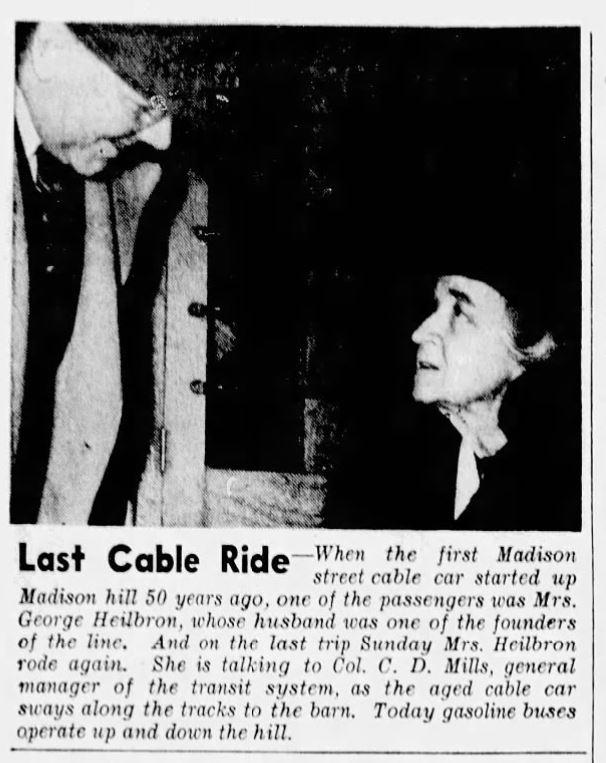
Seattle Star, 15-April-1940

I just put the January 2023 version of my Cable Car Home Page on the server:

http://www.cable-car-guy.com/

It includes some new items:
1. Picture of the Month: Last Cable Ride -- When the first Madison street cable car started up Madison 50 years ago, one of the passengers was Mrs. George Heilbron, whose husband was one of the founders of the line. And on the last trip Sunday Mrs. Heilbron rode again. She is talking to Col. C. D. Mills, general manager of the transit system, ahe aged cable car sways along the tracks to the barn. Today gasoline buses operated up and down the hill. (Source: Seattle Star, 15-April-1940, page 11)
2. On the Cable Cars in the Pacific Northwest page: More pictures and information about Seattle cable cars, including newspaper accounts of the closing of three lines in 1940. Aside from the lines in San Francisco, these were the last three Hallidie-type cable car lines in the United States.
3. Add News item about the Cable Car Cleanup

Ten years ago this month (January, 2013):
1. Picture of the Month: Looking up Seattle's Madison Street Hill. A Front Street Cable Railway car crosses on First Street. (Source: "Portland, Tacoma, Seattle, Everett, Astoria," The Street Railway Journal, May, 1893. Volume IX, Number 5.
2. More about the 100th birthday of the San Francisco Municipal Railway
3. On the Cable Cars in the Pacific Northwest page: More pictures and information about Seattle cable cars, including selected articles from The Street Railway Journal.
4. On the Decorated Cable Cars page: More cable cars decorated for Christmas 2012.
5. Added News item about a new book from the Friends of the Cable Car Museum

Twenty years ago this month (January, 2003):
1. Picture of the Month: New Powell/Market turntable
2. Add the Beach Pneumatic Subway to the Cable Car Lines in New York and New Jersey page.
3. Add article about the Powell Street Turntable Replacement to the San Francisco page.
4. Added photos and thumbnailed others on the Clay Street Hill Railroad page. Also expanded added photos and expanded article on Andrew S Hallidie on the Who page.
5. Add photos to the News items about the bell ringing contest and Powell Street turntable replacement.

175 years ago on 24-January-1848, James Marshall discovered gold in the run of Sutter's Mill near Coloma, CA. This led to the Gold Rush, which shaped the future of California and San Francisco.

75 years ago on 15-January-1948, Carl Hubbell, great Giants pitcher, was elected to the Hall of Fame.

Coming in February, 2023: On the Cable Cars in the Pacific Northwest page: More pictures and information about the Portland Cable Railway

The Cable Car Home Page now has a Facebook page:
https://www.facebook.com/CableCarHomePage/


Joe Thompson
The Cable Car Home Page (updated 01-January-2023)
http://www.cable-car-guy.com/
San Francisco Bay Ferryboats (updated 31-January-2020)
http://www.cable-car-guy.com/ferry/
Park Trains and Tourist Trains (updated 30-September-2022)
http://www.cable-car-guy.com/ptrain/
The Pneumatic Rolling-Sphere Carrier Delusion (updated spasmodically)
http://cablecarguy.blogspot.com
The Big V Riot Squad (new blog)
http://bigvriotsquad.blogspot.com/

Monday, February 11, 2019

Seattle General Strike of 1919 -- February 11, 2019

Seattle Star, 11-February-1919
The Seattle General Strike of 1919 started 06-February-1919. Several shipyard unions had gone on strike for better wages, including unions affiliated with the American Federation of Labor (AFL) and the Industrial Workers of the World (IWW). Shipyard owners resisted strongly and striking workers appealed to the Seattle Central Labor Council. Many other unions also went on strike.

The Strike Committee allowed some unions to work to provide food and other essential services.  The Mayor of Seattle, Ole Hanson, claimed that they were trying to take over the government, as the Soviets had done in Russia.

The general strike ended 100 years ago today, on 11-February-1919.  Even though there was no unrest or violence, Mayor Hanson brought in more and more police and soldiers.  National unions worried that the strike would hurt them.

City Speeds Up; General Strike Over

Purged of attempted Bolshevik rule, Seattle today resumes normal business, with the exception of the shipyards, where the strike is still on.

While the general strike was ordered over at noon by the conference of union leaders yesterday, the bustle and rush of the city's business district was again in evidence long before the scheduled hour.

Street cars continued in operation since Saturday afternoon, the men refusing to abide by the eleventh-hour order of the strike committee that they discontinue yesterday afternoon and remain on strike till today noon. Similarly several other unions began work Monday and Tuesday morning.

Restaurants along the downtown streets opened sharply at the stroke of noon. Cooks were back in the kitchens and the members of the Waitresses' union once more donned their aprons.

At noon Tuesday Seattle tooted its whistles and switched its civic gear into "high" agrain. as the five-day sympathetic strike of workmen came to a close.

Business did its best to make up for lost time.

Street crowds hastened to deferred shopping, thronging the avenues and the stores.

Markets, shops, groceries, theatres—places of commerce and amusement—combined to restore the interrupted social and industrial life of the harried Northwestern metropolis.

"Speed up." was the word everywhere.

This evening will see the opening of all the city's theatres and motion picture houses. A number had already operated Monday evening.

In strike circles Tuesday morning the principal topic of discussion was the action of the street car men. When the committee decided Monday that the strike end today, they stipulated that those unions already at work should again quit their jobs in order that all union men in the city might go back together.

This the street car men refused to do. A number of teamsters, however, listened to the strike committee appeal and failed to show up for work Tuesday morning, after completing their rounds Monday.

The barbers, too, steadfastly remained at their chairs, in spite of the dictates of the labor leaders. "A further strike would be of no additional benefit to organized labor," is the way the carmen expressed their opinion in a resolution.

Mayor Hanson had ordered that all municipal car employes would be considered to have relinquished their jobs if they walked out a second time. No such order went forth from the traction company headquarters, the men deciding of their own initiative that one strike was enough.

Fear that workmen who had participated in the general walkout might be discriminated against by employers, was an admittedly big actuating motive in the leaders' eleventh-hour decision for a final demonstration.

The big strike ends after five days' duration. However, the backbone of the strike was virtually broken by Saturday, after two days of the walkout. It was on Saturday morning that the strike committee gathered at the Labor temple to take up the proposition of calling the strike off.

While no date was set at that time for the return of the men to work, street cars began operation Saturday afternoon and by Sunday morning traction traffic was normal.

The strike passed off without any rioting or disturbances. The only arrests made were in connection with the distribution of Bolshevik leaflets entitled "Russia Did It."

A few restaurants were open this morning, but generally, the eating places did not seek to open for regular business till this afternoon.

The general strike has caused the city to appropriate $50,000 for men and supplies for protection and preparative purposes. It is estimated that another $50,000 appropriation will be made before the issue is finally settled. More than 3,500 emergency policemen were employed, 600 being added to the police payroll. The appointments were ratified by the city council.


WATERFRONT IS BACK TO LIFE

Waterfront activities started gradually in Seattle Monday. and were scheduled to be in full swing before Tuesday night. The first vessel to be worked wan the Pacific Steamship company's liner Alameda, which discharged several hundred boxes of fresh fish with union and non union men. The steam schooner Multnomah, of the Charles Nelson fleet, started unloading with union and non union help. Union Pacific pier officials announce they would start work independently of union longshoremen.

STRIKE STILL ON IN SHIPYARDS

J. Von Carnop, shipyard strike leader and one of the members of the Metal Trades conference committee, declared at noon today that the walkout of the shipyard workers is in nowise affected by the settlement of the general strike.

"Our status is just the same as it was before the other unions went out," Von Carnop asserted.

"The conference committee is in session thruout the day, and you can say for us that the shipyard men are still on strike."

Wednesday, February 6, 2019

Seattle General Strike of 1919 -- February 6, 2019

Seattle Star, 06-February-1919
The Seattle General Strike of 1919 started 100 years ago today, on 06-February-1919.  Several shipyard unions had gone on strike for better wages, including unions affiliated with the American Federation of Labor (AFL) and the Industrial Workers of the World (IWW).  Shipyard owners resisted strongly and striking workers appealed to the Seattle Central Labor Council. Many unions also went on strike. The general strike lasted five days. 

from the Tennessee News-Scimitar, 06-January-1919:
SEATTLE SCENE OF GENERAL STRIKE
City Virtually at Standstill as Big Walkout Is Staged.

Seattle Wash., Feb. 6. -- Seattle's general strike was called at the scheduled time, 10 a.m. today. First reports rom the downtown section said union street car men started their cars for the barns at 10 o clock, union elevators in all the large buildings abandoned their cars and restaurants closed their doors when their union cooks and waiters left.

Most of the city stores announced they would remain open as long as their stocks lasted. They will be unable to replenish them as the truck drivers are striking. Telephone operators remained at their posts, according to reports. Seattle expects to have lights tonight as the strike committee of the Central Labor council exempted the engineers in the municipal lighting plants from the strike order.

Schools may he closed because of the strike of janitors and engineers, the superintendent of schools stated. Moving picture houses will be crippled by the strike of operators.

Today's walkout was called by the Seattle Central Labor council as a sympathetic move to help shipyard workers who, numbering 25,000 struck for higher pay Jan. 21.

Sunday, January 29, 2017

Nieuport 28 -- January 29, 2017


When I was a kid, someone gave me a book about World War One airplanes.  I virtually memorized it. The Nieuport 28 was rejected by the French Armée de l'air, but the American Army Air Service, lacking equipment, took them. 

In July, 2010, we visited the Museum of Flight near Seattle.   I took this photo in the Personal Courage Wing, which features airplanes, mostly fighters, from World War One and World War Two.  The museum's Nieuport 28 is an original.  It is painted in the colors of Quentin Roosevelt, the son of Theodore Roosevelt, who died in a Nieuport 28.  


Today is also the start of Catholic Schools Week.

I'm grateful that my parents put me in Catholic schools for 12 years.  I'm also grateful to my teachers. 

Good Shepherd in Pacifica gave our daughter a great education and continues to do the same for many other children. They are having an open house today from 11am to 1:30pm.  The school is worth considering if you live in or near Pacifica: http://goodshepherdschool.us/

Thursday, October 20, 2016

Nieuport 24bis - October 20, 2016


When I was a kid, someone gave me a book about World War One airplanes.  I virtually memorized it. The Nieuport 24bis was one of a long series of sesquiplane (wing-and-a-half) fighters from the French Nieuport company.  The 24 was more aerodynamically clean than its predecessor, the Nieuport 17.  The original 24 had problems with its tail, so the company produced the 24bis, whith a tail based on the 17.  The 24bis was soon replaced as a front line fighter by the Spad 7, but continued to be used as an advanced trainer.  This example is a reproduction. 


Ace Paul Tarascon named his 24bis Zigomar, after a popular series of stories and movies about a a master criminal. 

Motography, 29-March-1913


In July, 2010, we visited the Museum of Flight near Seattle.   I took this photo in the Personal Courage Wing, which features airplanes, mostly fighters, from World War One and World War Two.

Monday, January 11, 2016

Albatros D.Va -- January 11, 2016


When I was a kid, someone gave me a book about World War One airplanes.  I virtually memorized it. The Albatros D.Va was one of a long series of fighters from the German Albatros company, but it was not a success.  The D.Va had sesquiplane wings which tended to shear off when diving too fast.  It looks pretty cool with the dragon on the side, but the plane was generally unpopular with German pilots.  This is a reproduction. 

In July, 2010, we visited the Museum of Flight near Seattle.   I took this photo in the Personal Courage Wing, which features airplanes, mostly fighters, from World War One and World War Two.

Wednesday, December 9, 2015

Royal Aircraft Factory S.E.5a -- December 9, 2015


When I was a kid, someone gave me a book about World War One airplanes.  I virtually memorized it.  One of my favorite fighters was the Royal Aircraft Factory S.E.5a.  It was easier to fly than the Sopwith Camel, but was just about as effective.  I thought the Lewis gun on the top wing was a nice visual feature.  This is a reproduction. 

In July, 2010, we visited the Museum of Flight near Seattle.   I took this photo in the Personal Courage Wing, which features airplanes, mostly fighters, from World War One and World War Two.

Thursday, November 5, 2015

Sopwith Triplane -- November 5, 2015


A reproduction of a Sopwith Triplane, a nimble fighter flown mostly by Britain's Royal Naval Air Service.  The "B" Flight of Number 10 Naval Squadron was called The Black Flight because their planes were painted black and named things like "Black Prince" and "Black Death."  All the pilots of the flight were Canadians, and it produced some of Canada's greatest aces like Raymond Collishaw.

After they saw the Tripe, the Germans wanted their own triplane fighter.

In July, 2010, we visited the Museum of Flight near Seattle.   I took this photo in the Personal Courage Wing, which features airplanes, mostly fighters, from World War One and World War Two.

Wednesday, July 1, 2015

Synchronized Machine Gun -- July 1, 1915


100 years ago today, on 01-July-1915, German Leutnant Kurt Wintgens, flying an early model Fokker Eindecker shot down a French Morane-Saulnier Type L Parasol scout near Lunéville, France.  This was the first victory of an airplane filing a synchronized machine gun through the propeller arc.  The French observer fought back with a carbine, but could not hold off the better-armed German airplane. 

Wintgens later received the Pour le Mérite.  He was a rare fighter pilot who wore glasses.  He was killed in action on 25-September-1916. 

In July, 2010, we visited the Museum of Flight near Seattle.   I took this photo in the Personal Courage Wing, which features airplanes, mostly fighters, from World War One and World War Two. This is a reproduction of a Fokker E.III, a later model than Wintgens flew in 1915. 

Monday, February 9, 2015

Ferryboat King County Will Operate on Lake Washington -- February 9, 2015

Seattle Post-Intelligencer, 11-November-1899

Ferry King County was built in Madison Park in Seattle.  It sailed from Madison Park to the suburb of Kirkland. 

Ferryboat King County Will Operate on Lake Washington.

WORK on the big ferryboat now being built by the board of county commissioners to ply on Lake Washington is rapidly progressing. The timbers of the boat are in place and the planking almost done, Moran Bros, who have the contract for the boat, are now working on the machinery, which will soon be taken out and placed in position.  The big ferry is being built on the shores of the lake near Madison street. She will be one of the finest craft of her kind on the Pacific coast, and will cost more than $60,000 complete. It is expected that she will make her trial trip early in the spring and will be running regularly by July 4.

The operation by the county of a public ferry on the lake will open to the merchants of Seattle a market that at present they reach only to a limited extent. It will pave the way, it is thought, for a large increase in the population of the farming district east of the lake. County Auditor Evenson is one of the warmest friends of the ferry scheme as a part of a "trunk" system of county roads which he advocates.

Friday, July 12, 2013

Ferry in the Fog -- July 12, 2013

I couldn't identify this ferry, glimpsed through the fog from Washington State Ferry Tacoma during our visit to Seattle in 2010. 

Wednesday, June 12, 2013

Ferry Kaleetan -- June 12, 2013

Washington State Ferries Kaleetan has just left Seattle's Colman Dock.  I took the photo during our visit in July, 2010. 

Tuesday, March 12, 2013

Ferry Santa Rosa -- March 12, 2013

Santa Rosa was built in 1927 for the Northwestern Pacific (my favorite railroad) as an auto ferry. She was later operated by the Southern Pacific/Golden Gate line. In 1940, displaced by the Golden Gate Bridge, she went to Puget Sound and was renamed Enetai.Puget Sound Navigation reengined her, replacing her diesel-electric drive with a with direct drive diesel engine and made her single-ended. She started on the Seattle-Bremerton run in 1941. Washington State Ferries retired Enetai in 1968 because she was single ended and expensive to operate.

Enetai returned to San Francisco, where she was restored to her original appearance and her original name. Santa Rosa is now docked at Pier 3 in San Francisco, and is leased out for parties and gatherings by Hornblower Yachts. I took the photo on 19-January-2013. 

Friday, November 5, 2010

Train Station #28 -- November 5, 2010

The Seattle Center Monorail Station is the gateway to the Space Needle. The Alweg monorail was built to carry people to the 1962 Century 21 Exposition. I took the photo during our July, 2010 visit to Seattle.

Tuesday, October 5, 2010

Train Station #27 -- October 5, 2010


The Westlake Center Mall Station of the Seattle Center Monorail. I took the photo during our July, 2010 visit to Seattle.

Monday, September 13, 2010

Door #3 -- September 13, 2010


The doorway of Seatle's Interurban Building, at Yesler Way and Occidental Avenue. This was one of the buildings that went up after the Great Fire of 1889. The Puget Sound Electric Railway had its offices in the building, giving it its current name. I took the photo on our visit in July, 2010.

Thursday, September 9, 2010

Alley #11 -- September 9, 2010


I can't find the name of this Seattle alley, either. The building on the left is the famous Smith Tower. We are looking north from Yesler.

We had light rain yesterday in Pacifica. Tonight there is a big fire in San Bruno, near Skyline. Lots of helicopters and airplanes are flying over.

Saturday, September 4, 2010

Firehouse #35 -- September 4, 2010


Former Seattle Fire Department Station 10 serves as department headquarters and houses a museum which was closed when we visited. The Museum is operated by the Last Resort Fire Department (http://www.lastresortfd.org/). I took the photo when we visited Seattle in July, 2010.

Friday, September 3, 2010

Train Station #26 -- September 3, 2010


Seattle's Union Station, right next to King Street Station (http://cablecarguy.blogspot.com/2010/08/train-station-25-august-5-2010.html), is a former train station, opened by the Union Pacific and the Milwaukee Road in 1911, which has been renovated and made into an office building. I took the photo when we visited Seattle in July, 2010.

Friday, August 20, 2010

Transit Tunnel -- August 20, 2010


I took this shot looking down into Pioneer Square Station from the mezzanine during our July visit to Seattle. The transit tunnel is shared by Metro Transit buses share the tunnel with Sound Transit light rail trains. This was the first time I had seen such an arrangement.