Showing posts with label Fokker. Show all posts

Thursday, December 14, 2023

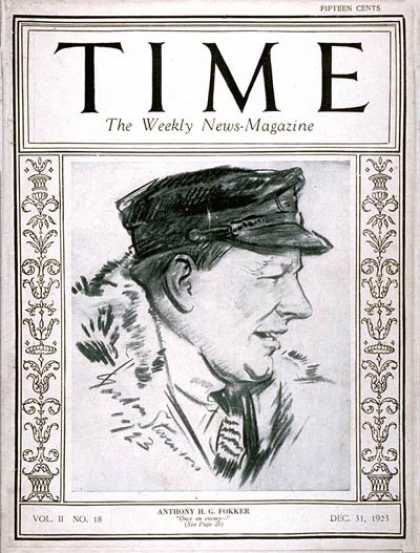
Time Magazine -- Anthony Fokker -- December 14, 2023

Time, December 21, 1923

Tony Fokker was a brilliant pilot, a pioneer manufacturer of airplanes and a lousy businessman. In the Netherlands, he designed, built and flew his first airplane in 1910. In 1912, he opened a factory in Germany. During World War One, his company built many successful airplanes for the German Army, including the Eindecker, the Dr.I Triplane and the D.VII fighter. Shoddy workmanship caused the Triplanes to lose their top wings until the problem was corrected. DVIIs also lost their top wings; Fokker blamed a design change forced upon him by the army inspectors. Fokker and his team developed the first successful synchronization gear, which allowed a machine gun to fire 

When the Armistice banned aircraft production in Germany, Fokker was able to sneak off to the Netherlands with much material from his German factory. He founded a new company which built successful civilian and military airplanes. In 1926, he moved to the US and started an American branch of his company. His most famous product in this period was the F.VII Trimotor. Fokker died in the US in 1939.

Thursday, October 6, 2022

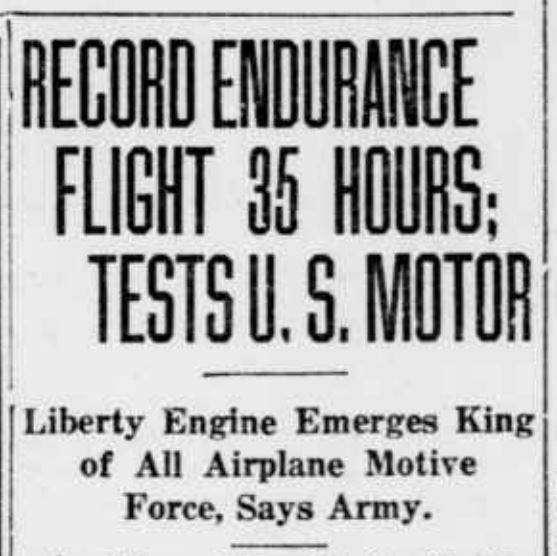
Record Endurance Flight 35 Hours -- October 6, 2022

Great Falls Tribune, 07-October-1922

100 years ago, on October 5-6 1922, United States Army Air Service Lieutenants John A Macready and Oakley G Kelly set an endurance record, keeping their single engine Fokker T-2 monoplane in the air for 36 hours, 4 minutes, and 32 seconds. They had initially set out to fly from San Diego to New York, but turned back because of bad weather. They decided to use their load of fuel and oil to set an endurance record, by flying in great circles over San Diego. They received the Mackay Trophy in acknowledgment of their achievement. 

They were able to fly from San Diego to Indianapolis in November and San Diego to New York in 1923.

The 400 HP V-12 Liberty engine was designed by two important engineers. 

RECORD ENDURANCE
FLIGHT 35 HOURS;
TESTS U.S. MOTOR
Liberty Engine Emerges King
of All Airplane Motive
Force, Says Army.

San Diego, Calif., Oct. 6. -- (By The Associated Press.) -- Lieutenants John A. Macreadv and Oakley Kelly, who had been flying over San Diego since 5:58 a. m. Thursday in the great monoplane T-2, landed at Rockwell field at 5:11:30 p. m. Friday, having broken all known records for sustained flight in a heavier-than-air flying machine. They were in the air 35 hours, 18 minutes and 30 seconds.

The aviators were well tired out but willing, they said, to have continued their flight except for their desire to reach the ground before darkness should make landing more difficult.

Whistles Greet Aviators

The landing of the big plane was the signal for a mighty chorus of whistles from the vessels in the harbor. When the airmen circled down to the field a small army of spectators, including the Rockwell field force and many civilians, was waiting to greet them.

Captain R. G. Erwin, commandant of Rockwell field, soon after the flight ended, gave out the time the aviators had been aloft as 35 hours, 18 minutes and 30 seconds. The official time of departure was set down in the Rockwell field records 5:33 a.m. instead of 5:50 a. m. as unofficially given out and the time of landing was given as 5:11:30 p. m.

The aviators were begrimed with oil and grease when they stepped from the big machine in which they had remained aloft, circling over the city for virtually two days and a night. That did not stop Mrs. Benjamin Macready, mother of one of the aviators, from rushing to greet her son. She kissed him full on his grimy cheek and when she turned around, smiling gladly, her lips were black with grease and oil.

Fliers Make Statement

Lieutenants Macready and Kelly joined in making the following statement:
"It was the wonderful Liberty motor which kept us up. There is no question that this flight proves the motor to be the best and most efficient in the world. It is due to the development of army aviation. The primary purpose of the test, it should be said, was to test the motor in the United States army transport T-2 and the result was all that could be expected.

"We are going to make the flight from San Diego to New York in November and we are confident that we shall be successful."

The first person to greet Lieutenant Kelly was Charles Dworack, chief mechanic, who came ahead of the aviators from Dayton, Ohio, to install the new motor in the monoplane. He superintended the entire job.

LIBERTY MOTOR BEST

Washington. Oct .6. -- Army air service officials in a statement tonight on the record established by Lieutenant Macready and Kelly, declared the demonstration has furnished "convincing proof of the wonderful reliability of the best aeronautical engine the world has yet produced -- the Liberty."

Attention was called to feats which each of the pilots has to his credit, among them the establishment by Lieutenant Macready of the world altitude record, when he piloted a plane 40,200 feet above Dayton, Ohio, in September, 1920.

The air service transport T-2, on its flight weighed 10,700 pounds, of which 4,600 pounds consisted of gas and oil, according to the statement. Lieutenant Macready is a native of Los Angeles and Kelly is from Geneva, Pa.

1922 Aircraft Yearbook


Saturday, September 23, 2017

Famous German Airman Killed on West Front -- September 23, 2017

Bisbee Daily Review, 03-October-1917

German ace Werner Voss, was shot down on 23-September-1917 after an epic dogfight.   This article from the03-October-1917 Bisbee, Arizona Daily Review, gives some inaccurate details.  The Germans did not find Georges Guynemer.  He is still missing.  The British did not allow their aviators to be identified. "Brown" may have been James McCudden.


FAMOUS GERMAN AIRMAN KILLED ON WEST FRONT
Lieutenant Vosse, Missing Since Late In September, Identified. Was Killed By British Airplane Pilot


(By Review Leased Wire) 

BRITISH HEADQUARTERS IN FRANCE AND BELGIUM. -- Monday, October 1. -- The body of the famous German aviator, Lieutenant Vosse who was recently reported in a German official communication as missing, has been found within the British lines and British airmen have already dropped messages behind the German front, giving notification of his death.

Vtosse was killed September 23 while engaged in a spectacular combat with a British airman. It is a peculiar coincidence that the famous French airman. Captain Guynemer lost his life about the same time in battle over enemy territory and was reported missing until the Germans found and identified the body.

The opponent of Vosse is one of the most brilliant British aviators who for the purposes of this narrative may be referred to as Brown that not being his real name. Here is the story:

The Story.

A number of British planes were patrolling on the twenty-third, flying at a height of 7,000 feet when one of them was attacked by a German red-nosed Albatross and a triplane. It appeared later that Vosse was the pilot of the triplane. Two other planes rushed up and engaged these two, with a third enemy scout who appeared on the scene. About eleven other enemy planes were waiting at a distance to join in the fray but did not attack as some ten British planes were circling about keeping them off.


Third Enemy Joins.

The third enemy scout who had joined in the combat vanished but the Albatross and the triplane fought in wonderful form. Brown singled but the triplane and a hard fight ensued. Brown got in a number of good bursts from his machine-gun and several times had to change drums on his gun, so furiously was he firing.

Opponents Circle.

For a long time the two opponents circled, dived and maneuvered for position and so close were they at times that only a few inches separated their wings. Eventually Brown got a little above Vosse and made for triplane, the British airman working his machine gun steadily all the time.

Narrow Escape.

Vosse passed Brown's right wing by inches and dived. The British airman wheeled into position and observed the German gliding westward with his engine shut off. He dived again and got a good shot at his opponent; then followed this with a heavy burst from his gun and Vosse did a slight right-hand turn and continued to go down until he disappeared.

End Of Battle.

This ended the adventure so far as Brown was concerned. He flew away, not knowing who his opponent had been or what had become of him. Later the shattered machine was found and the body identified.

Much Fighting Lately.

There has been much fighting in the air recently and the aviators have had some remarkable experiences. One British lieutenant, flying last Wednesday, had just forced the enemy to pull down a big balloon when he was engaged by machine-guns from the ground. He dived on the gunners and fired more than a hundred rounds, dispersing the crew, who fled, leaving two of their number stretched on the ground. Continuing onward, the lieutenant had nine separate combats with enemy planes. Eight of these were indecisive, but in the other case he brought down the German.

Returns Home.

In this last combat he got right on the enemy plane, first killing the observer, then firing into the pilot and engines. The enemy plane spun down to earth. The British airman engaged in still further fighting and returned home very much shot about, one bullet having pierced the ear pad of his flying cap.

Thursday, December 15, 2016

Fokker D.VII -- December 15, 2016


When I was a kid, someone gave me a book about World War One airplanes.  I virtually memorized it. The coffin-nosed Fokker D.VII was one of the greatest fighters of the war.  Fokker engineer Reinhold Platz designed it.  In the Armistice, Germany was specifically ordered to surrender all D.VIIs.

In July, 2010, we visited the Museum of Flight near Seattle.   I took this photo in the Personal Courage Wing, which features airplanes, mostly fighters, from World War One and World War Two.  The museum's D.VII is a replica with an original engine and machine guns.  It is painted in the colors of ace Rudolf Berthold. 

Wednesday, July 1, 2015

Synchronized Machine Gun -- July 1, 1915


100 years ago today, on 01-July-1915, German Leutnant Kurt Wintgens, flying an early model Fokker Eindecker shot down a French Morane-Saulnier Type L Parasol scout near Lunéville, France.  This was the first victory of an airplane filing a synchronized machine gun through the propeller arc.  The French observer fought back with a carbine, but could not hold off the better-armed German airplane. 

Wintgens later received the Pour le Mérite.  He was a rare fighter pilot who wore glasses.  He was killed in action on 25-September-1916. 

In July, 2010, we visited the Museum of Flight near Seattle.   I took this photo in the Personal Courage Wing, which features airplanes, mostly fighters, from World War One and World War Two. This is a reproduction of a Fokker E.III, a later model than Wintgens flew in 1915. 

Friday, December 17, 2010

Pulp #19 -- December 17, 2010

The cover of the January, 1932 Aces features Ernst Udet, the highest scoring ace to survive World War One and recipient of the Pour le Mérite. I assume the red Fokker Triplane is his.

After the war, he appeared in movies and toured the world giving exhibition flights. After the Nazis took power, he joined the party and became head of the new Luftwaffe's development wing. When World War Two broke out, Udet felt overwhelmed by the Luftwaffe's problems and eventually killed himself.