Showing posts with label Lusitania. Show all posts

Friday, June 19, 2015

News of the Week June 19, 1915 -- June 19, 2015


The 19-June-1915 Motography featured "News of the Week as Shown in Films," with items from current newsreels.


"Thousands of mourners pay loving tribute to the memory of Charles Frohman.  Copyright 1915 by Universal Animated Weekly."  Theatrical producer Charles Frohman died in the sinking of the Lusitania. 

"African Chausseurs show their proficiency in welding (sic - wielding? - JT) their lances, at Seulis, France.  Copyright 1915 by Pathe News."   The Chasseurs d'Afrique were a light cavalry regiment in the French Army. 


"Members of Chinese Commercial Commission arrive in New York.  Copyright 1915 Hearst-Selig News Pictorial."  The commission travelled across the country from San Francisco. 

"Coney Island, N. Y., again becomes the mecca of summer pleasure-seekers.   Copyright 1915 by Universal Animated Weekly."  I wonder if that is Luna Park. 


"Two of the deadly bombs dropped on Bury St. Edmunds, England from Zeppelins.  Copyright 1915 by Pathe News."   I guess that is a British policeman holding two duds. 

"Braves  hoist the championship pennant over the home grounds.  Copyright 1915 Hearst-Selig News Pictorial."  The Miracle Braves won the 1914 World Series after being in last place on July 4.  They defeated the Philadelphia Athletics in the World Series. 

Friday, May 22, 2015

News of the Week May 22, 1915 -- May 22, 2015


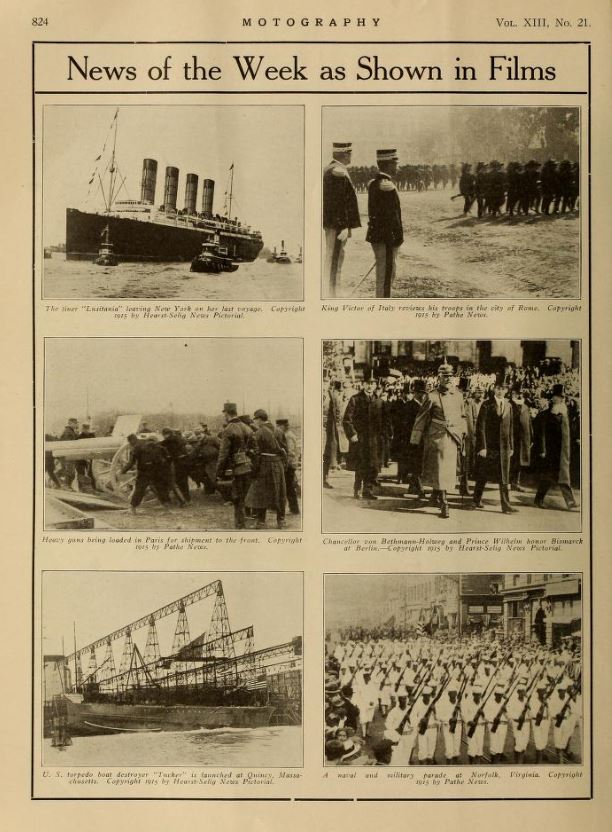
The 22-May-1915 Motography featured "News of the Week as Shown in Films," with items from current newsreels.


"The liner 'Lusitania' leaving New York on her last voyage.  Copyright 1915 Hearst-Selig News Pictorial." On 01-May-1915, Cunard liner RMS Lusitania sailed for Britain.  The German embassy in Washington DC placed an ad warning that the ship was liable to be sunk:
http://cablecarguy.blogspot.com/2015/05/lusitania-warning-may-1-2015.html
On 07-May-1915, U-20 torpedoed and sank Lusitania near the coast of Ireland:  
http://cablecarguy.blogspot.com/2015/05/great-liner-lusitania-torpedoed-and.html

"King Victor of Italy reviews his troops in the city of Rome.  Copyright 1915 by Pathe News." Italy was neutral until 23-May-1915, when it declared war on Austria-Hungary.  Victor Emmanuel III is looking at a troop of Bersaglieri, who wear feathers in their hats and jog rather than march. 


"Heavy guns being loaded in Paris for shipment to the front.  Copyright 1915 by Pathe News." I don't know what gun that is.  Since they call it heavy, I assume it is bigger than a 75. 

"Chancellor von Bethmann-Holweg and Prince Wilhelm honor Bismarck at Berlin.  Copyright 1915 Hearst-Selig News Pictorial." Theobald von Bethmann-Hollweg was the German Chancellor.  I think he is in uniform.  I don't see Wilhelm the Crown Prince and his son Wilhelm was too young to be one of these men. 


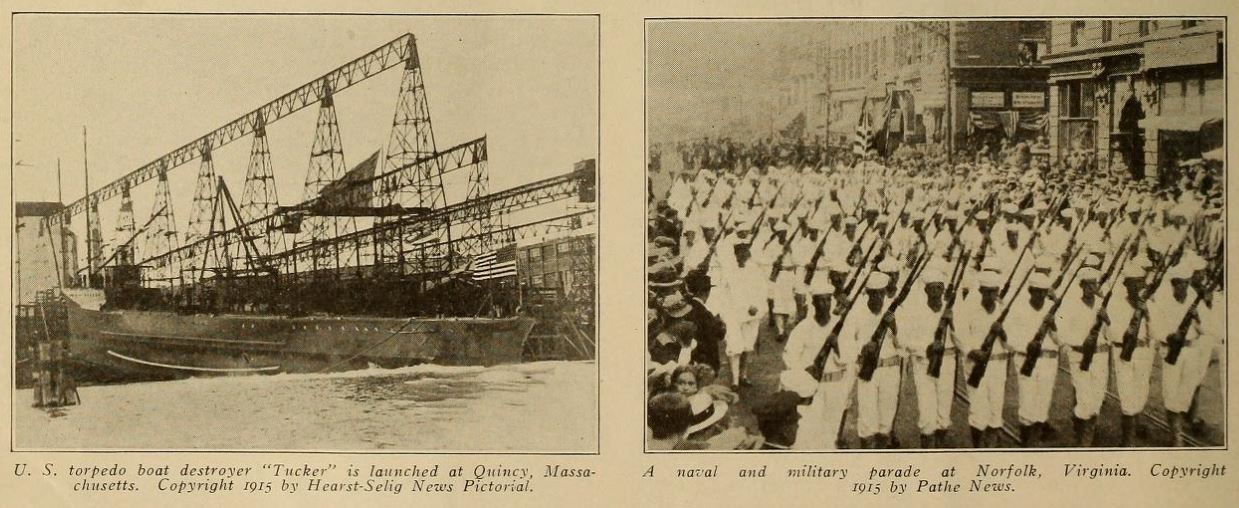
"U. S. torpedo boat destroyer "Tucker" is launched at Quincy, Massachusetts.  Copyright 1915 Hearst-Selig News Pictorial." USS Tucker (DD-57) was a destroyer which served the Navy and the Coast Guard until 1936. 

"A naval and military parade at Norfolk, Virginia.  Copyright 1915 by Pathe News." Naval Station Norfolk is a key part of the economy of the area. 

Thursday, May 7, 2015

Great Liner Lusitania Torpedoed and Sent to Bottom By Germans -- May 7, 2015

Ogden Standard, 07-May-1915

After a year of war, Germany was not in a good position.  The British had established a fairly tight blockade of imports, and the army had failed to take Paris and had settled into static positions on the Western Front.  In order to disrupt vital shipping to Britain, Germany had decided to adopt a policy of unrestricted submarine warfare.  U-Boats would no longer warn civilian vessels before sinking them.  On 07-May-1915, U-20 torpedoed and sank RMS Lusitania near the coast of Ireland.  A number of Americans died and this nearly drove the country into the war on the side of the Allies, Britain, France and Russia.  Germany promised to stop unrestricted submarine warfare and America stayed out until they resumed it again. 

Lusitania carried 1,962 passengers.  1,191 died.  128 of the dead were Americans. 

Great Liner Lusitania Torpedoed and Sent to Bottom By Germans
Nineteen Hundred People On Board The Big Ship When The Fatal Blow Is Struck

London. May 7, 7.35 p. m -- No information as to the fate of the passengers and crew of the Lusitania was available in London up to 7:30 o'clock this evening. The Cunard offices in London were besieged by inquiries, among them many Americans having relatives or friends aboard the Cunard liner.

Washington, May 7. --  Ambassador Page at London cabled :
"Lusitania torpedoed and sunk within 30 minutes. No news of passengers yet."

Queenstown, May 7. -- News received here from the steamer at 3:25 p. m. said that, before sinking, her lifeboats were over her sides.

New York, May 7. -- The New York office of the Cunard line announced this afternoon that the Lusitania had been sunk.

Confirmation of the report was received in a dispatch dated Queenstown. 4.59 p. m. today and reading as follows:
"Old Head, Kinsale, about twenty boats all sorts, belonging to Lusitania, are in the vicinity where sunk. About fifteen boats are making for the spot to rescue."

The cablegram was preceded by the following message:
"Liverpool. May 7. Lands End wireless reports distress calls made by Lusitania, as follows 'Come at once.  Big list. Position ten miles west Kinsale.' A third cable dispatch read as follows: 'Queenstown, May 7. All available craft in harbor dispatched to assist '"

Kinsale is a seaport of Ireland, 13 miles southwest of Cork. It lies near the entrance of St. Georges channel, between Ireland and England, through which trans-Atlantic vessels pass on their way to Liverpool.

London, May 7. -- The Lusitania sank at 2:33 this afternoon. The passengers on board the Lusitania are believed to be safe.

Queenstown, May 7, 2 25 p. m. -- Immediately the news of the torpedoeing of the Lusitania was received here, the admiral in command of the naval station dispatched to the scene all assistance available. The tugs Warrior, Stormick and Julia together with five trawlers and the local life boat in tow of a tug were hurried to sea.

Queenstown, May 7. p. m. -- The Admiralty officers here have no news concerning the safety of the passengers and the crew of the Lusitania. 

Liverpool, May 7, 5 40 p m. -- The Evening Express was officially informed this evening by officials of the Cunard Steamship company that the Lusitania had been torpedoed and that she sank this afternoon.

New York. May 7. -- The Dow and Jones company ticker service, in a report from London. declares the Lusitania was beached and passengers and crew, according to Lloyds, were saved.

London. May 7, 5 50 p m -- The manager of the Cunard company has informed the Liverpool Evening Express that he received this afternoon the following message from the wireless station at Old Head, off Kinsale:
"The Lusitania was sunk by a submarine at 2:33 o'clock this afternoon, eight miles south by west (off this point)."

London, .May 7, 5 55 p. m -- A dispatch from Liverpool to the Exchange Telegraph company says it is not known how many of the Lusitania's passengers were saved

London. May 7 6:52 p m. -- Official announcement was made this evening that the Lusitania had remained afloat at least twenty minutes after being torpedoed and that "twenty boats were on the spot at the time."

Queenstown. May 7 -- According to a report received here, the first wireless S. O. S. call was sent by the Lusitania at 2:15. This read "Wanting assistance; listing badly "

London. May 7, 7:54 p. m. -- The Echo has been Informed that a message to the Cunard line reads as follows:
"The Lusitania was torpedoed and sunk at 2:33 this afternoon off Kinsale. There is no word of her passengers or crew, who number over 1900."

Queenstown. May 7. -- The Lusitania was seen from the signal station at Kinsale to be in difficulties at 2: 12 p. m. At 2:33 p. m. she had completely disappeared. This indicates that the liner was afloat nineteen minutes after what was the beginning of her trouble.

New York. May 7 -- Late this afternoon the Cunard made public the following dispatch from Liverpool:
"Following received by admiralty:
"Gailley Head 4:25 p. m. -- Several boats, apparently survivors, south east nine miles. Greek steamer proceeding to assist."

New York. May 7. -- Cork newspapers report, according to a Liverpool dispatch received by the Cunard line late today that 300 passengers have been landed at Clonakilty

New York. May 7, -- There were 188 American passengers on board the Lusitania, according to a compilation made late today at the Cunard offices. The British numbered 956 and other nationalities made up he remainder of the 1253 passengers aboard. 

MOST SERIOUS EVENT OF WAR
Washington Official Circles Greatly Disturbed Over Lusitania Affair.

Washington, May 7 -- News of the torpedoeing of the Lusitania struck official Washington like a bomb.  While disposed to await full details before expressing opinions, all administration officials realized the incident was probably the most serious Washington has faced since the beginning of the war

Officials did not believe there would be complications, however, unless American lives were lost.
A few days ago American officials heard privately from personal sources that Germany intended to destroy the Lusitania at the first opportunity to terrorize British shipping and restrict ocean commerce with the allies.  It was taken for granted by officials here that if there existed a plan in the German admiralty to torpedo the Lusitania, every precaution had been suggested to the German government to insure the safety of the passengers. Should any Americans lose their lives, the case would he covered, officials thought, by the warning to Germany that she would be held in that event by the United States "to a strict accountability."

Washington. May 7 -- President Wilson was Informed of the sinking of the Lusitania and White House officials showed keen anxiety to learn whether any American lives were lost No comment was made. 

New York. .May 7. -- The Cunard liner Lusitania, one of the fastest ships afloat, was torpedoed and sunk this afternoon off the coast of Ireland, ten miles b south of Kinsale. 

She had aboard 1,253 passengers.  She sailed from this port last Saturday, May 1, and carried, in addition to her own large passenger list. 163 passengers transferred to her from the Anchor liner Cameronia.

The news of her sinking was announced by the local office of the Cunard line and was based on cable
advices received from the home office of the company in Liverpool. Three dispatches, received in the order named, were made public by the line, and read as follows:
"We received from the Lands End wireless station news of repeated distress calls made by the Lusitania asking for assistance at once. Big list.  Position ten miles south of Kinsale.  Subsequently received telegram from Queenstown that all available craft in the harbor had been dispatched to assist."

The second message to the local office read .
"Queenstown 4 59 p m. -- About twenty boats of all sorts belonging to our line are in vicinity where Lusitania sunk. About fifteen other boats are making for spot to render assistance."

The third cablegram was dated Liverpool and read:
"Following received by admiralty:
Galley Head. 4 26 p m. Several boats, apparently survivors southeast nine miles. Greek steamship proceeding to assist."

Dispatches received here from London Liverpool and Queenstown confirmed the news. One of the messages said it was believed that all the big liner's passengers had been saved.  No definite news as to the fate of the passengers had been received by the Cunard line early this afternoon.

The Cunard line announced that it would make public as fast as received all dispatches on the sinking of the Lusitania. including those relating to the fate of the passengers.

The stock market was stunned by the news.  A torrent of selling orders poured in from every section of the country.  A period of intense excitement followed. 

Prices in war specialties broke fifteen to thirty points within an hour.  Stable issues slumped five to ten points.

Late today the Cunard officials received a dispatch from Queenstown stating that a large steamer and many smaller vessels and boats were in the vicinity rendering assistance. Then follows :

"Large steamer just arrived in vicinity. Apparently rendering assistance. Tugs. patrols, etc , now on the spot taking boats in tow. Motor fishing boats with two Lusitania boats bearing by for Kinsale."

This information came from Old Head, Queenstown.

The news struck official Washington like a bomb Administration officials, it was said, realized that the incident was probably the most serious faced by the government since the beginning of the war. President Wilson was informed of the sinking of I the liner and White House officials, while refraining from commenting, were keenly anxious to learn if any American lives had been lost.

NO WARNING IS GIVEN THE SHIP
Big Liner Went Down Almost Immediately After Being Torpedoed.

New York May 7. -- According to a London dispatch put out by the Dow Jones ticker late today, the Cunard Steamship company in London issued an official statement there tonight, declaring that the Lusitnnia had been torpedoed without warning and sank almost immediately

GREAT LINER WAS DOOMED
Germans Had Declared They Would Sink the Ocean Greyhound.

New York, May 7. -- When the Lusitania sailed she had 1310 passengers.  Some nervousness had been caused because of the publication in the morning papers of Saturday of an advertisement warning intending travelers that a state of war existed between Germany and Great Britain and
her allies, that the zone of war includes the waters adjacent to the British Isles; that in accordance with notice given by the German government. vessels flying the flag of Great Britain are liable to destruction in those waters and that travelers sailing in the war zone on ships of Great Britain or her allies, do so at their own risk. This advertisement was signed "Imperial German embassy."

This warning apparently did not cause many cancellations, for the ship sailed with a very full passenger list.  Just before the steamer's departure, a number of the passengers received telegrams at the pier, signed by names unknown to them, and presumed to be fictitious, advising them not to sail as the liner was to be torpedoed by submarines. Alfred Gwynne Vanderbilt was one of the passengers who received the message.

Vanderbilt commented on the advertisement appearing in the morning papers, characterizing it as silly performance and below the dignity of a foreign diplomat of any country. 

Alexander Campbell, general manager for John Dewar and sons. London, who also sailed, referred to the advertisement as "tommy rot."

Other passengers on the Lusitania included Elbert Hubbard, publisher of the Philistine. D. A. Thomas the wealthy Welsh coal operator and his daughter Lady Mackworth, the English suffragette. All these persons took occasion to say that they saw nothing to worry about in the advertisement.

Charles P. Sumner, general agent of the Cunard line, said when the Lusitania sailed that the trip was not attended by any risk whatever, as the liner had a speed of twenty-five and a half knots and was provided with unusual water-tight bulk-heads. 

In commenting on the report of the torpedoing of the Lusitania today, marine men pointed out that in their opinion the Lusitania could not he sunk by a single torpedo. 

Charles T. Bowring, head of the firm of Bowring Brothers and president of the St Georges society was one of the passengers.

New York May 7 -- It was the steamer Lusitania whose flying of the American flag in the month of February on her way from Queenstown to Liverpool, in order to protect her against possible attack by a German submarine, caused considerable astonishment on both sides of the ocean and resulted in the issuance of a statement by the British foreign office justifying the use of a neutral flag under circumstances as these.

The Lusitania was one of the largest transatlantic liners, as well as one of the speediest. She was built
in Glasgow in 1906. She was 785 feet long, 88 feet beam and 60 feet deep.  Her gross tonnage was 32,500 and her net tonnage 9,145. She was owned by the Cunard Steamship company, limited, of Liverpool. Her captain was W. T. Turner.

The presence of German submarines oft the southern coast of Ireland and along the line of travel the
Lusitania would follow in going to Liverpool, was made known in a dispatch from Glasgow last night which recited that the British steamer Cherbury had been torpedoed in the Atlantic ocean off the Irish coast. This was on April 29 Two other vessels were sent to the bottom more recently, the Centurion and the Candidate.  Just where these ships were attacked has not been made known, but their destinations led to the belief that one or more German submersibles have been operating in the lines of trans-Atlantic travel.  It might be that they were waiting for the Lusitania, and in the meantime attacked such other vessels as came within their range. 

Friday, May 1, 2015

Lusitania Warning -- May 1, 2015

New York Sun, 01-May-1915

After a year of war, Germany was not in a good position.  The British had established a fairly tight blockade of imports, and the army had failed to take Paris and had settled into static positions on the Western Front.  In order to disrupt vital shipping to Britain, Germany had decided to adopt a policy of unrestricted submarine warfare.  U-Boats would no longer warn civilian vessels before sinking them.  The Imperial German Embassy in Washington DC posted a notice in several American newspapers, often above or below the ad for Cunard's service to Europe on fast, modern ships like RMS Lusitania.  Click on the image to see a larger version. 

Notice!

Travellers intending to embark on the Atlantic voyage are reminded that a state of war exists between Germany and her allies and Great Britain and her allies; that the zone of war includes the waters adjacent to the British Isles; that, in accordance with formal notice given by the Imperial German Government, vessels flying the flag of Great Britain, or any of her allies, are liable to destruction in those waters and that travellers sailing in the war zone on the ships of Great Britain or her allies do so at their own risk.

Imperial German Embassy
Washington, D.C., April 22, 1915.
 
===================================================

News of the Week for 01-May-1915 will appear tomorrow. 

Monday, August 4, 2014

Belgian Cities in Flames -- August 4, 2014


100 years ago today, the German Empire violated the neutrality of Belgium by invading that country on its way to invade France.  This set of articles is from the 05-August-1914 Washington Times.  No German dreadnaughts were captured during the war.  Germany did not invade Holland in 1914. 

HUNDREDS DIE IN BATTLE
BELGIAN CITIES IN FLAMES

BELGANS REPULSE ATTACK IN FORCE

Liege, bearing the brunt of a determined assault on the Belgian frontier, is ablaze from German shells. 

The first assault by 50,000 men was repulsed with heavy casualties.

King Albert is to lead his army in person.

Namur, another Belgian frontier town,  is being shelled by long-range artillery preliminary to an assault by a second column. 

Official news from all points is withheld but, with large bodies of men fighting at close range with
modern guns, the losses along, the German frontier must be in the thousands.

A clash between the German and British North Sea squadrons is believed to be in progress.

Heavy firing off the Maine coast reported, may indicate a naval battle near the United States. 

Holland and Belgium are aflame with war zeal.

In Holland, the Dutch army is falling back before the German advance.

A heavy artillery duel is being maintained near Toui and Epinal, where 100,000 Germans are seeking
a gap between the French defense. Hospitals at Nancy are filled with wounded.

At Petit Croix a second assault of Germans, to isolate Belfort, has been repulsed.

Heavy casualties are reported from several battlefields. Surrender of a German dreadnought and a cruiser and the sinking of a third warship by the French fleet gave the allies the first naval victory.


German Assault on Liege Repulsed; Heavy Losses

BRUSSELS, Aug. 5. It is officially announced today that the Belgian forces have effectively checked the German advance. Both attacking and defending forces suffered heavy loss.

The country is aflame with the war spirit and even the women are demanding that they be enrolled in defense of the nation. It is announced that King Albert will take the field in person as soon as the war measures are completed.
The German army, having Cologne as its base, crossed the Belgian frontier at Gemmenieh. Divided into two columns, it advanced against Liege and Namur.

The heaviest fighting was in the attack on Liege, where a German force of 50,000 was engaged by Belgians of half that number. The Germans attempted to carry the entrenchments beyond Liege by storm, but were repulsed by a withering artillery fire and the advance column fell back in confusion, leaving many dead and wounded.

The Belgians had mounted machine guns along the railway line commanding the right of way and the military road that paralleled it and the Germans were unable to carry the position by storm.

After falling back, the Germans hurriedly entrenched and mounted artillery with which they are now bombarding Liege and Namur from a half circular position extending for eight miles.

Both Liege and Namur have been set on fire by shells.

The fight at Liege will be long continued, as this is the strongest point in all Belgium. The defenses of the city comprise twelve forts on the outskirts of the city, all equipped with modern artillery. The garrison is strong, and additional troops were rushed there yesterday.

The war office is confident that Liege can hold out against the German attack indefinitely and that the German movement through Belgium has now been rendered ineffective.

The towns of Vise and Argemen have been burned by the Germans and scores of Belgians slain.

GERMAN WAR AVIATOR KILLED BY BELGIANS.


BRUSSELS, Aug. 5. A German aviator flew across the Belgium defenses outside of Liege today. He was greeted with a storm of bullets from the forces and literally shot to pieces, falling to the ground in the middle of the Belgian force. As a result of this other German airmen who had been seen in the distance flew back to the German lines.

THE WAR AT A GLANCE.


ENGLAND -- Army mobilized; minor fighting in the North sea, off Scotland and Yorkshire; main battle fleet steaming toward German coast with orders to "capture or destroy" German fleet; food shortage evident; poor suffering.

FRANCE Enormous invading German army already across frontier headed for Paris engaged by French in skirmishing preliminary to general battle; Mediterranean fleet has sunk German cruiser;
captured dreadnaught and cruiser.

GERMANY Kaiser, battling with England, France, Russia, Holland, Belgium, Servia, and Montenegro, getting little assistance from Austria, which is pressed by Russia and Servia, has appealed to Italy to assist him. Fully 5,000,000 men are under arms.

RUSSIA Invading Austria and Prussia; war fleets bottled up in Black sea and Gulf of Finland; mobilization proceeding very slowly.

AUSTRIA Army unable to penetrate Servia; now menaced with Russian invasion.

BELGIUM Entire frontier devastated by overwhelming German army; but holding invaders in check at Liege; bloodiest fighting of war in progress here with hundreds already killed and wounded.

JAPAN War fleet coaling, and will strike in aid of England should fighting spread to Far East.

HOLLAND Germans, attempting to cross country, attacked by Dutch troops on border; dykes will be cut and country flooded should invasion continue.

SERVIA Holding Austrians in check, prepares to invade Bosnia.

LUSITANIA MAKES DASH FOR ENGLAND

Cunard Giantess Will Be Convoyed by the British Cruiser Essex.

NEW YORK, Aug. 5. The Cunard giantess, Lusitania, is today racing for England under convoy of the British cruiser Essex. With 200 passengers aboard and a rich cargo. including $200,000 in gold, the liner slipped from her pier at 1:20 a. m. today and dashed out into the gloom of early dawn confident of eluding capture by three German warships believed to be watching and waiting to prey on British commerce.

The British cruiser Essex convoyed the White Star liner Olympic into safety off the entrance to New York harbor last night, and then slipped into the .night, awaiting word from the Lusitania that she had started.

Captain Dow's orders on the Lusitania were that every deck light should be extinguished except the masthead and port and starboard signal lamps. Below decks portholes were blanketed to conceal state room and saloon lights.  The Lusitania's officers laughed at the possibility of capture by German warships. The Cunarder speeds twenty-seven knots an hour, faster than most war vessels except torpedo boats.

The cruiser Karlsrhue, one of the three German warships now believed off Sandy Hook was built to make this speed, but has made it only for a short distance on a trial trip.

Captain Dow expects, to make the trip to England in less than five days.  Ordinarily the Lusitania's running time is five and one half days. She carried reserve coal supplies and will steam under forced draft.

The Cunard liner will be accompanied by British or French cruisers all the way across, according to her officers.

From wireless signals picked up here, it is believed that at the present time there are three German cruisers and the converted liner Kronprinz Wilhelm; three British cruisers and three French
cruisers patrolling the high seas just off the entrance to New York harbor.  It is not believed the Germans will risk the chance of an encounter with the French and British vessels.

The White Star Liner Olympic and the Hamburg-American liner President Lincoln arrived today.

The Olympia (should be Olympic - JT) came from Southampton and on the last stage of her voyage was in constant wireless touch with one of the British cruisers which steamed within a short distance of her during the last stages of the trip.

The President Lincoln came from Hamburg. Passengers of the President Lincoln told a thrilling story of the night of the liner before what she believed to be a hostile warship last night.  Believing danger was passed, officers of the ship announced that the ballroom might be lighted. Just as dancing was at its height, the watch sighted a long streak of light sweeping the southern horizon. It swept across the sky and then the water.

Immediately stewards ran through the vessel again ordering lights out and the President Lincoln plunged forward, her engines under increased pressure. Even the mast and all sailing lights were extinguished and the big ship steamed along in total darkness. Not until the three-mile limit was reached were the lights again turned on.

The President Lincoln saw the dark form of the Lusitanla heading out to sea at top speed about 2 a. m.


Liner Lorraine Sails With 1,200 Reservists


NEW YORK, Aug. 5. The French liner Lorraine sailed today.

Aboard her were 1,200 French reservists. They answered the call to the tri-color. Just before the vessel cleared her dock some one started the "Marseillaise." The departing ones took up the thrilling refrain in a chorus that swelled out over the docks.

Father Paul Renaud, pastor of the Church of Our Lady of Lourdes, was one of the reservists answering the call of his country. He said he expected to go with the army as a chaplain, or else in the hospital corps.

"He says so," remarked Mayor Mitchell, who, with Collector of the Port Dudley Field Malone, was there to see Father Renaud off, "but I believe he's going over to put a few in the hospital."  The soldier ship sailed out of New York Harbor amid the greatest demonstration in years. British, American, and French liners tied their whistles down to greet her. Only one liner, the Vaterland, from whose flagstaff fluttered the red, white, and black of Germany, did not join.

Every person on board the Lorraine had a flag either French or American. Just as the ship cleared, a man produced a big bundle and distributed souvenirs aboard ship. The souvenirs were the "Erin Go Bragh" flag of Ireland entwined with the tri-color of France.

Vaterland Expected to Run Gauntlet of Ships


NEW YORK. Aug. 5. The Hamburg American liner Vaterland, biggest ship afloat. Is making ready to slip out and run the gauntlet of British and French cruisers off the New York coast in a desperate attempt to reach Germany.

Extraordinary preparations at the vessel's dock, the hailing by special guards of all visitors to the dock and the knowledge that Germany needs the 2,000 reservists now waiting In New York, give rise to this belief. But the Hamburg-American officials flatly denied that the vessel will sail.
The liner kept steam up all day today.  She is on the German navy reserve list, and is needed In the service as a supply and transport auxiliary.