 |
| San Francisco Call, 23-February-1897 |
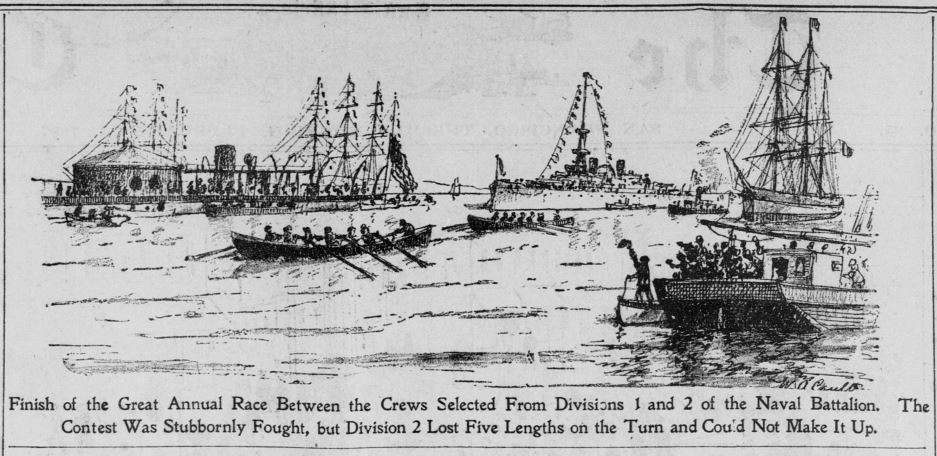
WA Coulter did many maritime drawings for the San Francisco Call. In 1897, California's naval militia put a show for members of the legislature, in honor of George Washington's birthday. The Camanche (that's how the Navy spelled it) was a Civil War monitor with an unusual history. After being built, she was disassembled and loaded into the hold of a sailing ship, the Aquila, which carried her around the horn. Aquila sank in her berth in San Francisco. After being salvaged, Camanche was assembled and launched in late 1864. By this time, she had been turned over to California's Naval Militia. The Oregon (BB-3) was a pre-Dreadnought battleship, built at San Francisco's Union Iron Works.
ON THE CAMANCHE
The Naval Battalion Inspected
by the Legislative Committee.
The National Guard of this section of the State had its day yesterday, being inspected by the adjutant-general, A. W. Barrett, and members of the Military Committee of the Senate and House. It was expected that Governor Budd, commander-in-chief of the Guard, would have been present/with his staff, but he was not present, and the excuse for bis absence was tbat public business prevented him from coming to this City.
The day commenced with a visit to the Naval Battalion on board of the monitor Camanche, at anchor in the bay off Folsom-street Wharf. It had been arranged that there was to be an inspection of the vessel and men and then a boat race between crews of the First and Second divisions of the battalion, but the order was reversed, the race came off first and then followed the inspection.
The party that went on the Camanche was conveyed there on the tug Governor H. H. Markham, made attractive by a liberal display of bunting. Tbe vessel was placed at the disposal of tbe party.
There were in the party Adjutant-General A. W. Barrett, Assistant Adjutant-General R. L. Peeler, Senator Pedlar, chairman of the Senate Military Committee, Senator Androus, Assembly man Cross, chairman of the House Military Committee, Assemblymen Jones, Godfrey, Mahoney. Powers, McLaren and Treacy of the House Committee, Lieutenant-Colonel Burgin and Lieutenant Sanborn of the Governor's staff. Lieutenant-Colonel C. H. Crocker. Captain D. A. Smith, adjutant of the Fifth Infantry, Second Brigade.
They were received on the tug by Lieutenant Dennis of the First Division, who, in tbe absence of Lieutenant-Commander Turner, commanded the battalion, and Lieutenant Elliott, adjutant of the battalion. The tug first followed the racers and. the party on board witnessed some good work by the men of the naval reserve.
When the tug was moored alongside of the iron ship the visitors were received by Lieutenant Gunn of tbe Second Division, acting executive officer of the battalion. The men of the reserve, who were mustered on deck, in their neat uniforms presented a picturesque appearance and drew from tne visitors many expressions of satisfaction.
The customary ceremonies observed on an occasion of this kind being over, the visitors were invited below, where they were shown over the berth deck and in the ward room, where refreshments were served and they were briefly addressed by Lieutenant Dennis. He explained what the naval reserve has done in the past, what it is doing and what it needs.
The party was then shown over the ship, a number of the inquisitive legislators crawling through one of the portholes into the turret to see the guns inside. They asked a great many questions and they learned a great deal. They admitted tbey saw much to admire in that branch of the service, and they were of the opinion that the water militia ought to have the State assistance it asks for.
The inspection over the party returned to the tug and was saluted by the boom of tne Hotcbkiss gun. Then by direction of Colonel Chadbourne the party was taken along the City front and out toward the heads until abreast of the Mabel Gray, tbe schooner that was dismantled by lightning. The tug rounded that vessel and returned to her berth.
When passing the Corwin, which was dressed in gala attire, that vessel fired a National salute of twenty-one guns. Some of the guileless individuals on the tug were of the opinion that the salute was in their honor, until they were reminded tbat the day was a holiday and that the salute was the one usually fired at noon in honor of the occasion.
THE BOAT-RACING.
Division I of the Naval Battalion
Captures a Flag for Fast
Rowing.
"A better, fairer or more hotly contested race was never seen in California," was the comment of Henry Peterson after the first division of the Naval Battalion hbad won the champion flag yesterday. "They rowed stroke for stroke up to the stake boat, but on the turn the first division gained a decided advantage and finally won by about five lengths."
After the race the men in Division 2's boat became the guests of the winners in the boathouse, and a merry half-hour was spent.
Last year the crew of the Second Division won the race, and on this occasion the First Division determined to win back the flag presented by Irving M. Scott for annual competition. It has to be won three times in succession and then becomes the property of the division that proves victorious. Yesterday R. Shualler, W. Giesler, F. J. Murphy, P. Murray, J. Meyers and George Green, with J. T. Healey as cockswain, upheld the honors of the First Division, while T. P. Shroeder and Messrs. Undgen, Olsen, Hansen, Johnson and Halleday, with T. Rowe as cockswain, fought out tbe battle on behalf of the Second Division. Henry Peterson was the referee, Lieutenant Calden was judge for the First Division, Lieutenant A. H. Elliot for the Second Division and S. J. Pembroke was timekeeper.
The course was from the Camanche to a buoy anchored off Mission Rock and return, a distance of about three miles. Considering that the men covered the distance in 20 minutes and 26 seconds, there is some truth in the remark made by Henry Peterson, "The best time ever made by green amateurs, in a ship's boat, in the world."
The start was a perfect one. Neither gained a foot during the first mile and a half, and when the stakeboats were reached it was anybody's race. It was then that Howe carried his boat wide, and Healey, who is an excellent cockswain, made his men slow down, and making a short turn gained at least six lengths on Division 2. With all that distance to make up, the boys never lost heart, and set out on a stern chase. They made up two boats-lengths, but the strain told on them, and during the last quarter of a mile they fell back a length.
The boys of Division 1 earned their victory. They were all out at the finish, and not one of them could have rowed another half-mile. Murphy was bleeding at the nose, and his rowing shirt and arms were covered with his blood; but just the same he stuck to bis work and stayed by his oar until the boat was alongside the monitor. When passing the Oregon and the bark Las Adelphes the men were heartily cheered, and when opposite the schooner on which Schnalier of the battalion had a party of friends the winners received an ovation. It was a perfect day for the races, and it was rowed at slack water and with little or no wind.
"Little Jack," whose clever maneuvering really won the race for Division 1, was afterward carried down below to the berthdeck by his delighted crew.
Then followed several races from the battle-ship. The course was from the Oregon, around the Camanche and back. The big cutter 13 was beaten by barge 32. It was nip and tuck with them until they got into the backwash from the sternwheeler A. C. Freese. Then the cutter lost headway and 32 finally won by four lengths.
In the next race No. 32 was pitted against cutter 41, and this time 32 turned the tables and won cleverly by two lengths.
The third and last race of the day was between dingeys 14 and 24, the former winning by three lengths.
Harrison, Folsom and Howard street wharves were crowded with spectators, all of whom enjoyed the spectacle. The British and American ships were covered with bunting, and it was one of the gayest spectacles seen on the bay in many a day. In point of decorations the Occidental and Oriental Company's Doric easily took the palm, and next came the battle-ship Oregon. The American fleet in port showed more flags and made a better appearance than they have in years.