Showing posts with label Civil War. Show all posts

Wednesday, June 19, 2024

Juneteenth, 2024 -- June 19, 2024

holidayscalendar.com

Happy Juneteenth, everyone. 

After Vicksburg fell in 1863, Texas was mostly cut off from the rest of the Confederacy. Slaves in Texas did not learn about President Lincoln's 1863 Emancipation Proclamation until 19-June-1865, when Union General Gordon Granger presented it to them. I don't think I learned about Juneteenth until I was in college. 

On June 17, 2021 President Joe Biden signed a law making Juneteenth a national holiday.


Monday, June 19, 2023

Juneteenth, 2023 -- June 19, 2023

holidayscalendar.com

Happy Juneteenth, everyone. 

After Vicksburg fell in 1863, Texas was mostly cut off from the rest of the Confederacy. Slaves in Texas did not learn about President Lincoln's 1863 Emancipation Proclamation until 19-June-1865, when Union General Gordon Granger presented it to them. I don't think I learned about Juneteenth until I was in college. On June 17, 2021 President Joe Biden signed a law making Juneteenth a national holiday.


Friday, March 5, 2021

James Longstreet 200 -- March 5, 2021

listal.com

James Longstreet, Lieutenant General, CSA, was born 200 years ago today, on 05-March-2021. He was a West Pointer who served honorably in the Mexican War. Longstreet met Ulysses S Grant at West Point and they remained friends for the rest of their lives. After the attack on Fort Sumter, he joined the Confederate States Army. When Robert E Lee became commander of the Army of Northern Virginia, Longstreet became one of his corps commanders. Longstreet led his troops to many victories.

After the surrender at Appomatox, Longstreet became a pariah in the south because he supported the Republican Party, supported Reconstruction, and accepted offices from President Grant. Lost Cause advocates attacked Longstreet's record, claiming that the defeat at Gettysburg was his fault. 

I need to read his memoirs. 


Saturday, March 28, 2020

George H Thomas 125 Years -- March 28, 2020


150 years ago today, on 28-March-1870, General George Thomas, USA died. This post is adapted from a 2013 item about General Thomas:
https://cablecarguy.blogspot.com/2013/08/nickname-28-august-17-2013.html

I recently read a wonderful essay by Lt Col Robert Bateman: The Meaning of Oaths and a Forgotten Man.  He talks about how Robert E Lee "was a traitor who should have been executed."  This is because Lee and other Regular Army officers who had sworn to protect and defend the United States should be regarded as traitorous opportunists who had violated their oaths and given up their honor.  He points to the example of George Henry Thomas of Virginia, a Regular Army officer who thought long and hard and when Virginia seceded and decided that "my oath of allegiance to the Federal government always came uppermost."

Colonel Bateman points out that Lee is idolized even though he killed tens of thousands of American soldiers, while Thomas, who remained loyal to his country and earned the nicknames "The Rock of Chickamauga" and "The Sledge of Nashville" by being one of the most effective generals on either side, is largely ignored except by historians.

General Thomas and his men stood fast at Chickamauga, preventing a Union defeat from turning into a rout.  Thomas destroyed Confederate General John Bell Hood's army at Nashville.  He continued to serve his country during Reconstruction. General George Henry Thomas died while serving as Commandant of the Presidio of San Francisco. 

Monday, August 14, 2017

Charlottesville -- August 14, 2017


A bunch of idiots went to Charlottesville, Virginia for something called the Unite the Right rally.  The rally was held to protest the removal of statues of Civil War traitors including Robert E Lee.  One of these superior people used his car to plow into a crowd of counter-protesters, killing one person and injuring 19 others.

Why do these people hate America so much?  They adopt the emblems of historical losers like the Confederacy and the Nazis.  They take inspiration from our so-called president. He can't bring himself to call this domestic terrorism.  He tries to blame both sides. 

Friday, April 1, 2016

Confederate Heritage Month - April 1, 2016

Fort Pillow Massacre
I wish this was an April Fools' Day joke.  The Governor of Mississippi, Phil Bryant, has declared that April is Confederate Heritage Month.

“Whereas it is important for all Americans to reflect upon our nation’s past, to gain insight from our mistakes and our successes, and to come to a full understanding that the lessons learned yesterday and today will carry us through tomorrow if we carefully and earnestly strive to understand and appreciate our heritage …”  Notice that the proclamation does not mention slaves or slavery.

To help celebrate Confederate Heritage in Mississippi, here is one of the high points of the Confederacy in that state, the Fort Pillow Massacre.  General Nathan Bedford Forrest, who later founded the Ku Klux Klan, captured the fort on 12-April-1864.  After the garrison of US Colored Troops surrendered and gave up their arms, Forrest and his cavalrymen slaughtered almost every one of them.  Many were castrated and lynched.  

I was happy to learn that the Mississippi NAACP has proposed that May should be Union Army Appreciation Month, to remember honorable men from Mississippi, black and white, who fought against treason:
http://naacpms.org/union-troops-appreciation-month/#1458570559639-14a3a768-bec6

Sunday, April 26, 2015

Capture of the Assassin Booth !! -- April 26, 2015


On the night of 14-April-1865, Good Friday, President Abraham Lincoln and his wife Mary went to Ford's Theater to see Laura Keene in the comedy Our American Cousin.  The coward John Wilkes Booth entered the presidential box during the third act and shot Lincoln in the back of the head.  Booth fled and was the subject of a huge manhunt for the next twelve days.  He spent much of the time squatting in a swamp, which seems appropriate.  On 26-April-1865,  Soldiers of the 16th New York Cavalry Regiment found him at the Garrett Farm.  Sergeant Boston Corbett put him out of his misery and allowed him to cheat the hangman.  Notice that Davey Herold's family name is spelled at least three different ways. From the 27-April-1865 Washington Evening Star.

EXTRA.
THRILLING NEWS!!
CAPTURE OF THE ASSASSIN BOOTH!!
HIS IGNOMINIOUS DEATH!!
CAPTURE OF HEROLD ALIVE!
BOOTH TAKEN IN A BARN!
HE FIRES ON OUR MEN!!
THE FIRE RETURNED.
BOOTH SHOT IN THE NECK.
HE DIES IN THREE HOURS.
THE BODY BROUGHT TO THE NAVY YARD.
Official Bulletin.
War Department, Washington, D. C., April 27, l865.
Major Gentral Dix, New York:

J. Wilkes Booth and Harrold were chased from the swamp in St. Mary's county, Md., pursued yesterday morning to Garrett's farm, near Port Royal, on the Rappahannock, by Col. Baker's force.

The barn in which they took refuge was fired.

Booth in making his escape was shot through the head and killed, lingering about three hours, and Harrold taken alive.

Booth's body and Harrold are now here.

Edwin M. Stanton, Secretary of War.


FURTHER PARTICULARS

The thrilling intelligence of the capture and ignominious death Of the assassin Booth was received with profound satisfaction here, the only shade of alloy being in the fact that the villain met any end less disgraceful than in having his neck stretched.

To Col. L. C. Baker, special detective of the War Department, and his admirably trained detective force, and to the New York cavalry, the active participators in the seizures, the country owes a debt of gratitude for this timely service.

It seems that a detachment of the 16th New York cavalry, numbering about twenty-five men, which was dispatched from this city on Monday under the direction of Colonel L. C. Baker, special detective of the War Department, in command of Lieut. Dogherty, accompanied by some of Col. Baker's officers, captured and killed Booth and captured Herold one of his accomplices alive.

The cavalry, after leaving here, landed at Belle Plain in the night, and immediately started out in pursuit of Booth and Herold, having previously ascertained from a colored man that they had crossed the river into Virginia at Swan Point, in a small canoe, hired by Booth from a man for $300.

Proceeding on towards Bowling Green, some three miles from Port Royal, Lieut. Dogherty, who was in command of the cavalry, discovered that Booth and Herold were secreted in a large barn, owned by a man named Garrett. and were well armed.

The cavalry then surrounded the barn and summoned Booth and his accomplice to surrender. Herold was inclined at first to accede to the request, but Booth accused him of cowardice, then they both peremptorily refused to surrender and made preparations to defend themselves,

In order to take the conspirators alive, the barn was fired, and the flames getting too hot for Herold he approached the door of the barn and signified his willingness to be taken prisoner. Herold then came out of the barn and gave himself up. and was securely handcuffed. Booth maintained a defiant attitude, refusing to surrender, and in braggadocia style challenged his pursuers to fight him by turns singly. As the roof of the barn was about falling in, and Booth manifested a disposition to make a bolt, be was shot by Sergeant Boston Corbett, of the 16th New York, the ball taking effect in the neck, from the effects of which he died in about three hours.

Booth, before breathing his last, was asked if he had anything to say, when he replied. "Tell my mother that I died for my country."

Herold and the body of Booth was brought into Belle Plain at eight o'clock last night, and reached the Navy Yard here at one o'clock this morning, on board of the steamer John S. Ides, Capt. Henry Wilson.

The statement heretofore published that Booth had injured one of his legs by the falling of his horse, has proven to be correct. After he was shot it was discovered that one of his legs was badly injured, and that he was compelled to wear an old shoe, and use crutches, which be had with him in the barn Booth was shot about 4 o'clock in the morning, and died about 7 o'clock.

Booth had upon his person some bills of exchange, but only $175 in Treasury notes.

It appears that Booth and Herold left Washington together on the night of the murder of President Lincoln, and passed through Leonardtown, Md., concealing themselves in the vicinity until an opportunity was afforded them to cross the river at Swan Point, which they did as above stated.

The man who hired Booth and his accomplice the boat in which he crossed the river was captured, we understand, but afterwards made his escape.

Herold has been lodged in a secure place.

Bowling Green, near which place Booth was killed, is a post village, the capital of Caroline county, Va, on the road from Richmond to Fredericksburg, 45 miles north of the former, and is situated in a fertile and healthy region. It contains 2 churches, 3 stores, 2 mills, and about 300 inhabitants.

Port Royal is a post village in Caroline county, Va., on the right bank of the Rappahannock river, twenty-two miles below Fredericksburg. It has a population of six hundred, and there is a good steamboat landing near the place.


THIRD EDITION
2 O'CLOCK P. M.
THE LAST OF BOOTH.
ANOTHER ACCOUNT.
VERY INTERESTING PARTICULARS.
STATEMENTS OF THE PARTIES WHERE BOOTH LODGED.
HE IS TAKEN THERE AS A WOUNDED MARYLAND SOLDIER.
HE PRETENDS GREAT HORROR OF THE ASSASSINATION.
DESCRIPTION OF HIS BODY.
THE SHOT THAT KILLS HIM ENTERS HIS HEAD VERY NEAR THE PLACE WHERE MR. LINCOLN WAS SHOT!

Booth and Herold reached Garrett's some days ago, Booth walking on crutches. A party of four or five accompanied them, who spoke of Booth as a wounded Marylander, on his way home, and that they wished to leave him there a short time, and would take him away by the 26th, (yesterday). Booth limped somewhat and walked on crutches about the place, complaining of his ankle. He and Herold regularly took their meals at the house, and both kept up appearances well.

One day at the dinner table the conversation turned on the assassination of the President when Booth denounced the assassination in the severest terms, saying that there was no punishment severe enough for the perpetrator. At another time some one said in Booth's presence that rewards amounting to $200,000 had been offered for Booth, and that he would like to catch him, when Booth replied, "Yes, it would be a good haul, but the amount would doubtless soon be increased to $500,000.

The two Garretts who lived on the place allege that they had no idea that these parties (Booth and Herold) were any other than what their friends represented themselves -- paroled Confederate soldiers on their way home. They also say that when the cavalry appeared in that neighborhood, and they heard that they were looking for the assassins, that they sent word to them that these two men were on the place. In other words, they assert that they are entirely innocent of giving the assassins any aid and comfort, knowing them to be such.

The Ida (tug boat) reached here about two o'clock last night with Herold and the two young men above referred to, as well as the body of Booth. Herold was immediately placed in a safe place. He thus far, it is stated, has manifested no disposition to speak of the affair, but as he was known as a very talkative young man, he may soon resume the use of his tongue.

Booth and Herold were dressed in Confederate grey -- new uniforms. Herold was otherwise not disguised much. Booth's moustache had been cutoff apparently with scissors, and his beard allowed to grow, changing his appearance considerably. His hair had been cut somewhat shorter than he usually wore it. Booth's body, which we have above described, was at once laid out on a bench and a guard placed over it. The lips of the corpse are tightly compressed, and the blood has settled in the lower part of the face and neck. Otherwise the face is pale and wears a wild haggard look, indicating exposure to the elements and a rough time generally in his skulking flight.

His hair is disarranged and dirty, and apparently had not been combed since he took his flight. The head and breast is alone exposed to view, the lower portion of the body, including the hands and feet, being covered with a tarpaulin thrown over it.

The shot which terminated his accursed life entered on the left side at the back of the neck, a point, curiously enough, not far distant from that in which his victim, our lamented President, was shot. No orders have yet been given as to what disposition will be made of the body.

Large numbers of persons have been seeking admission to the Navy Yard to-day, to get a sight of the body, and to hear the particulars, but none excepting the workmen, the officers of the yard, and those holding orders from the Department, are allowed to enter.

A Spencer carbine, which Booth had with him in the barn, at the time he was shot by Sergeant Corbett, and a large knife, with blood on it, supposed to be the one which Booth cut Major Rathbone with in the theater box on the night of the murder of President Lincoln, and which was found on Booth's body, has been brought to the city. The carbine and knife are now in the possession of Col. Baker at his office.

The bills of exchange, which are for a considerable amount, found on Booth's person, were drawn on banks in Canada in October last. About that time Booth was known to have been in Canada.

It is now thought that Booth's leg was fractured in jumping from the box in Ford's Theatre upon the stage, and not by the falling of his horse while endeavoring to make his escape, as was at first supposed.

Tuesday, April 14, 2015

Assassination of the President -- April 14, 2015


The Civil War was nearing its end.  On the night of 14-April-1865, Good Friday, President Abraham Lincoln and his wife Mary went to Ford's Theater to see Laura Keene in the comedy Our American Cousin.  The coward John Wilkes Booth entered the presidential box during the third act and shot Lincoln in the back of the head.  Fellow conspirator Lewis Powell attacked Secretary of State William Seward and his family at their home.  No one died from that attack.  This article from the 14-April-1865 Washington Evening Star was published, or at least composed, while Lincoln still lived. 

ASSASSINATION OF THE PRESIDENT.

ATTEMPTED MURDER OF SECRETARY SEWARD AND SONS.

Despatches from Secretary Stanton.

War Department,
WASHINGTON, D. C., April 15 -- 1.30 P. M.

Major General John A. Dix, New York:

Last evening, at 10.30 p. m., at Ford's Theater, the President, while sitting in his private box with Mrs. Lincoln, Miss Harris, and Maj. Rathbun, was shot by an assassin who suddenly entered the box. He approached behind the President. The assassin then leaped upon the stage, brandishing a large dagger or knife, and made his escape by the rear of the theater.  The pistol ball entered the back of the President's head. The wound is mortal. The President has been insensible ever since it was inflicted, and is now dying.

About the same hour an assassin, either the same or another, entered Mr. Seward's house and, under pretence of having a prescription, was shown to the Secretary's sick chamber.  The Secretary was in bed, a nurse and Miss Seward with him. The assassin immediately rushed to the bed, inflicting two or three stabs on the throat, and two in the face. It is hoped the wounds may not be mortal. My apprehension is that they will prove fatal. The nurse alarmed Mr. Frederick Seward, who was in an adjoining room, and hastened to the door of his father's room, where he met the assassin, who inflicted upon him one or more dangerous wounds. The recovery of Frederick Seward is doubtful.

It is not probable that the President will live through the night.

Gen. Grant and wife were advertised to be at the theater this evening, but the latter started to Burlington at six o'clock last evening.

At a Cabinet meeting, at which Gen. Grant was present to-day, the subject of the state of the country, and the prospects of speedy peace was discussed. The President was very cheerful and hopeful, spoke very kindly of Gen. Lee and others of the Confederacy, and the establishment of Government in Virginia. All the members of the Cabinet, except Mr. Seward, are now in attendance upon the President. have seen Mr. Seward, but he and Frederick were both unconscious.

E. M. Stanton, Secretary of War

----------------------------

War Department,
Washington, D. C., 3 a.m., April 15, 1865.


Lieutenant General Grant:

The President still breathes, but is quite insensible, as he has been ever since be was shot.  He evidently did not see the person who shot him, but was looking on the stage, as he was approached behind.

Mr. Seward has rallied, and it is hoped he may live. Frederick Seward's condition is very critical. The attendant who was present was stabbed through the lungs, and is not expected to live. The wounds of Major Seward are not serious.

Investigations strongly indicates J. Wilkes Booth as the assassin of the President. Whether it was the same, or a different person that attempted to murder Mr. Seward, remains in doubt.

Chief Justice Cartter (? - JT) is engaged in taking the evidence. Every exertion has been made to present the escape of the murderer. His horse has been found on the road near Washington.

Edwin M. Stanton, Secretary of War

----------------------------

War Department,
Washington, D. C., 4:10 a.m., April 15, 1865.


Major General John A. Dix, New York:

The President continues insensible, and is sinking. Secretary Seward remains without change.  Frederick Seward's skull is fractured in two places, besides a severe cut upon the head. The attendant is still alive, but hopeless.

Major Seward's wounds are not dangerous.  It is now ascertained with reasonable certainty, that two assassins were engaged in the horrible crime -- Wilkes Booth being the one that shot the President; the other, a companion of his, whose name is not known, but whose description is so clear that he can hardly escape. 

It appears, from a letter found in Booth's trunk, that the murder was planned before the fourth of March, but fell through then because the accomplice backed out until Richmond could be beard from. Booth and his accomplice were at the livery stable at six o'clock last evening, and left there with their horses about ten o'clock, or shortly before that hour.

It would seem that they had for several days been seeking their chance, but for some unknown reason, it was not carried into effect until last night. One of them has evidently made his way to Baltimore, the other has not yet keen traced.

Edwin M. Stanton, Secretary of War

----------------------------

TEN THOUSAND DOLLARS REWARD

Headquarters Dep't of Washington,
April 15, 1860.

A REWARD OF TEN THOUSAND DOLLARS
will be paid to the party or parties arresting the murderer of the President, Mr. Lincoln, and the assassin of the Secretary of State, Mr. Seward, and his son.

C. C, Auger,
Major General, Com'd'g Department.

----------------------------

GENERAL GRANT ADVISED OF PRES1DENT LINCOLN'S ASSASSINATION.

Philadelphia, April 11.-- General Grant received the news of the attempted assassination of the President when at Walnut street wharf, when about taking the cars for Burlington.

----------------------------

ASSOCIATED PRESS ACCOUNT.

President Lincoln and wife, together with other friends, last evening visited Ford Theater for the purpose of witnessing the performance of the American Cousin. It was announced in the newspapers that Gen. Grant would also be present, but that gentleman, instead, took the late train of cars for New Jersey. The theater was densely crowded, and everybody seemed delighted with the scene before them.

During the third act, and while there was temporary pause for one of the actors to enter, a sharp report of a pistol was heard, which merely attracted attention, but suggesting nothing serious until a man rushed to the front of the President's box, waiving (sic - JT) a long dagger in his right hand, and exclaiming "Sic Semper Tyrannis," and immediately leaped from the box, which was of the second tier, to the stage beneath, and ran across to the opposite side thus making his escape, amid the bewilderment of the audience, from the rear of the theater, and, mounting a horse, fled.

The screams of Mrs. Lincoln first disclosed the fact to the audience that the President had been shot, when all present rose to their feet, rushing toward the stage, exclaiming, "Hang him!" "Hang him!''

The excitement was of the wildest possible character, and, of course, there was an abrupt termination of the theatrical performance.

There was a rush towards the President's box, when cries were heard. "Stand back" "Give him air!" "Has anyone stimulants!"

On a hasty examination it was found that the President had been shot through the head, above and back of the temporal bone, and that some of the brain was oozing out. He was removed to the private residence of Mr. Peterson, opposite to the theater, and the Surgeon General of the Army and other surgeons sent for to attend to his condition.

On examination of the private box blood was discovered on the back of the cushioned rocking chair in which the President had been sitting, also on the partition and on the floor.

A common single barreled pocket pistol was found on the carpet.

A military guard was placed in front of the private residence to which the President had been conveyed.

An immense crowd was in front of it, all deeply anxious to learn the condition ot the President. It had been previously announced that the wound was mortal, but all hoped otherwise.

The shock to the community was terrible.

At midnight the Cabinet, with Messrs. Sumner, Colfax, Farnsworth, Judge Cartter, Gov. Oglesby, General Meigs, Major Hay, and a few personal friends, with Surgeon General Barnes and his medical associates, were around his bedside. The President was in a state of syncope, totally insensible, and breathing slowly, the blood oozing from the wound at the back of his head. The surgeons were exhausting every possible effort of medical skill, but all hope was gone. The parting of his family with the dying President is too sad for description.

The President, and Mrs. Lincoln did not start to the theatre, till fifteen minutes past eight o'clock. Speaker Colfax was at the White House at the time, and the President stated to him that he was going, although Mrs. Lincoln had not been well, because the papers had advertised that General Grant and themselves were to be present and, as General Grant had gone North, he did not wish the audience to be disappointed. He went with apparent reluctance, and urged Mr. Colfax to go with him; but that gentleman had made other engagements, and with Mr. Ashmun, of Massachusetts, bade him good-bye.

When the excitement at the theatre was at its wildest height, reports were circulated that Secretary Seward had also been assassinated.

On reaching this gentleman's residence a crowd and a military guard were found at the door, and, on entering, it was ascertained that reports were based upon truth.

Everybody was so much excited that scarcely an intelligible account could be gathered. But the facts are substantially as follows: About ten o'clock, a man rang the bell, and the call having been answered by a colored servant, he said he had come from Dr. Verdi, Secretary Seward's family physician, with a prescription, at the same time holding in his hand a small piece of folded paper, and saying, in answer to a refusal that he must see the Secretary, as he was intrusted with particular directions concerning the medicine. He still insisted on going up, although repeatedly informed that no one could enter the chamber.

The man pushed the servant aside and walked heavily toward the Secretary's room, and was there met by Mr. Frederick W. Seward of whom he demanded to see the Secretary, making the same representation which he did to the servant. What further passed in the way of colloquy is not known, but the man struck him on the head with a billy, severely injuring the skull, and falling him almost senseless.

The assassin then rushed into the chamber and attacked Major Seward (paymaster United States army) and Mr. Hanseil, a messenger of the State Department, and two male nurses, disabling them all. He then rushed upon the Secretary, who was lying in bed in the same room, and inflicted three stabs in his neck, but severing, it Is thought and hoped, no arteries, though be bled profusely.

The assassin then rushed down stairs, mounted his horse at the door and rode off before an alarm could be given; and in the same manner of the assassin of the President.

It is believed the injuries of the Secretary are not mortal, nor those of either of the others. although both the Secretary and the Assistant Secretary are very seriously injured.

Secretaries Stanton and Welles, and other prominent officers of the Government, called at Secretary Seward's house to inquire into his condition, and hearing there of the assassination of the President, proceeded to the house where he was lying, exhibiting, of course, intense anxiety and solicitude.

An immense crowd was gathered in front of the President's house, and a strong guard was also stationed there, many persons evidently supposing that be would be brought to his home.

The entire city last night presented a scene of wild excitement, accompanied by violent expressions of indignation, and the profoundest sorrow. Many persons shed tears.

The military authorities have despatched mounted patrols in every direction, in order, if possible, to arrest the assassins, while the Metropolitan police are alike vigilant for the same purpose. The attacks, both at the theater and at Secretary Seward's, took place at about the same hour -- ten o'clock -- thus showing a precented plan to assassinate these gentlemen.

Some evidence of the guilt of the party who attacked the President is in possession of the police.

Vice President Johnson is in the city, and his hotel quarters are guarded by troops.

2 1/2 a. m.-- The President is still alive, but is growing weaker. The ball is lodged in his brain, three inches from where it entered the skull. He remains insensible, and his condition utterly hopeless

The Vice President has been to see him, but all company except the Cabinet, his family, and a few friends, are rigidly excluded.

Large crowds still continue in the street, as near to the house as the line of guards allow.

----------------------------

IMPORTANT ORDER BY A. O. RICHARDS, SUPERINTENDENT OF THE METROPOLITAN POLICE.

The following was issued by Superintendent Richards at 3 o'clock this morning:
In view of the melancholy events of last evening, I am directed to close all places where liquor is sold to be closed during this day and night.

The sergeants of the several precincts will see that this order is enforced.

A. C. Richards, Superintendent.

----------------------------

FURTHER PARTICULARS OF THE ASSASSINATION.

[From the Chronicle.]

"At half-past ten o'clock last night, in the front upper left hand private box in Ford's Theater, while the seond scene of the third act of 'Our American Cousin' was being played, a pistol was fired, and Abraham Lincoln shot through the neck and lower part of the head.  A second after the shot was fired, a man vaulted over the baluster of the box, saying 'Sic Semper tyrannis.' and, adding another
sentence, which closed with the words, 'revenge for the South,' ran across the stage with a gleaming knife, double-edged and straight, in his right hand. The man was of middle stature, well-built, white faced and beardless save that he wore a black moustache. His hair and eyes were black.

"The crowd ascended the stage; the actresses, pale beneath their rouge, ran wildly about. Miss Keene, whose benefit night it was, came forward, endeavoring to quiet the audience. Several gentlemen climbed to the box, and finally the audience were ordered out by some gentlemen.

" Mrs. Lincoln, Miss Harris and Maj. Rathbnrn were in the box with the President."

The assassin left behind him his hat and spur, which have been identified as belonging to the suspected man, (J. W. Booth.)

The ball entered three inches below the left ear and behind it a little, just beneath the base of the brain, taking an upward direction and lodging in the brain, where it could be felt by the surgeons, but not dislodged.


Thursday, April 9, 2015

Surrender of Lee and His Whole Army -- April 9, 2015


Robert E Lee surrendered the Army of Northern Virginia.  The Civil War was not over, but it was close.  From the 10-April-1865 New York Sun. 

Friday, May 9, 2014

The Death of General John Sedgewick 150 -- May 9, 2014


150 years ago, on 09-May-1864, at the Battle of Spotsylvania Court House, Major General John Sedgewick was killed by a sniper.  His alleged last words are famous. From Battles and Leaders of the Civil War: Volume IV

THE DEATH OF GENERAL JOHN SEDGWICK.


BY MARTIN T. MCMAHON, BREVET MAJOR-GENERAL, U. S. V.; CHIEF-OF-STAFF, SIXTH CORPS.


ON May 8th, 1864, the Sixth Corps made a rapid march to the support of Warren, near Spotsylvania Court House. We arrived there about 5 p. M., and passed the rest of the day in getting into position on Warren's left. After nightfall General Sedgwick rode back into an open field near General Warren's headquarters and, with his staff, lay down on the grass and slept until daylight. Shortly after daylight he moved out upon his line of battle. We had no tents or breakfast during that night or morning. The general made some necessary changes in the line and gave a few unimportant orders, and sat down with me upon a hard-tack box, with his back resting against a tree. The men, one hundred feet in front, were just finishing a line of rifle-pits, which ran to the right of a section of artillery that occupied an angle in our line. The 1st New Jersey brigade was in advance of this line.
 
After this brigade, by Sedgwick's direction, had been withdrawn through a little opening to the left of the pieces of artillery, the general, who had watched the operation, resumed his seat on the hard-tack box and commenced talking about members of his staff in very complimentary terms. He was an inveterate tease, and I at once suspected that he had some joke on the staff which he was leading up to. He was interrupted in his comments by observing that the troops, who during this time had been filing from the left into the rifle-pits, had come to a halt and were lying down, while the left of the line partly overlapped the position of the section of artillery. He stopped abruptly and said, '' That is wrong. Those troops must be moved farther to the right; I don't wish them to overlap that battery." I started out to execute the order, and he rose at the same moment, and we sauntered out slowly to the gun on the right. About an hour before, I had remarked to the general, pointing to the two pieces in a half-jesting manner, which he well understood, "General, do you see that section of artillery? Well, you are not to go near it today." He answered good-naturedly, "McMahon, I would like to know who commands this corps, you or I?" I said, playfully, "Well, General, sometimes I am in doubt myself"; but added, "Seriously, General, I beg of you not to go to that angle; every officer who has shown himself there has been hit, both yesterday and to-day." He answered quietly, "Well, I don't know that there is any reason for my going there." When afterward we walked out to the position indicated, this conversation had entirely escaped the memory of both.

I gave the necessary order to move the troops to the right, and as they rose to execute the movement the enemy opened a sprinkling fire, partly from sharp-shooters. As the bullets whistled by, some of the men dodged. The general said laughingly, "What! what! men, dodging this way for single bullets! What will you do when they open fire along the whole line? I am ashamed of you. They couldn't hit an elephant at this distance." A few seconds after, a man who had been separated from his regiment passed directly in front of the general, and at the same moment a sharp-shooter's bullet passed with a long shrill whistle very close, and the soldier, who was then just in front of the general, dodged to the ground. The general touched him gently with his foot, and said, "Why, my man, I am ashamed of you, dodging that way," and repeated the remark, "They couldn't hit an elephant at this distance." The man rose and saluted, and said good-naturedly, "General, I dodged a shell once, and if I hadn't, it would have taken my head off. I believe in dodging." The general laughed and replied, "All right, my man; go to your place."
 
For a third time the same shrill whistle, closing with a dull, heavy stroke, interrupted our talk, when, as I was about to resume, the general's face turned slowly to me, the blood spurting from his left cheek under the eye in a steady stream. He fell in my direction; I was so close to him that my effort to support him failed, and I fell with him.
 
Colonel Charles H. Tompkins, chief of the artillery, standing a few feet away, heard my exclamation as the general fell, and, turning, shouted to his brigade-surgeon, Dr. Ohlenschlager. Major Charles A. Whittier, Major T. W. Hyde, and Lieutenant-Colonel Kent, who had been grouped near by, surrounded the general as he lay. A smile remained upon his lips but he did not speak. The doctor poured water from a canteen over the general's face. The blood still poured upward in a little fountain. The men in the long line of rifle-pits, retaining their places from force of discipline, were all kneeling with heads raised and faces turned toward the scene; for the news had already passed along the line.
 
I was recalled to a sense of duty by General Ricketts, next in command, who had arrived on the spot, and informed me, as chief-of-staff, that he declined to assume command of the corps, inasmuch as he knew that it was General Sedgwick's desire, if anything should happen to him, that General Horatio G. Wright, of the Third Division, should succeed him. General Rieketts, therefore, suggested that I communicate at once with General Meade, in order that the necessary order should be issued. When I found General Meade he had already heard the sad intelligence, and had issued the order placing General Wright in command. Returning I met the ambulance bringing the dead general's body, followed by his sorrowing staff. The body was taken back to General Meade's headquarters, and not into any house. A bower was built for it of evergreens, where, upon a rustic bier, it lay until nightfall, mourned over by officers and soldiers. The interment was at Cornwall Hollow, Connecticut.

Condensed from a letter to General J. W. Latta, President of the Sedgwick Memorial Association. 

Monday, May 5, 2014

Happy Cinco de Mayo #6 -- May 5, 2014


Happy Cinco de Mayo everyone. General Ignacio Zaragoza Seguín led the Mexican army which defeated the French invaders at the Battle of Puebla in 1862. "The national arms have been covered with glory" General Zaragoza wrote in a letter to President Benito Juárez. Some people credit this defeat with preventing French interference in the US Civil War.

Monday, February 24, 2014

Joshua Lawrence Chamberlin 100 Years -- February 24, 2014


Joshua Lawrence Chamberlin of Maine died only 100 years ago.  He took a leave of absence from his position as a professor at Bowdoin College to volunteer for the Union Army.  He served well, rising to the rank of Brigadier General, with a brevet to Major General.  He received the Congressional Medal of Honor for his leadership of the 20th Maine on Little Round Top during the second day of the Battle of Gettysburg.  Chamberlin was wounded six times during the war. 

When the Confederate Army of Northern Virginia surrendered at Appomatox Courthouse, Chamberlin led the Union Troops as the defeated Confederates passed in review.  Chamberlin ordered his men to stand at attention and carry arms (a form of salute) as a sign of respect. 

After the war, Chamberlin served as Republican Governor of Maine.  After he left office, Chamberlin returned to Bowdoin College and taught until the effects of his wounds forced him to resign.  He volunteered to serve in the Spanish-American War but was turned down because of his health.  When he died in 1914, he was considered to be the last veteran of the US Civil War to die of his wounds. 

A lot of people became aware of Chamberlin when he was prominently featured in Ken Burns' 1990 series The Civil War. 

Chamberlin's Medal of Honor citation:
"The President of the United States of America, in the name of Congress, takes pleasure in presenting the Medal of Honor to Colonel Joshua Lawrence Chamberlain, United States Army, for extraordinary heroism on 2 July 1863, while serving with 20th Maine Infantry, in action at Gettysburg, Pennsylvania, for daring heroism and great tenacity in holding his position on the Little Round Top against repeated assaults, and carrying the advance position on the Great Round Top."

Sunday, February 16, 2014

H. L. Hunley Sinks the USS Housatonic 150 -- February 16, 2014


I have always been interested in early hand-powered submarines like David Busnhell's Turtle and Robert Fulton's Nautilus. 

150 years ago tomorrow, on 17-February-1864, Confederate boat HL Hunley became the first submarine to sink a ship when she attacked the USS Housatonic, a steam sloop of war, in Charleston Harbor, South Carolina.  Five men died on the Housatonic and the crew of eight in the Hunley died when the submarine failed to return to base for unknown reasons.  Hunley had already killed five of her first crew and all of her second crew of eight, including inventor Horace Hunley, during trials. 

The submarine was located in 1995 and raised from the bottom in 2000. 

The Union Navy built a hand-powered submarine, the USS Alligator, but it never saw combat.  In 1863, the French had launched Plongeur, which was powered by compressed air. 

Wednesday, November 20, 2013

Gettysburg Address 150 -- November 20, 2013

I meant to post this yesterday on the actual 150th anniversary of the Gettysburg Address, the greatest piece of rhetoric in American history. 

"Four score and seven years ago our fathers brought forth on this continent, a new nation, conceived in Liberty, and dedicated to the proposition that all men are created equal.

"Now we are engaged in a great civil war, testing whether that nation, or any nation so conceived and so dedicated, can long endure. We are met on a great battle-field of that war. We have come to dedicate a portion of that field, as a final resting place for those who here gave their lives that that nation might live. It is altogether fitting and proper that we should do this.
 
"But, in a larger sense, we can not dedicate -- we can not consecrate -- we can not hallow -- this ground. The brave men, living and dead, who struggled here, have consecrated it, far above our poor power to add or detract.
 
"The world will little note, nor long remember what we say here, but it can never forget what they did here. It is for us the living, rather, to be dedicated here to the unfinished work which they who fought here have thus far so nobly advanced. It is rather for us to be here dedicated to the great task remaining before us -- that from these honored dead we take increased devotion to that cause for which they gave the last full measure of devotion -- that we here highly resolve that these dead shall not have died in vain -- that this nation, under God, shall have a new birth of freedom -- and that government of the people, by the people, for the people, shall not perish from the earth."

Wednesday, August 21, 2013

Comic Book #26 -- August 21, 2013

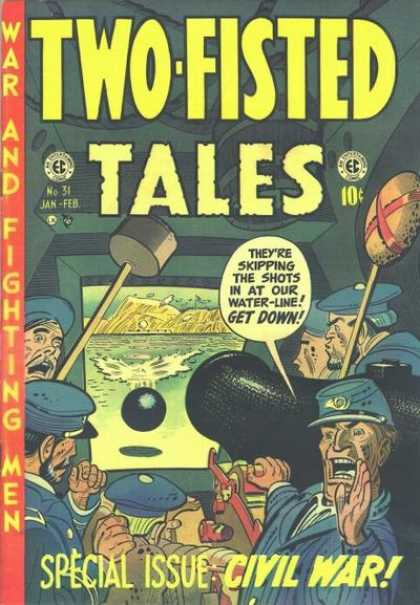
Two-Fisted Tales was a famous war comic from EC.  This cover of this issue depicts a scene on a Union ironclad during the US Civil War. 

The image is from the wonderful site CoverBrowser (http://www.coverbrowser.com/).  

Monday, August 19, 2013

Pulp #46 -- August 19, 2013

The only issue, Spring 1940, of Civil War Stories. 

The image is from Phil Stephensen-Payne's wonderful Galactic Central (http://www.philsp.com/).

Saturday, August 17, 2013

Nickname #28 -- August 17, 2013

I recently read a wonderful essay by Lt Col Robert Bateman: The Meaning of Oaths and a Forgotten Man.  He talks about how Robert E Lee "was a traitor who should have been executed."  This is because Lee and other Regular Army officers who had sworn to protect and defend the United States should be regarded as traitorous opportunists who had violated their oaths and given up their honor.  He points to the example of George Henry Thomas of Virginia, a Regular Army officer who thought long and hard and when Virginia seceded and decided that "my oath of allegiance to the Federal government always came uppermost."

Colonel Bateman points out that Lee is idolized even though he killed tens of thousands of American soldiers, while Thomas, who remained loyal to his country and earned the nicknames "The Rock of Chickamauga" and "The Sledge of Nashville" by being one of the most effective generals on either side, is largely ignored except by historians.

General Thomas and his men stood fast at Chickamauga, preventing a Union defeat from turning into a rout.  Thomas destroyed Confederate General John Bell Hood's army at Nashville.  He continued to serve his country during Reconstruction. General George Henry Thomas died while serving as Commandant of the Presidio of San Francisco. 

Thursday, July 4, 2013

Happy Independence Day #7 -- July 4, 2013

Happy Fourth of July to all.

Actress Myrna Loy, one of my favorites, ignores the sign prohibiting fireworks.  From Motion Picture Magazine, August, 1928.
150 years today, on 04-July-1863, Confederate Lieutenant General John C Pemberton surrendered the fortified town of Vicksburg, a key point on the Mississippi River, to Union Major General Ulysses S Grant.  Grant  had besieged the city for six weeks and the defenders and the civilian population had become desperate.  Vicksburg, along with the just-concluded Battle of Gettysburg, was a turning point in the war.  

Monday, July 1, 2013

Battle of Gettysburg 150 -- July 1, 2013

Alonzo Cushing
Lewis Armistead
On 01-July-1863, advance units of the Confederate Army of Northern Virginia and the Union Army of the Potomac stumbled into each other near the town of Gettysburg, Pennsylvania.  The battle which continued over the next three days became the largest engagement of the war and is considered by many historians to be a major turning point.

On 03-July-1863, Brevet Major Alonzo Cushing of Battery A, 4th US Artillery led his men in holding a critical position on Cemetery Ridge. At the same time, Brigadier General Lewis Armistead CSA, who had been a Captain in the regular army before the war, led his brigade up the ridge as part of Pickett's Charge.

After being wounded three times and forced to hold his intestines in with his hands, Cushing refused a direct order to go to the rear.  His sergeant had to hold him up and repeat his commands.  Cushing died when a bullet passed through his head.

In 2002, Senator Russ Feingold of Wisconsin nominated Cushing for the Congressional Medal of Honor. The Army investigated his case and approved the nomination in 2010. Congress awarded the medal.

Lewis Armistead placed his hat on the tip of his saber and led his men up Cemetery Ridge toward the Union position known as the Angle.  Armistead and some of his men made it over the stone wall and he is said to have placed a hand on a Union cannon before he fell from his wounds.  Evacuated to the rear, he died a few days later in a Union hospital.

The spot where Cushing and Armistead died is called by some historians "the high water mark of the Confederacy." Their monuments stand close together on the battlefield.


I have never seen it mentioned in a film history book, but Armistead's feat in leading the charge and laying a hand on a Union cannon probably inspired the famous scene in DW Griffith's Birth of a Nation where Henry B Walthall as Colonel Ben Cameron leads his men across the battlefield, picks up the colors from a fallen man, and rams the staff down the barrel of a Union cannon before he collapses because of his wounds.

Saturday, September 22, 2012

Preliminary Emancipation Proclamation - September 22, 2012

In July, 1862, President Abraham Lincoln showed his cabinet a draft of an order that freed the slaves in any rebellious state that did not return to the Union by 01-January-1863.  Some cabinet members objected, but Lincoln said he would issue the proclamation after the next Union victory.  He had to wait until 22-September-1862, after the Battle of Antietam, when the Army of the Potomac drove back the Army of Northern Virginia, which had invaded Maryland.

The stamp was issued to commemorate the 100th anniversary of the proclamation taking effect.  

Update 9:15pm: The Giants beat the Padres to win the National League West.

Today we drove to Fifth and Mission and walked down Market.  We visited The Melt in the Embarcadero Center and had lunch.  We stopped at the MSR Museum and then walked to the ballpark.  We saw Sergio Romo, Brian Wilson and Tim Flannery arrive.  We walked back on Third Street.