|
| San Francisco Call, 14-July-1897 |
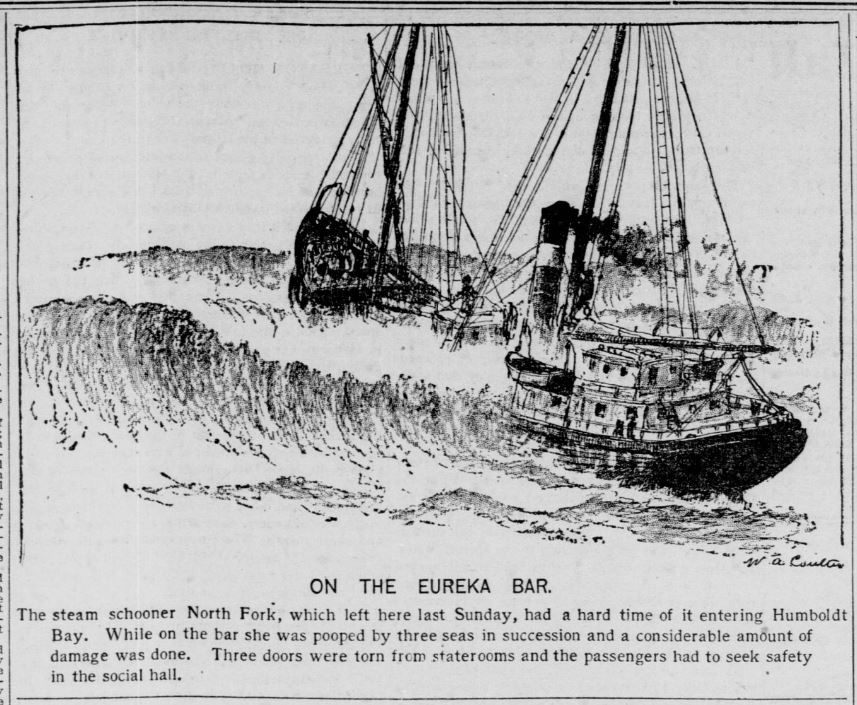
William A Coulter did many maritime drawings for the San Francisco Call. In late 1897, there was a great shortage of suitable ships to take adventurers to the Klondike Gold Rush.
HUNDREDS
CROWD THE
STEAMERS
Even a Collier Is Now Being
Pressed Into the
Service.
THE CLEVELAND HUSTLES OFF
OVERLOADED.
Transportation Utterly Inadequate to the
Rush -- A Digest of the Dominion
Mining Laws -- Reindeer Too.
So great is the rush from here to the Yukon that loaded colliers are being hustled on their way that they may be unloaded in time to help carry the horde that has overrun every available means of transportation.
The hegira from San Francisco can now be measured, in spite of the universal advice to wait until spring. A great majority of those who really intend to go have decided to be wise after this manner, but those who are going anyway from this port and from Seattle have filled every regular and special steamer on the ocean highway to the northern coast, and the surplus of passengers is causing almost hysterical efforts to secure and provide transportation.
The uttermost limit of passenger transportation via St. Michaels and the Yukon River having been quickly reached days ago the Juneau route absorbs intention. The steamer Cleveland, especially chartered for the Northwestern Transportation Company to make a trip to St. Michaels, left last night with 52 passengers from here, and many were refused passage, as 150 are waiting at Seattle for the steamer. The passengers will have to sleep any way, packed like sardines, but nobody cares -- not yet.
The Pacific Coast Steamship Company, finding its regular steamer and its special one from San Francisco and Portland utterly inadequate, has arranged to send to Juneau the steamer Willamette, en route here with coal. Two steam schooners are about ready to go, and all sorts of vessels are being looked up for possible special engagement for parties to Juneau.
There was a great trade rush in Alaskan outfits and a band of pack mules is being shipped to Juneau.
One of the interesting developments is that Sheldon Jackson is sending a lot of reindeer into the Yukon country from the Government reindeer stations on the coast, to see how they are adapted to the needs of the mining population.
RUSH FOR JUNEAU.
"I'll give you $25 advance on your ticket," was the proposition made again and again to passengers who had been fortunate enough to secure passage to Dawson City, via St. Michaels, on the steamer Cleveland yesterday.
The steamer has been chartered by Schwabacher & Co. of Seattle and will connect with the steamers of the North American Transportation Company at St. Michael. Every inch of space on the vessel has been sold and the chances are that onjy the officers will come back on the vessel, as the deckhands, cabin-boys and firemen will make a bee line for Klonkyke (sic -- JT) as soon as the Cleveland reaches the mouth of the Yukon.
"I say, mister; I'll give you $100 over and above your expenses and buy your kit if you give me your ticket to Dawson City," was the despairing wail of what looked to be a '49er, as he pulled out a small cotton bag from his hip pocket and counted out the shining twenties.
"No, no, father," said the young man to whom th» offer was made. "You stay at home. You've done your share of the work. Now stay at home and let us youngsters take our chances. No, father, I won't take $500 for my chance of having to beat my way back to San Francisco."
On her regular trips between San Francisco and Puget Sound ports the Cleveland has accommodation for from sixty to eighty passengers. These figures include both cabin and steerage passengers. On this occasion the steamer went out with 52 miners from this port and 150 more are to join her at Seattle. The information that this big crowd was waiting transportation was received by the agents here late in the afternoon, and it was found necessary to delay the departure of the vessel to lay in extra supplies and extra bedding.
Wagon-load after wagon-load of mattresses were sent down from the California Furniture Company, and wagon-load after wagon-load of fresh and dried fruits, canned goods and fresh meat kept pouring down until darkness fell on the scene.
Some of the room intended for passengers was absorbed, and on the starboard side of the vessel two cold-storage boxes were built. In these meats and vegetables were picked and in consequence some of the 150 booked from Seattle will have to sleep against the smokestack.
The fortunate few who have secured cabin accommodations will fare all right. In fact, as far as the commissariat part of the vessel is concerned everybody will fare well, as the larder is fully supplied and everything is of the best. Still the Cleveland is a very narrow ship and the sleeping accommodations are bound to be skimped.
Almost everything has been removed from the main deck and wherever possible a berth or hammock has been placed and so long as the miners can get a place to lay their heads they don't care as long as the steamer is headed for Dawson City.
The Umatilla, the crack boat of the Pacific Coast Steamship Company's line, leaves this morning for the sound. She connects at Port Townsend with the same company's City of Topeka, and will have on board when she leaves tne dock fully 300 passengers for Juneau. Every berth on the City of Topeka has been sold, and neither love, money nor influence can persuade Goodall, Perkins and Co. to issue another ticket. Many miners have bought tickets by tne Umatilia for Port Townsend on the off chance of netting a passage on the Topeka, but nothing but an iron-clad order from the agents here will allow anybody aboard that vessel at any of the sound ports.
Failing to secure passage on the Umatilla the crazy crowd turned their attention to the George W. Elder, which is to leave Astoria in a few days. In a few minutes every passage was gobbled up, and "the cry is, 'Still they come!'" said Agent Waters.
Late In the afternoon the agents of the steamer (Goodall, Perkins & Co.) applied to the inspectors of hulls and boilers for permission to put in bunks and provide extra accommodation. The chances are that the request will be granted, as the Elder is a thoroughly seaworthy boat, and in that event at least 100 more fortune-seekers will be able to get as far as Dyea on their way to the new El Dorado.
The agents of the Pacific Coast Steamship Company have grown weary of advising people not to try the "divide" until early next spring. All and sundry laugh at them, and think it is a bluff on the part of the company to get higher rates.
The masses will go, and that is all there is to it. If they cannot go by the regular route they will charter small boats and take their chances.
The overflow from the Umatilla, George W. Elder and Cleveland will have a chance to reach Juneau on the big steamer Willamette. The latter is now on her way here from Seattle with a cargo of coal, and on her arrival she will be worked night and day until everything has been discharged. Then she will be fitted out to carry 500 passengers, the Pacific Coast Steamship Company having chartered her to make a trip from here to Alaskan ports.
If the rush continues ihe Willamette will make another trip to Dyea with miners who will tempt their fortune in the spring. Captain Holmes is one of the most careful and experienced masters on the Pacific Coast, and what he does not know aoout the Sound and its tributaries is not worth knowing. He is a genial, whole-souled old salt, and anybody who makes a trip with him will always long to make another.
After discharging her cargo the Pacific Coast Steamship Company will put the big vessel on the berth, and will dispatch her on or about the 30th inst.
Private parties are now tne order of the day. "Teddy" Osborne of the Ferry saloon and restaurant; Geoge Birdsell, his chief assistant; George Knox Jr. and "Harry" Lang have formed a close corporation and will start at once for the Klondyke.
The side-wheeler Tiger, that for years did good service for the North Pacific Coast Railroad on the freight route, is a stanch sea boat, and more seaworthy than the H. C. Grady, now on her way here from Astoria. The chances are that she will be purchased and that a band of Sausalito boys, headed by those named, will put her in commission and start for Dawson City.
The steam schooner Noyo is to start for Dyea via Juneau next Sunday. She has accommodations for 200 passengers, and so far 150 have booked. In the event of the rush keeping up, the Bessie K will be put on the route to follow the Noyo.
Herriman & Mills, the stevedores, are figuring on sending a schooner to St. Michaels. Should tney decide upon the venture, a small steamer to carry the passengers direct to Dawson City will be taken as part of the deckload of the schooner.
The gasoline schooner Chetco is being got ready for her trip to the north. Captain Swan, who will go in command of her, says that they will have no difficulty in reaching Dawson City, and that the chances are that on the return trip she will bring the first news from the new El Dorado.
Great indignation is felt over the action of the Secretary of the Treasury in making Dyea a sub-port of entry. This action means that British vessels are now on an equal f6oting with American vessels in American waters. The Canadian Pacific Navigation Company, through its manager, Captain J. Irvine, asked permission to carry a United States customs inspector from Victoria, B. C, to Dyea. This privilege was asked for to facilitate the transportation of passengers and merchandise from British to American soil. The request was more than granted. Dyea is now a sub-port of entry and now British vessels have all the facilities and all the protection accorded an American ship in the bay of San F^ancieco. As a result of this ruling the steamer Islander will leave Victoria, B. C, on the 28th inst., for Dyea with 500 miners who would under any other circumstances have taKen an American steamer from either Seattle, Tacoma or Port Townsend.
The steamer Cleveland left last night at half-past 10. Among the passengers on board bound for the goldfieids were: George Pulver, W. Westlake, R. J. Nickson, C. F. Jensen, H. Jensen, L. Jensen, E. P. Harrison, L. Lampart, H. Williams, J. Goslair, A. W. Latle, W. Gill, J. Golding, M. Jacobs, J. Jensen, W. Faulkes, A. M. Strangher, J. M. Fairchild, William Ready, P. Girarde, J. Walch, B. A. Ericksen, E. Andersen, H. Osborn, H. Regan.
THE DASH TO DAWSON.
People May Go if They Will but
Wait for Their Turn at a
Steamer.
Umatilla .............. July 25
State of California ... July 27
City of Puebla ........ July 28
All connecting for Juneau.
The demand for passage to the Klondyke has not abated in the least, and the transportation companies are deluged with inquiries as to the time boats leave, when they are expected to reach Alaska, the fare, and innumerable other questions more difficult to answer, such as: "Do you think it advisable to go?" "Will it pay?" "With my constitution will I be able to stand it?" All this when every berth in every boat booked to leave is taken, and there is absolutely no chance to get a passage on any of them.
The Pacific Coast Steamship Company has three boats which will leave for the North within the next week. This morning the Umatilla sails for Port Townsend, where she will connect with the City of Topeka, which leaves for Juneau July 28.
She carries 200 passengers and is taxed to her utmost capacity.
On the 27th the State of California takes 250 passengers to Portland for the special Alaska steamer George W. Elder. The City of Puebla, leaving here July 30 for the Sound, meets the Al-Ki, whicn departs for Juneau and Dyea about August 2. She is built for 220 passengers and the list is full already.
The company has several boats in drydock which are beinp overhauled with the intention of putting them in shape to make the trip to Alaska. It is not known when they will be in condition to start.
Every mail brines letters from all over the country asking for particulars. Telegrams have been received from Tennessee, Texas, New York and Arizona. A New York man wired the Pacitic Coast Steamship Company to save him a berth. A woman writes to know the elevation and population of Juneau and if it is advisable for a healthy woman to make the trip. Here is a letter received from a doctor:
Can you tell me what the chances are for a first-class physician and surgeon in the interior of Alaska? Also, how many doctors there are in Juneau?
When will the next steamer leave and what is ihe fare?
One man is negotiating with the company to take ten goats with him, while quite a number are going to take dogs to draw sleds, though it is claimed that dogs not used to the climate would be useless in the north.
At the offices of the Alaska Commercial Company inquiries for passage have almost ceased, us it is now generally understood that there are no more tickets to be sold for the Excelsior. The company will not give out the exact number of people to go in its boat, but there will be in the neighborhood of one hundred, exclusive of newspaper correspondents. The Excelsior is being loaded now with the provisions to be taken up to the company's stores, and they will be ail on board by Tuesday.
This is the only boat the Alaska Company will send up this season that will carry passengers. The Bertha will probably start for St. Michael next Saturday, but will take passengers only as far as Unalaska. The reason for not taking them through to St. Michael is that it is feared connections could not be made with the bouts for up the river.
The unfortunate ones who have the gold fever but were too late to secure passage on tne boats are offering those who secured passage a great deal more for their tickets than they originally cost the owner. None of the lucky ones, however, seem disposed to give up heir berths even at the large premiums offered.
They have their minds made up to go to Alaska, and are gone. In case one of them should desire to make a transfer of his ticket it would not be permitted by the companies.
THE WHITE PASS TRAIL.
Work on a New Road Over the
Range Is Already Well Under
Way.
This is the White Pass route. A company is building a trail that is a toll road over this pass a little souih of Chilkoot Pass and the progress was recently thus reported by the Alaska Mining Record:
George Rice returned Monday from an extended exploration trip on the White Pass. He reports eighteen men at work on the trnil, and making good progress, the trail being completed tor about half the distauce to the summit. When completed it will be possible to ride a horse with ease, without dismounting, over the entire distance from Skagua wharf to the lakes. Mr. Rice is of the opinion that practically the entire travel to the Yukon next year will be over this pass, as from personal observation it seems to be the only natural outlet from the Yukon Valley.
From information gained through Mr. Rice's labors the company now operating on that route has changed its course in some respects from that originally selected.
K. K. Billinghurst, who came down a few days ago from Skagua, says that when this trail is completed the Yukoner may sleigh his outfit over every foot of the way with very little doubling on the route. It is expected that the work will be completed by the 1st of September.
THESE HAVE GOT IT.
The Gold Fever Has Seized a
Number of People Across the
bay.
OAKLAND, Cal., July 24. -- J. D. Garfield and W. E Knowles will leave for Seattle to-morrow and will go from there to Juneau by vessel, taking the overland route to the Klondyke. The family of the former remain at their home in East Oakland. Mr. Knowles is an old associate of Clarence Berry and lived at Selma. Quite a party from that place and Fresno will go up, with instructions from Mr. Berry as to points and locations.
Lisle McKee of this city will go with this party.
Dr. J. M. Shannon had made up his mind to go and had made all his arrangements to transfer his practice, but Mrs. Shannon protested, and the doctor has decided that he will stay at home.
At West Oakland there is considerable talk among tne railroad men and it is announced that Engineer Sloman Small, son of tbe late Hank Small, intends to go to Alaska.
W. M. Rank, late superintendent of the Alameda electric road, is going up to Alaska next week as the agent of a local syndicate which will invest in that region. It is said that Mr. Rank is to remain a year at least and that he will develop mines and be prepared to engage in commercial enterprises in which there may be a prospect of profits. A number of local capitalists are said to be interested in the syndicate which Mr. Rank is to represent.
O. A. Lane, the well-known real-estate man, is convinced that there is any amount of money in the venture. He wants to take a party north with him, and for this purpose he is looking for a steamer that he can charter and run a transportation business.
"I am going as soon as I can organize a party," said Mr. Lane, "and I am certain there is good money in it. I have been hunting for a steamer and as soon as I find one it will be filled in a few hours. Thpre is an enormous demand for passages to the north, and everybody seems to have enough money to pay a fancy price to make the trip."
Pat Eckles of Emeryville, who is now in camp with the Fifth Regiment at Santa Cruz, has been intending to return to Alaska soon. The strike at Dawson will hasten his return. Eckles has had considerable experience in the far north.
Harry Troy, son of J. H. Troy, who has been associated with his father in the insurance business, will try his fortunes in the Klondyke. He will go up with a party of six, to start on Thursday, and was in San Francisco to-day purchasing supplies. He will go up to the Sound by rail, thence to Juneau by vessel, and take the overland route to the Yukon.
MINING METHODS.
How They Get the Klondyke Gold
In Midwinter.
The mining methods of the Klondyke are very strange and are adapted to peculiar conditions. There the pay gravel happens to lie several feet below the mucky beds of the creeks and must be mined out. At nearly all the other Yukon placers ranged along the river for 300 miles the gold is in suriace gravel. In these diggings little or nothing can be done except from about June 15 to Septemoer 1, when the water runs.
On the Klondyke the running water prevents mining out the gravel under the creek beds, and so it is all taken out during the months when everything is frozen solid, and when the icy chains break in the short summer the gravel that has been mined is quickly sluiced and the gold cleaned up. Prospecting consists of sinking a shaft to bedrock by the creek by thawing the ground with fires and digging it out. When the bottom is reached the prospector knows more than he did before. If a pan of bottom gravel washed out with water from meited ice shows up rich the claim is worked by tunneling in.
In doing this dry wood is piled against the face of the drift and then other pieces are thickly set slantwise over them. As the fire burns gravel falls down from above and gradually covers the slanting shield of wood. The fire smolders away and becomes a charcoal-burning. It is when it reaches this confined stage during the night that its heat is most effective against the face of the drift. Next day the miner finds the face of his drift thawed out for a distance of from ten to eighteen inches, according to conditions. He shovels out the dirt and if only a part is pay dirt he puts only that on his dump. Thus, at the rate of a few inches a day, the drifting out of the precious gravel goes on with the long winter.
The descriptions by the returned miners show that a hitherto unnoticed peculiarity exists. While much of the gravel just above bedrock is wonderfully rich, the bedrock itself is the richest depository. The bedrock appears to be everywhere cracked and broken up, though evidently yet "in place."
It is thus full of crevices and interstices filled with a clayey gravel, and it is these crevices which yield most richly. "Crevicing" is familiar to all placer miners, but this is something strange. There is here a phenomenal multiplication of crevices in bedrock, and they are described as often extending downward several feet.
No specimens of the rock appear to have been brought down, and there is no reliable identification of the rock. This bedrock is so greatly broKen up in the way described that no blasting is necessary. It is ensily removed with picks and it is simply thrown on the dumps, to be sluiced as the gravel is.
The gold is so concentrated in the crevices sticks to the clinging gravel and clay, and is in the residue, which is shoveled out, too, of course.
No one has given the slightest description of the fields as a mining engineer would like to hear it. Inquiry as to whether any "mining expert" had been heard of In the Yukon elicited the reply:
'Yes; there is a fellow up there who pretends to know a lot. I believe. That's 'Swift- Water Bill.' I don't know his other name."
PERILS AWAIT THEM.
Dr. Kierulff of Berkeley Says That
Klondyke Gold-Seekers Have
Much to Contend With.
BERKELEY, Cal., July 24 -- Dr. H. N. Kierulff of Berkeley, who claims to be thoroughly familiar with the Klondyke region., having spent two years in Alaska as surgeon of the United States Alaskan Boundary Commission, advises no one to go there unless he has plenty of suitable clothing and provisions as well as $500 or so in cash upon arrival. In addition he says that it would be the height of folly for a man to attempt the trip unless in sound health and in every way able to withstand the rigor of an Arctic winter. Those who disreuard these warnings, he declares, will surely come to grief.
Rank Is Going.
ALAMEDA, Cal, July 24. -- The latest man to fall a victim to the prevailing Klondyke epidemic is W. M. Rank, president of the electric railway. It is said that a syndicate of capitalists has been formed which nas engaged Mr. Rank to go to the Klondyke as their representative and engage in the mining business. Many others here are catching the fever, and only lack of means prevents a large number of young men from starting for the diggings.
Yukon Mining; Will Be Only Fun When the Reindeer Come.
 |
| San Francisco Call, 25-July-1897 |
Uncle Sam is going to send a lot of reindeer into the Yukon country, to see if they would help the miners out, and as likely as not the Yukoners will be skipping about the Arctic circle making calls and hauling gold dust and provisions by the picturesque and speedy method here depicted. There seems to be no reason why the reindeer would not be as great a blessing in the Yukon region as in Lapland and Eastern Siberia.
The news of this enterprising experiment comes from Juneau in connection with the reports of Dr. Sheldon Jackson's doings. Sheldon Jackson, who has become famous through his many years of labor in Alaska, has been appointed United States Commissioner of Education for Alaska, and has also been appointed a special agent to investigate the agricultural possibilities of the Yukon Valley and the interior of Alaska generally. He has just gone into the interior. Before going he secured material for sledges to take along and arranged to have thirty or forty reindeer sent from the reindeer stations on tne upper coast of the Yukon River. Those sent will be broken to harness, and this winter the experiment of what they would do for the civilization of the mining region will be tried. When he returns from the Yukon he will visit the reinder stations in the revenue cutter Bear, and will later make another trip to Siberia for more reindeer at Government expense.
It was Sheldon Jackson who conceived the idea of populating Alaska with reindeer for the benefit of the natives, to whom the animals will be food, clothing, transportation and wealth when they multiply sufficiently and the natives learn their use and value. Three or four quite large herds have been brought from the Siberian coast and are now carefully bred and cared for by native Laplanders at three stations.
MINING LAWS OF THE KLONDYKE
Useful Information for Prospective Travelers in the Yukon Gold Fields -- How to Locate
and Hold Claims.
Below will be found a comprehensive digest of the Canadian laws particularly pertinent to mining in the Klondyke country. Mining operations in that region are not, as is popularly supposed, subject to the regulations of the province of British Columbia, but to the general laws of ths Dominion.
On the American side, in Alaska, mining operations are subject only to United States mining laws and the general laws of the State of Oregon as they existed in 1884 when the law providing a civil government for Alaska was passed. This law provided "that the general laws of the State of Oregon now in force are hereby declared to be the law in said district, so far as the same be applicable and not in conflict with the provisions of this act or the laws of the United States"; hence the laws of Oregon in force May 17, 1884, are the laws of Alaska.
On the wild frontiers of Alaska, however, little attention has ever been paid to the literal provisions of laws of any kind, and mining has been carried on in a primitive and independent manner.
PLACER MINING.
Nature and Size of Claims.
For "Bar Diggings" A strip of land 100 feet wide at high-water mark and thence extending into the river at its lowest water level.
For "Dry Diggings" -- One hundred feet square.
For "Creek and River Claims" -- Five hundred feet along the direction of the
stream, extending in width from base to base of the hill or bench on either side.
The width of such claims, however, is limited to 600 feet when the benches are a
greater distance apart than that. In such a case claims are laid out in areas of
ten acres with boundaries running north and south, east and west.
For "Bench Claims" -- One hundred feet square.
Size of claims to discoverers or parties of discoverers:
To one discoverer, 300 feet in lengtn; to a party of two, 600 feet in length; to a party of three, 800 feet in length; to a party of four, 1000 feet in length; to a party of more than four, ordinary sized claim only.
New strata of auriferous gravel in a locality where claims are abandoned, or dry diggings discovered in the vicinity of bar diggings, or vice versa, shall be deemed new mines.
Entries of grants for placer mining must be renewed and entry fee paid every year.
No miner shall receive more than one claim in the same locality, but may hold any number of claims by purchase, and any number of miners may unite to work their claims in common, provided an agreement be duly registered and a registration fee of $5 be duly paid therefor.
Claims may be mortgaged or disposed of provided such disposal be registered and a registration fee of $2 be paid therefor.
Although miners shall have exclusive right of entry upon their claims for the "miner-like" working of them, holders of adjacent claims shall be granted such right of entry thereon as may seem reasonable to the superintendent of mines.
Each miner shali be entitled to so much of the water not previously appropriated flowing through or past his claim as the superintendent of mines shall deem necessary to work it, and shall be entitled to drain his own claim free of charge.
Claims remaining unworked on working days for seventy-two hours are deemed abandoned, unless sickness or other reasonable cause is shown or unless the grantee is absent on leave.
For the convenience of miners on back claims, on benches or slopes, permission may be granted by the superintendent of mines to tunnel through claims fronting on watercourses.
In case of the death of a miner the provisions of abandonment do not apply during his last illness or after his decease.
Acquisition of Mining Locations.
Marking of Locations -- Wooden posts, four inches square, driven eighteen inches into the ground and projecting eighteen inches above it, must mark the four corners of a location. In rocky ground, stone mounds three feet in diameter may be piled about the post. In timbered land, well-blazed lines must join the posts. In rolling or uneven localities, flattened posts must be placed at intervals along the lines to mark them, so that subsequent explorers shall have no trouble in tracing such lines. When locations are bounded by lines running north and south, east and west, the stake at the northeast corner shall be marked by a cutting instrument or by colored chalk, "M.L. No. 1" (mining location, stake number 1). Likewise the southeasterly stake shall be marked "M.L. No. 2," the southwesterly "M.L. No. 3" and the northwesterly "M.L. No. 4." "Where the boundary lines do not run north and south, east and west, the northerly stake shall be marked 1, the easterly 2, the southerly 3, and the westerly 4. On each post shall be marked also the claimant's initials and the distance to the next post.
Application and Affidavit of Discoverer -- Within sixty days after marking his location, the claimant shall file in the office of the Dominion Land Office for the district a formal declaration, sworn to before the land agent, describing as nearly as may be the locality and dimensions of the location. With such declaration he must pay the agent an entry fee of $5.
Receipt Issued to Discoverer -- Upon such payment the agent shall grant a receipt authorizing the claimant, or his legal representative, to enter into possession, subject to renewal every year, for five years, provided that in these five years $100 shall be expended on ths claim in actual mining operations. A detailed statement of such expenditure must also be filed with the agent of Dominion lands, in the form of an affidavit corroborated by two reliable and disinterested witnesses.
Annual Renewal of Location Certificate -- Upon payment of the $5 fee therefor, a receipt shall be issued entitling the claimant to hold the location for another year.
Working in Partnership -- Any party of four or less neighboring miners, within three months after entering, may, upon being authorized by the agent, make upon any one of such locations, during the first and second years but not subsequently, the expenditure otherwise required on each of the locations. An agreement, however, accompanied by a fee of $5, must be filed with the agent. Provided, however, that the expenditure made upon any one location shall not be applicable in any manner or for any purpose to any other location.
Purchase of Location -- At any time before the expiration of five years from date of entry a claimant may purchase a location upon filing with the agent proof that he has expended $500 in actual mining operations on the claim and complied with all other prescribed regulations. The price of a mining location shall be $5 per acre, cash.
On making an application to purchase the claimant must deposit with the agent $50, to be deemed at payment to the Government for the survey of his location. On receipt of plans and field notes and approval by the Surveyor-General a patent shall issue to the claimant.
Reversion of Title -- Failure of a claimant to prove within each year the expenditure prescribed, or failure to pay the agent the full cash price, shall cause the claimant's right to lapse and the location to revert to the crown, along with the improvements upon it.
Rival Claimants -- When two or more persons claim the same location the right to acquire it shall be in him who can prove he was the first to discover the mineral deposit involved, and to take possession in the prescribed manner. Priority of discovery alone, however, shall not give the right to acquire. A subsequent discoverer, who has complied with other prescribed conditions, shall take precedence over a prior discoverer who has failed so to comply.
When a claimant has, in bad faith, used the prior discovery of another and has fraudulently affirmed that he made independent discovery and demarcation, he shall, apart from other legal consequences, have no claim, forfeit his deposit and be absolutely debarred from obtaining another location.
Rival Applicants -- Where there are two or more applicants for a mining location, neither of whom is the original discoverer, the Minister of the Interior may invite competitive tenders or put it up for public auction, as he sees fit.
Transfer of Mining Rights.
Assignment of Right to Purchase -- An assignment of the right to purchase a location shall be indorsed on the back of the receipt or certificate of assignment, and execution thereof witnessed by two disinterested witnesses. Upon the deposit of such receipt in the office of the land agent, accompanied by a registration fee of $2, the agent shall give the assignee a certificate entitling him to all the rights of the original discoverer. By complying with the prescribed regulations such assignee becomes entitled to purchase the location.
Regulations in respect to placer mining, so far as they relate to entries, entry fees, assignments, marking of locations, agents' receipts, etc., except where otherwise provided, apply also to quartz mining.
Nature and Size of Claims.
A location shall not exceed the following dimensions: Length 1500 feet, breadth 600 feet. The surface boundaries shall be from straight parallel lines and its boundaries beneath the surface the planes of these lines.
Limit to Number of Locations.
Not more than one mining location shall be granted to any one individual claimant upon the same lode or vein.
For "Bench Claims" -- One hundred feet square.
Size of claims to discoverers or parties of discoverers:
To one discoverer, 300 feet in lengtn; to a party of two, 600 feet in length; to a party of three, 800 feet in length; to a party of four, 1000 feet in length; to a party of more than four, ordinary sized claim only.
New strata of auriferous gravel in a locality where claims are abandoned, or dry diggings discovered in the vicinity of bar diggings, or vice versa, shall be deemed new mines.
Rights and Duties of Miners.
Entries of grants for placer mining must be renewed and entry fee paid every year.
No miner shall receive more than one claim in the same locality, but may hold any number of claims by purchase, and any number of miners may unite to work their claims in common, provided an agreement be duly registered and a registration fee of $5 be duly paid therefor.
Claims may be mortgaged or disposed of provided such disposal be registered and a registration fee of $2 be paid therefor.
Although miners shall have exclusive right of entry upon their claims for the "miner-like" working of them, holders of adjacent claims shall be granted such right of entry thereon as may seem reasonable to the superintendent of mines.
Each miner shali be entitled to so much of the water not previously appropriated flowing through or past his claim as the superintendent of mines shall deem necessary to work it, and shall be entitled to drain his own claim free of charge.
Claims remaining unworked on working days for seventy-two hours are deemed abandoned, unless sickness or other reasonable cause is shown or unless the grantee is absent on leave.
For the convenience of miners on back claims, on benches or slopes, permission may be granted by the superintendent of mines to tunnel through claims fronting on watercourses.
In case of the death of a miner the provisions of abandonment do not apply during his last illness or after his decease.
Acquisition of Mining Locations.
Marking of Locations -- Wooden posts, four inches square, driven eighteen inches into the ground and projecting eighteen inches above it, must mark the four corners of a location. In rocky ground, stone mounds three feet in diameter may be piled about the post. In timbered land, well-blazed lines must join the posts. In rolling or uneven localities, flattened posts must be placed at intervals along the lines to mark them, so that subsequent explorers shall have no trouble in tracing such lines. When locations are bounded by lines running north and south, east and west, the stake at the northeast corner shall be marked by a cutting instrument or by colored chalk, "M.L. No. 1" (mining location, stake number 1). Likewise the southeasterly stake shall be marked "M.L. No. 2," the southwesterly "M.L. No. 3" and the northwesterly "M.L. No. 4." "Where the boundary lines do not run north and south, east and west, the northerly stake shall be marked 1, the easterly 2, the southerly 3, and the westerly 4. On each post shall be marked also the claimant's initials and the distance to the next post.
Application and Affidavit of Discoverer -- Within sixty days after marking his location, the claimant shall file in the office of the Dominion Land Office for the district a formal declaration, sworn to before the land agent, describing as nearly as may be the locality and dimensions of the location. With such declaration he must pay the agent an entry fee of $5.
Receipt Issued to Discoverer -- Upon such payment the agent shall grant a receipt authorizing the claimant, or his legal representative, to enter into possession, subject to renewal every year, for five years, provided that in these five years $100 shall be expended on ths claim in actual mining operations. A detailed statement of such expenditure must also be filed with the agent of Dominion lands, in the form of an affidavit corroborated by two reliable and disinterested witnesses.
Annual Renewal of Location Certificate -- Upon payment of the $5 fee therefor, a receipt shall be issued entitling the claimant to hold the location for another year.
Working in Partnership -- Any party of four or less neighboring miners, within three months after entering, may, upon being authorized by the agent, make upon any one of such locations, during the first and second years but not subsequently, the expenditure otherwise required on each of the locations. An agreement, however, accompanied by a fee of $5, must be filed with the agent. Provided, however, that the expenditure made upon any one location shall not be applicable in any manner or for any purpose to any other location.
Purchase of Location -- At any time before the expiration of five years from date of entry a claimant may purchase a location upon filing with the agent proof that he has expended $500 in actual mining operations on the claim and complied with all other prescribed regulations. The price of a mining location shall be $5 per acre, cash.
On making an application to purchase the claimant must deposit with the agent $50, to be deemed at payment to the Government for the survey of his location. On receipt of plans and field notes and approval by the Surveyor-General a patent shall issue to the claimant.
Reversion of Title -- Failure of a claimant to prove within each year the expenditure prescribed, or failure to pay the agent the full cash price, shall cause the claimant's right to lapse and the location to revert to the crown, along with the improvements upon it.
Rival Claimants -- When two or more persons claim the same location the right to acquire it shall be in him who can prove he was the first to discover the mineral deposit involved, and to take possession in the prescribed manner. Priority of discovery alone, however, shall not give the right to acquire. A subsequent discoverer, who has complied with other prescribed conditions, shall take precedence over a prior discoverer who has failed so to comply.
When a claimant has, in bad faith, used the prior discovery of another and has fraudulently affirmed that he made independent discovery and demarcation, he shall, apart from other legal consequences, have no claim, forfeit his deposit and be absolutely debarred from obtaining another location.
Rival Applicants -- Where there are two or more applicants for a mining location, neither of whom is the original discoverer, the Minister of the Interior may invite competitive tenders or put it up for public auction, as he sees fit.
Transfer of Mining Rights.
Assignment of Right to Purchase -- An assignment of the right to purchase a location shall be indorsed on the back of the receipt or certificate of assignment, and execution thereof witnessed by two disinterested witnesses. Upon the deposit of such receipt in the office of the land agent, accompanied by a registration fee of $2, the agent shall give the assignee a certificate entitling him to all the rights of the original discoverer. By complying with the prescribed regulations such assignee becomes entitled to purchase the location.
QUARTZ MINING.
Regulations in respect to placer mining, so far as they relate to entries, entry fees, assignments, marking of locations, agents' receipts, etc., except where otherwise provided, apply also to quartz mining.
Nature and Size of Claims.
A location shall not exceed the following dimensions: Length 1500 feet, breadth 600 feet. The surface boundaries shall be from straight parallel lines and its boundaries beneath the surface the planes of these lines.
Limit to Number of Locations.
Not more than one mining location shall be granted to any one individual claimant upon the same lode or vein.
Mill Sites.
Land used for milling purposes may be applied for and patented, either in connection with or separate from a mining location, and may be held in addition to a mining location, provided such additional land shall in no case exceed five acres.
GENERAL PROVISIONS.
Decision of Disputes.
The Superintendent of Mines shall have power to hear and determine all dis putes in regard to mining property arising within his district, subject to appeal by either of the parties to the Commissioner of Dominion Lands.
Leave of Absence.
Each holder of a mining location shall be entitled to be absent and suspend work on his diggings during the "close" season, which "close" season shall be declared by the agent in each district, under instructions from the Minister of the Interior.
The agent may grant a leave of absence pending the decision of any dispute before him.
Any miner is entitled to a year's leave of absence upon proving expenditure of not less than $200 without any reasonable return of gold.
The time occupied by a locator in going to and returning from the office of the agent or of the superintendent of mines shall not count against him.
Additional Locations.
The Minister of the Interior may grant to a person actually developing a location an adjoining location equal in size, provided it be shown to the Minister's satisfaction that the vein being worked will probably extend beyond the boundaries of the original location.
Forfeiture.
In event of the breach of the regulations, a right or grant shall be absolutely forfeited, and the offending party shall be incapable of subsequently acquiring similar rights, except by special permission by the Minister of the Interior.
 |
| San Francisco Call, 25-July-1897 |