Showing posts with label phonograph. Show all posts

Wednesday, February 3, 2016

Race Records -- February 3, 2016

Talking Machine World, March, 1928

Okeh made many records aimed at minority groups.  These were often referred to as "race records."  Jazz and blues artists Louis Armstrong and Victoria Spivey made many records for the company.  Okeh also produced dance records and operatic records.


Texas Alexander was a guitar playing blues singer.


I can't find much about Blue Belle.  Her original name was Bessie Mae Smith.  She may have recorded using a number of names.  Here is Blind Blake's version of "Boa Constrictor Blues."


I can't find much about Mark Fisher either.  Here is organist Jesse Crawford's version of "Baby Feet Go Pitter Patter." 


Seger Ellis played the piano and sang.  His style is an acquired taste.  I haven't acquired it. 

Thursday, January 7, 2016

Clear As a Bell -- January 7, 2015

New York Tribune, 30-April-1916

The Sonora Phonograph Company was founded in New York City in 1913.  The Sonora Phonograph won a gold medal at the 1915 Panama-Pacific International Exposition in San Francisco. 

Thursday, December 3, 2015

What Shall I Give This Christmas? -- December 3, 2015

Edison Phonograph Monthly, December, 1916
Amberola was the Thomas Edison Company's name for phonographs with internal horns.  Diamond referred to the reproducer, probably the Diamond C in 1916, which played the records.  Edison Diamond records were recorded using the hill and dale method. 

Tuesday, November 3, 2015

Novel -- Entertaining -- Instructive -- November 3, 2015

Bisbee Daily Review, 19-November-1914

100 years ago, ballroom dancing was very popular.  The Columbia Phonograph Company offered Columbia Dance Instruction records for $0.75 each. 

"IMPORTANT NOTICE:

"All Columbia records will play on Victor talking machines.  Likewise all Columbia Grafanolas will play Victor records." 


Thursday, September 3, 2015

Monday, June 1, 2015

Berg Artone Portable Phonograph -- June 1, 2015

Talking Machine World, March, 1928

The Berg A. T. and S. Company (anyone know what that stands for?) made the Artone portable phonograph.  "Artone portables have been designed to sell on TONE (with long horns) and EYE VALUE!"

Sunday, February 1, 2015

Something New for Long Winter Evenings -- February 1, 2015

Saint Louis Republic, 02-December-1900
This ad touts the "New 1901 Model" of "Thomas A. Edison's Phonograph."  "Join one of our phonograph clubs." 

Wednesday, December 3, 2014

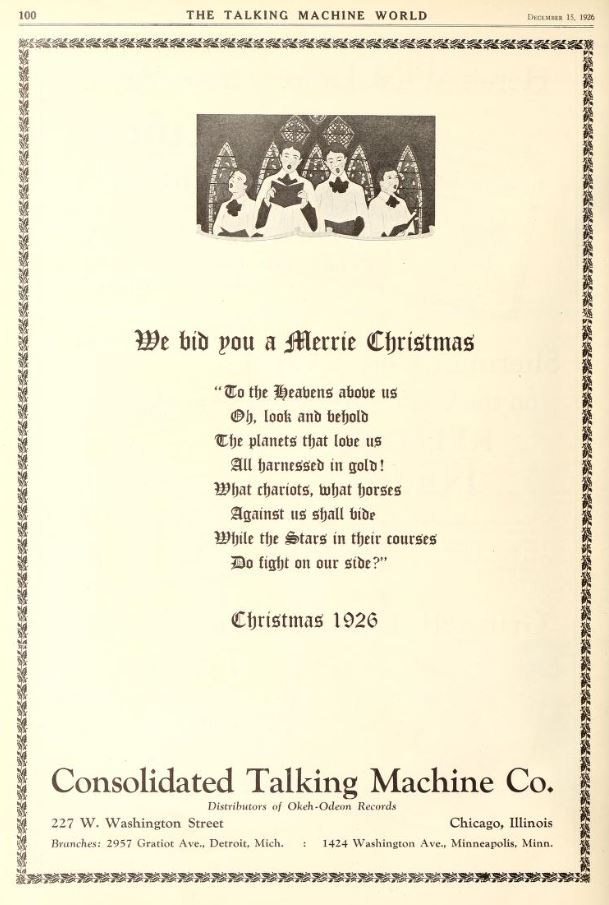
We Bid You a Merrie Christmas -- December 3, 2014

Talking Machine World, 15-December-1926

The Consolidated Talking Machine Company of Chicago bid a "Merrie Christmas" in this ad. 

Talking Machine World, 15-December-1926
In this ad from the same issue, they offered the Nifty, a $15 portable. 

Wednesday, November 12, 2014

They Know Their Jazz -- November 12, 2014

Talking Machine World, February, 1928

Okeh made many records aimed at minority groups.  Jazz and blues artists Louis Armstrong and Victoria Spivey made many records for the company.  Okeh 40966 featured Frankie Trumbauer and his Orchestra.  Trumbauer was a saxophone player who wrote, arranged and lead.  The band on this session included his friend cornetist Bix Beiderbecke.  Bix was a major figure in 1920s jazz.  He influenced many later trumpet players 

Be sure to click on this ad from Talking Machine World to see a larger version.  I like the John Held, Jr-derived images. 

Both sides of 40966 are available on YouTube:


Justin Ring was a pseudonym used by Sam Lanin.  Lanin was a popular orchestra leader who made many records during the 1920s.  His brother Lester became a famous leader in the 1930s and beyond.  The two sides of Okeh 40977 are also YouTube:


Seger Ellis played the piano and sang.  I did not look too hard to find any of the items on the two records listed.  His style is an acquired taste.  I haven't acquired it. 

Monday, October 6, 2014

Entertain Your Lumberjacks -- October 6, 2014

Canadian Forest Product Industries, 01-July-1914

"It will pay you to give your men entertainment after the day's hard work.  It will keep them cheerful and contented."  This is even better than giving them fair pay and decent working conditions. 

Thursday, September 4, 2014

The Instrument Specially Made to Play Victor and Victrola Records -- September 4, 2014


In 1906, the Victor Talking Machine Company introduced a revolutionary phonograph with an internal amplifying horn. They called it the Victrola. Victrola almost became a synonym for phonograph. Many of my older relatives called any phonograph a Victrola, just as they called a refrigerator a Frigidaire. This ad is from the January, 1920 Shadowlands.

Saturday, August 2, 2014

First and Last Word in Phonographs -- August 2, 2014


A prototype ad from the June, 1916 Edison Phonograph Monthly reminds buyers that Edison invented the phonograph.  It says the Edison Diamond Amberola "absolutely matches every human quality of the actual living voice."  The Amberola was a phonograph designed to play Edison's superior Blue Amberol cylinders with a diamond stylus. 

"The EDISON DIAMOND AMBEROLA is not a mere 'talking machine.'"  This is a dig at Edison's rival, the Victor Talking Machine Company. 

Thursday, July 3, 2014

This is the 8 Foot Horn -- July 3, 2014


This ad from the November, 1903 Edison Phonograph Monthly shows how a dealer in Utica, New York attracted attention to his shop using an 8 foot long phonograph horn.  From the July, 1903 issue:

An Advertising Horn 8 Feet 8
Inches Long With a 3 Foot 3
Inch Bell.

"Perhaps the largest advertising horn in use is the one that hangs in front of our supply house," writes E. A. Batchelor, manager of the Utica Electric and Phonograph Supply House, of Utica, N.Y.  "We use this horn and a Home Phonograph to give concerts on certain evenings during the week.  Every night that we use it the street becomes so crowded that it is hard for anyone to pass through.  This horn is made of galvanized iron and bronzed with aluminum.  It is very distinct and full of volume.  It may be easily heard above the rumbling of the street railroads and the rattling of wagons.  Any Dealer wishing to build a horn of this size may ascertain the cost of the horn and a swinging arm to hold same from the building by writing to Frank Ecker, iron pattern maker, 12 Pearl street, Utica, N.Y.  We believe this will be of great value to Phonograph Dealers who will take hold of it.  No Dealer need think this is an experiment, for it is not; it is in actual use at our store." 

In a competition with Freudian overtones, Shenandoah, Louisiana dealer DR Wilson used a 21-foot long horn to advertise his wares at the Page County Fair.  From the February, 1904 Edison Phonograph Monthly. 

Wednesday, June 4, 2014

La Nueva Victrola Ortofónica -- June 4, 2014


In 1906, the Victor Talking Machine Company introduced a revolutionary phonograph with an internal amplifying horn.  They called it the Victrola.  Victrola almost became a synonym for phonograph.  Many of my older relatives called any phonograph a Victrola, just as they called a refrigerator a Frigidaire. 

Victor started to use the trade name Orthophonic in 1925 to describe Victrolas that were designed to optimally play electrically recorded disks. 

The ad is from the February, 1927 Cine Mundial, a Spanish-language movie fan magazine published in the United States for distribution in Spain and Latin America. 

Wednesday, May 14, 2014

The Columbia Graphophone -- May 14, 2014


The original graphophone was a cylinder machine designed by Alexander Graham Bell and Charles Sumner Tainter as an improvement on Edison's phonograph.  Instead of using tinfoil wrapped around an iron cylinder, they recorded sound on a layer of wax around a cardboard core.  This produced better sound reproduction and more durable records.  The graphophone eventually became controlled by Columbia Records.  Columbia continued to use the name even after they began producing disc machines. 

This ad, from the 16-April-1905 Omaha Bee, offers a Columbia Disc Graphophone "Practically Free to Omaha Bee Readers."  Columbia Records offers "3,000 Different Selections From Grand Opera to Rag-Time." 

Thursday, April 3, 2014

Be Sure It Is a Victrola -- April 3, 2014


In 1906, the Victor Talking Machine Company introduced a revolutionary phonograph with an internal amplifying horn.  They called it the Victrola.  Victrola almost became a synonym for phonograph.  Many of my older relatives called any phonograph a Victrola, just as they called a refrigerator a Frigidaire. 

Wednesday, March 5, 2014

The Gram-o-phone Suggests Itself -- March 5, 2014


In this ad from the 27-December-1898 San Francisco Call, Sherman. Clay and Company offers a Gramophone.  Sherman. Clay and Company is a piano store founded in San Francisco in 1870, which is going out of business in May this year.  The gramophone was originally the name for devices which played flat records, like Berliner's, instead of Edison-type phonograph cylinders.  Chauncey M Depew was a famous New York corporate attorney who later became a United States Senator. 


Today is Ash Wednesday.  I went to get ashes at the old Federal Reserve Building. 

Wednesday, February 5, 2014

Did You Ever Make a Phonograph Record? -- February 5, 2014


This ad, from the 29-January-1911 New York Tribune, touts the ability of the Edison Phonograph to do home recording.  All the statements in the ad are true.  The cylinders could be recycled by shaving off a layer of wax. 

I received a cassette recorder as a birthday present when I was in the Fifth Grade, but I had been reading a lot about early phonographs, so I wanted to reproduce one.  The Scout manual had an activity for making a phonograph out of a cone of paper and a toothpick.  I found it didn't work very well and was awfully hard on the records.  Based on my reading, I used a balloon to make a diagram and stuck a needle through it so the needle projected below the bottom of the tube.  That worked better.  It inspired me to try to make records using paraffin or other waxes.  I couldn't get enough energy into the diaphragm and needle to carve a good groove. 

Be sure to click on the image to see a larger version. 

Friday, January 3, 2014

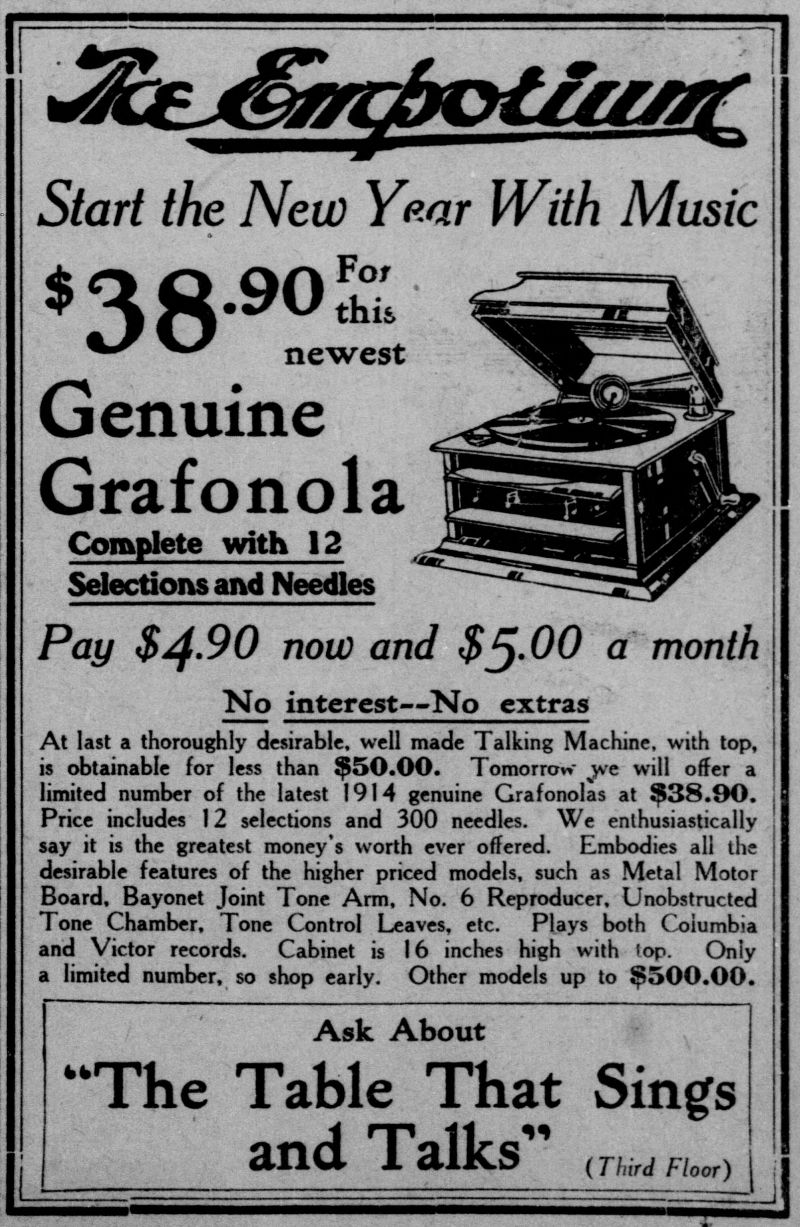
Genuine Grafonola -- January 3, 2014

This ad, from the 30-December-1913 San Francisco Call and Post, offers a limited number of Genuine Grafonolas for $38.90.  The Grafonola was the Columbia Phonograph Company's product intended to complete with the Victor Talking Machine Company's Victrola.  Both machines used an internal horn. 

"At last a thoroughly desirable, well made Talking Machine, with top, is obtainable for less than $50.00. Tomorrow we will offer a limited number of the latest 1914 genuine Grafonolas at $38.90.  Price includes 12 selections and 300 needles. We enthusiastically say it is the greatest money's worth ever offered. Embodies all the desirable features of the higher priced models, such as Metal Motor Board, Bayonet Joint Tone Arm, No. 6 Reproducer, Unobstructed Tone Chamber, Tone Control Leaves, etc. Plays both Columbia and Victor records. Cabinet is 16 inches high with top. Only a limited number, so shop early. Other models up to $500.00."

The Emporium, "The Big E," was a department store on Market Street in San Francisco.  The store opened in 1896 in the Parrott Building, which is not to be confused with the Parrott Block on Montgomery Street.  The façade was preserved when the store was demolished to make way for a Bloomingdale's.  I fondly remember the Roof Rides.