Showing posts with label IWW. Show all posts

Wednesday, March 13, 2024

Time Magazine -- Eugene O'Neill -- March 13, 2024

Time, March 17, 1924

Eugene O'Neill was a realist playwright. 

Alta California, 15-June-1884

His father, James O'Neill, spent a significant portion of his career playing Edmond Dantes, The Count of Monte Cristo. James O'Neill played the part over 6000 times between 1875 and the early Twentieth Century. He grew sick of the role and felt that it stunted his growth as an actor, but the public demanded that he play the Count.

After Eugene was expelled from Princeton, he joined the merchant marine. He fought with depression and alcoholism, but he gathered material for many of his plays. He joined the IWW's Marine Transport Workers Union.

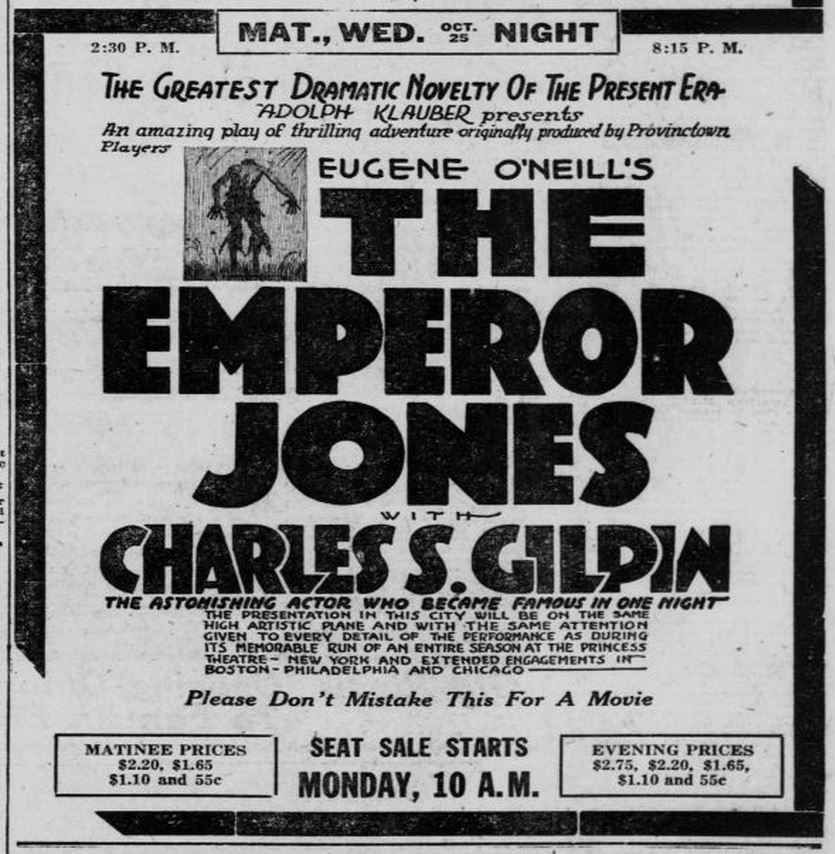
Topeka State Journal, 21-October-1922


listal.com

Struck by tuberculosis, he spent time ashore in a sanitarium. He began to write plays. He received the Nobel Prize for Literature in 1936. This gave him enough money to buy a house in Danville, California. Tao House is a national historic monument. I have never visited there.

Many of his plays were successes on stage and went on to become movies.

New York Tribune, 03-November-1921

Casper Daily Tribune, 21-December-1923

Brooklyn Daily Eagle, 16-November-1924

listal.com

Monday, February 11, 2019

Seattle General Strike of 1919 -- February 11, 2019

Seattle Star, 11-February-1919
The Seattle General Strike of 1919 started 06-February-1919. Several shipyard unions had gone on strike for better wages, including unions affiliated with the American Federation of Labor (AFL) and the Industrial Workers of the World (IWW). Shipyard owners resisted strongly and striking workers appealed to the Seattle Central Labor Council. Many other unions also went on strike.

The Strike Committee allowed some unions to work to provide food and other essential services.  The Mayor of Seattle, Ole Hanson, claimed that they were trying to take over the government, as the Soviets had done in Russia.

The general strike ended 100 years ago today, on 11-February-1919.  Even though there was no unrest or violence, Mayor Hanson brought in more and more police and soldiers.  National unions worried that the strike would hurt them.

City Speeds Up; General Strike Over

Purged of attempted Bolshevik rule, Seattle today resumes normal business, with the exception of the shipyards, where the strike is still on.

While the general strike was ordered over at noon by the conference of union leaders yesterday, the bustle and rush of the city's business district was again in evidence long before the scheduled hour.

Street cars continued in operation since Saturday afternoon, the men refusing to abide by the eleventh-hour order of the strike committee that they discontinue yesterday afternoon and remain on strike till today noon. Similarly several other unions began work Monday and Tuesday morning.

Restaurants along the downtown streets opened sharply at the stroke of noon. Cooks were back in the kitchens and the members of the Waitresses' union once more donned their aprons.

At noon Tuesday Seattle tooted its whistles and switched its civic gear into "high" agrain. as the five-day sympathetic strike of workmen came to a close.

Business did its best to make up for lost time.

Street crowds hastened to deferred shopping, thronging the avenues and the stores.

Markets, shops, groceries, theatres—places of commerce and amusement—combined to restore the interrupted social and industrial life of the harried Northwestern metropolis.

"Speed up." was the word everywhere.

This evening will see the opening of all the city's theatres and motion picture houses. A number had already operated Monday evening.

In strike circles Tuesday morning the principal topic of discussion was the action of the street car men. When the committee decided Monday that the strike end today, they stipulated that those unions already at work should again quit their jobs in order that all union men in the city might go back together.

This the street car men refused to do. A number of teamsters, however, listened to the strike committee appeal and failed to show up for work Tuesday morning, after completing their rounds Monday.

The barbers, too, steadfastly remained at their chairs, in spite of the dictates of the labor leaders. "A further strike would be of no additional benefit to organized labor," is the way the carmen expressed their opinion in a resolution.

Mayor Hanson had ordered that all municipal car employes would be considered to have relinquished their jobs if they walked out a second time. No such order went forth from the traction company headquarters, the men deciding of their own initiative that one strike was enough.

Fear that workmen who had participated in the general walkout might be discriminated against by employers, was an admittedly big actuating motive in the leaders' eleventh-hour decision for a final demonstration.

The big strike ends after five days' duration. However, the backbone of the strike was virtually broken by Saturday, after two days of the walkout. It was on Saturday morning that the strike committee gathered at the Labor temple to take up the proposition of calling the strike off.

While no date was set at that time for the return of the men to work, street cars began operation Saturday afternoon and by Sunday morning traction traffic was normal.

The strike passed off without any rioting or disturbances. The only arrests made were in connection with the distribution of Bolshevik leaflets entitled "Russia Did It."

A few restaurants were open this morning, but generally, the eating places did not seek to open for regular business till this afternoon.

The general strike has caused the city to appropriate $50,000 for men and supplies for protection and preparative purposes. It is estimated that another $50,000 appropriation will be made before the issue is finally settled. More than 3,500 emergency policemen were employed, 600 being added to the police payroll. The appointments were ratified by the city council.


WATERFRONT IS BACK TO LIFE

Waterfront activities started gradually in Seattle Monday. and were scheduled to be in full swing before Tuesday night. The first vessel to be worked wan the Pacific Steamship company's liner Alameda, which discharged several hundred boxes of fresh fish with union and non union men. The steam schooner Multnomah, of the Charles Nelson fleet, started unloading with union and non union help. Union Pacific pier officials announce they would start work independently of union longshoremen.

STRIKE STILL ON IN SHIPYARDS

J. Von Carnop, shipyard strike leader and one of the members of the Metal Trades conference committee, declared at noon today that the walkout of the shipyard workers is in nowise affected by the settlement of the general strike.

"Our status is just the same as it was before the other unions went out," Von Carnop asserted.

"The conference committee is in session thruout the day, and you can say for us that the shipyard men are still on strike."

Wednesday, February 6, 2019

Seattle General Strike of 1919 -- February 6, 2019

Seattle Star, 06-February-1919
The Seattle General Strike of 1919 started 100 years ago today, on 06-February-1919.  Several shipyard unions had gone on strike for better wages, including unions affiliated with the American Federation of Labor (AFL) and the Industrial Workers of the World (IWW).  Shipyard owners resisted strongly and striking workers appealed to the Seattle Central Labor Council. Many unions also went on strike. The general strike lasted five days. 

from the Tennessee News-Scimitar, 06-January-1919:
SEATTLE SCENE OF GENERAL STRIKE
City Virtually at Standstill as Big Walkout Is Staged.

Seattle Wash., Feb. 6. -- Seattle's general strike was called at the scheduled time, 10 a.m. today. First reports rom the downtown section said union street car men started their cars for the barns at 10 o clock, union elevators in all the large buildings abandoned their cars and restaurants closed their doors when their union cooks and waiters left.

Most of the city stores announced they would remain open as long as their stocks lasted. They will be unable to replenish them as the truck drivers are striking. Telephone operators remained at their posts, according to reports. Seattle expects to have lights tonight as the strike committee of the Central Labor council exempted the engineers in the municipal lighting plants from the strike order.

Schools may he closed because of the strike of janitors and engineers, the superintendent of schools stated. Moving picture houses will be crippled by the strike of operators.

Today's walkout was called by the Seattle Central Labor council as a sympathetic move to help shipyard workers who, numbering 25,000 struck for higher pay Jan. 21.

Thursday, November 19, 2015

Joe Hill 100 Years -- November 19, 2015


100 years ago today, on 19-November-1915, Joe Hill was murdered by the State of Utah. Joel Hägglund was born in Sweden and came to America. He worked all over the country and became an organizer for the IWW (Industrial Workers of the World). He wrote songs.

He was accused of murdering a storekeeper and his son in Salt Lake City.  He did not do it, and there was little evidence, but the state refused to listen to pleas to pardon him or change his sentence.  Hill did not fight for acquittal, wanting to serve as a martyr for the cause.  He was shot by a firing squad.  He is remembered.


Tuesday, May 1, 2012

May Day #2 -- May 1, 2012

Today is May Day. The image comes courtesy of the Walter P. Reuther Library, Wayne State University (https://www.reuther.wayne.edu/).  The 1912 Lawrence Textile Strike, the Bread and Roses Strike, was an important stage in the growth of unionism in the United States. Immigrant workers in the Lawrence, Massachusetts textile factories struck when a law capping the hours women could work in the week resulted in wage cuts for people who already could barely feed their families.

The A.F. of L. had little interest in organizing unskilled foreigners, so the Industrial Workers of the World stepped in, sending Big Bill Heywood and Elizabeth Gurley Flynn to lead a team of organizers. The Wobblies helped the strikers to gain sympathy by sending their children to other cities so they would not starve. Mill owners sent the police and the militia to stop a group of women from sending their children to Philadelphia. Photographs of police beating women, one of whom miscarried, lost any sympathy people might have had for management.

The poster decries the use of child labor in the mills and includes a quote from Bill Heywood: "The worst thief is he who steals the playtime of children."

All of this seems appropriate in light of attacks on unions by people like Wisconsin Governor Scott Walker.

Thursday, January 12, 2012

Treasures 5: The West #2 -- January 12, 2012


One of my Christmas presents was the fifth Treasures From the American Film Archives, The West.

Disc two starts with "Over Silent Paths: A Story of the American Desert," a 1910 one-reeler directed by DW Griffith for the American Biograph Company.  A wanderer in the California desert accidentally kills a prospector while robbing him.  The wanderer runs away, overcome by grief.  The prospector's daughter finds her father.  She buries him and swears vengeance over his grave.  As she drives their wagon towards town, San Fernando, she finds the wanderer lying unconscious.  She gives him water and takes him to town.  She reports the murder to the sheriff.  Rather quickly, this being a one-reeler, the daughter and the wanderer become attracted to each other.  There is a brief romantic scene by Mission San Fernando Rey de España. When the Wanderer proposes marriage, he pulls out a sack of gold. The daughter recognizes the sack as her father's. She pretends to accept his proposal, but snatches the pistol from his belt and marches him to the sheriff. Griffith could fit a lot of story into 16 minutes.

"Life on the Circle Ranch in California" was shot in 1912 in Santa Monica.  It is a documentary of ranch life, but the commentary by Donald W Reeves is careful to point out where scenes are staged, like the setting up of the camp and the fiesta after the roundup.  He is sarcastic about the scenes where people who are not cowboys try to brand a calf.

"Broncho Billy and the Schoolmistress" is a 1912 Essanay produced during the company's stay in San Rafael.  A new school marm arrives in town and all the men are interested, including Gilbert M Anderson, Broncho Billy, Augustus Carney, who played Alkali Ike in the Snakeville comedy series, and a character named Jack.  Men warn the new teacher not to go out at night to visit her students, but she pulls out a revolver and shows it to them.  They think it is too small.  The men decide for some reason to scare her by faking a robbery and they persuade Broncho Billy to be the robber.  Jack shoots him and then things are confusing and then Broncho Billy marries the teacher.  The image above shows "Broncho Bill" and Alkali Ike. It is from the 13-November-1911 Chicago Day Book.

"How the Cowboy Makes His Lariat" is part of a 1917 movie in which wild west show star Pedro León demonstrates collecting horse hair, twisting it into rope, and making a cinch.  He does not make a lariat in the surviving footage.

"Mexican Filibusters: An Incident in the Recent Uprising" is a 1911 Kalem film about Mexican Americans who are smuggling arms to revolutionaries in Mexico.  The smugglers are the heroes and the female smuggler saves the day.  There are some nice railroad scenes.

"The Better Man" is a 1912 Vitagraph one-reeler, shot in Santa Monica, about a no-good father who leaves the house to gamble while his daughter is dangerously ill.  A Mexican American horse thief breaks into the house and demands food.  The mother wants him to go for a doctor.  He tries to ignore her, but the daughter takes his hand and the mother points to an image of Mary and Jesus.  The father leaves the saloon and sees a wanted poster for the thief.  He decides to collect the reward.  The thief runs towards town and the father tries to catch him, but falls over a cliff.  The thief winds up on the father's horse.  He gets the doctor and they ride back towards the house.  The ride is intercut with the father running towards the house.  The doctor treats the little girl and the father tries to capture the thief.  The mother tells the father to let him go.  This was the other movie we raised money to preserve in the 2010 For the Love of Film Blogathon (http://cablecarguy.blogspot.com/2010/02/why-do-we-need-to-preserve-films-brief.html).  

"Ammunition Smuggling on the Mexican Border" is a unique three-reeler produced in Texas in 1914 by a former sheriff, Eugene Buck.  It tells the true story of the capture of Buck and a deputy, Candelario Ortiz, by gun runners.  Ortiz is killed by the smugglers as two posses search for them.  There are two commentaries.  One, by Martin Marks, explains the background of the movie and speculates that Buck may have made the movie to tell his side of the story because he was the star witness in the trial of the surviving smugglers, who included an American IWW member.  The other commentary talks about the musical accompaniment.  My favorite line:  "It doesn't matter where the music comes from, it matters where it is going."

"Lake Tahoe, Land of the Sky," is a 1914 documentary by Essanay.  I enjoyed seeing the steamboat and the train arriving at Truckee in a snowstorm.

Mantrap is a 1926 feature starring Clara Bow and directed by Victor Fleming.   It was a wonderful comedy.

"The Golden West" is an excerpt from a 1938 film by an unidentified amateur.  It was shot in Kodachrome and it documents a trip to Los Angeles, probably from Pennsylvania.  It shows many freakish sites, including a gas station built around a Fokker F32 airliner with rotating propellers.

I'll do Disc Three another day.

Disc One: http://cablecarguy.blogspot.com/2012/01/treasures-5-west-1-january-11-2012.html

Disc Three: http://cablecarguy.blogspot.com/2012/01/treasures-5-west-3-january-19-2012.html


Monday, September 6, 2010

Happy Labor Day #3 -- September 6, 2010

I remember in the early 1980s reading about an independent (non-Communist) labor union in Poland called Solidarity. It was influenced by Catholic social teachings. I figured they were doomed, but they persisted through persecution and martial law. They followed the One Big Union idea of the IWW. Eventually, they won. This is good to remember on Labor Day.