Showing posts with label slapstick. Show all posts

Sunday, January 12, 2014

Classic Movie History Project Blogathon -- January 12, 2014

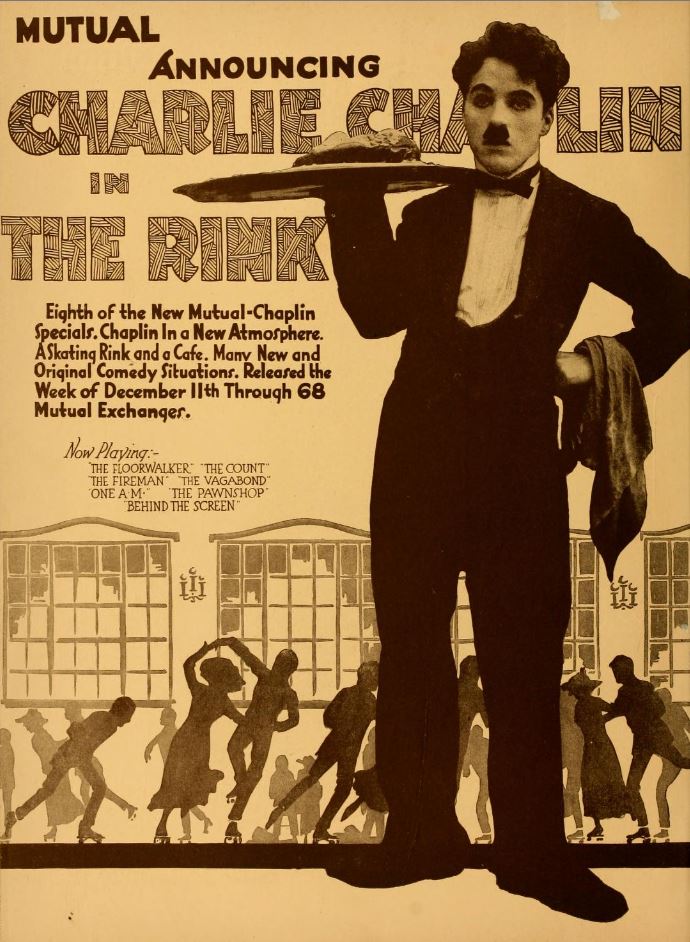
Over at my new blog, The Big V Riot Squad (http://bigvriotsquad.blogspot.com/), I am participating in the Classic Movie History Project Blogathon.  Each blogger is writing about one year between 1915 and 1950.  My entry is "1916, A Funny Year" (http://bigvriotsquad.blogspot.com/2014/01/1916-funny-year-january-12-2014.html).  I wrote about the state of slapstick in 1916.  Charlie Chaplin's first eight Mutual comedies came out in 1916.  Harold Lloyd and many others were still imitating Chaplin.  Lloyd Hamilton was appearing in Ham and Bud movies.  Oliver Hardy was in the Plump and Runt series. 

I'm looking forward to reading about every year. 

The image is from the 16-December-1916 Moving Picture Magazine. 

Friday, December 13, 2013

The Boy is There and He's a Winner -- December 13, 2013

After he left Mack Sennett, Harry Langdon's first feature on a lucrative First National contract was Tramp Tramp Tramp, the story of cross-country walking race.

This ad is from the 16-March-1926 Film Daily. It is the last of a series of cross-country ads that paralleled the race.  Here Harry arrives at the finish in Los Angeles. 

That was the last of this series of ads for Tramp Tramp Tramp, but the slapstick series will continue on my new movies-mostly blog, The Big V Riot Squad, which will premiere on 01-January-2014. 

Thursday, November 14, 2013

I Just Sent a Mormon on a Laughing Jag -- November 14, 2013

After he left Mack Sennett, Harry Langdon's first feature on a lucrative First National contract was Tramp Tramp Tramp, the story of cross-country walking race.

This ad is from the 15-March-1926 Film Daily. It is one of a series of cross-country ads to parallel the race. Here he arrives in Salt Lake City and makes a joke about a Mormon with nine wives.  Next stop, Los Angeles. 

Friday, October 18, 2013

It's the Fact That I'm a Winner -- October 18, 2013

After he left Mack Sennett, Harry Langdon's first feature on a lucrative First National contract was Tramp Tramp Tramp, the story of cross-country walking race.

 This ad is from the 14-March-1926 Film Daily. It is one of a series of cross-country ads to parallel the race. Here he arrives in Denver and stands on a mountaintop. I am missing the ad where he visited Omaha.  Next stop, Salt Lake City. 

Friday, September 20, 2013

I'll Make My Hit With the Laughs I Give -- September 20, 2013


After he left Mack Sennett, Harry Langdon's first feature on a lucrative First National contract was Tramp Tramp Tramp, the story of cross-country walking race.

 This ad is from the 10-March-1926 Film Daily. It is one of a series of cross-country ads to parallel the race. Here he arrives in Des Moines and stands among the corn. Next stop, Omaha.

Sunday, August 18, 2013

Into the Heart of the Heart of America -- August 18, 2013

After he left Mack Sennett, Harry Langdon's first feature on a lucrative First National contract was Tramp Tramp Tramp, the story of cross-country walking race.

This ad is from the 09-March-1926 Film Daily. It is one of a series of cross-country ads to parallel the race.  Here he arrives in Kansas City, "the heart of the heart of America."  Next stop, Des Moines. 

Friday, August 2, 2013

Harry Langdon, Heart Trouble in Australia #2 -- August 2, 2013


I had a request for anything about Harry Langdon's last silent feature under his lucrative First National contract.  Heart Trouble flopped at the box office and we may never know if it was any good because it is considered lost.  I remembered seeing several items in digitized Australian newspapers.  In part one, I gave some of the results, showing the progression from main feature to second feature.  Here we see it shown until 1931, even as talkies came to dominate the market.  Click on each image to see a larger version.  I found the newspapers using the Trove Project, which is digitizing more papers all the time.  I am splitting this post into two parts.  

Part One
Part Two
A review from the December, 1928 Motion Picture Magazine 


"Movie Notes" from the 08-April-1929 Grenfell Record and Lachlan District Advertiser says that in the second feature Heart Trouble, Harry Langdon "Bombs the blues with mirth."   The main feature The Red Dance is supported the second night by a movie we saw twice in part one, Almost Human.

This large ad from the 18-April-1929 Werribee Shire Banner promotes the upcoming showing of Heart Trouble and Buster Keaton's The Cameraman at the Mechanic's Palais.  There is a nice graphic for The Cameraman.  John Ford's Four Sons was coming first. Sorry I had to split it into three pieces. 

By 17-June-1929, this ad from the Hobart Mercury says that Heart Trouble was playing on the island of Tasmania.  Note the item at the bottom: "BOX PLAN OPENS TO-DAY FOR 'THE JAZZ SINGER,' the first "TALKIE"


The 09-October-1929 Townsville Daily Bulletin, from the northeast coast of Queensland, has Heart Trouble as the main feature with a Carlyle Blackwell movie.  Harry "Bombs the blues with mirth" and is described as "the frozen-faced Comedian."  I had never seen "frozen-faced" used to describe Harry Langdon.


Two days later, the 11-October-1929 Townsville Daily Bulletin reported Heart Trouble was playing at a different theater as second feature to a Hoot Gibson movie.

This article, from the 15-September-1929 Perth Sunday Times, reports that Hal Roach has announced that he will be producing one talkie comedy a week, featuring stars such as Laurel and Hardy, Charley Chase, Our Gang, and Harry Langdon. 

This article from the 24-March-1930 Northern Star of Lismore New South Wales, says that a Hal Roach talkie short featuring Harry and Thelma Todd, "Hotter than Hot" is playing with Mary Nolan's first talkie, Shanghai Lady.  This probably decreased peoples' interest in Harry's silents. 


Meanwhile, way down yonder in Tasmania, the 07-June-1930 Burnie Advocate reported that the Burnie Theatre featured film of the arrival of aviatrix (love that word) Amy Johnson, the first woman to fly solo from Great Britain to Australia, which was playing with a talkie, King Vidor's Hallelujah.  The Davenport Majestic Theatre and Town Hall played Life's Circus, which was a silent German movie called Manege according to the IMDB, along with Heart Trouble as a second feature.  I threw in the ad for Lon Chaney in West of Zanzibar for the Chaney fans. 

In Melbourne, the 26-November-1930 Argus has Heart Trouble playing second feature to an Australian movie, When the Kellys Were Out, which must have been about Ned Kelly's gang, in a kiddie show, the Regent Children's Party.  Other movies on the bill were a chapter of Tarzan the Tiger and an Oswald the Lucky Rabbit cartoon.  There was also a live show with a cowboy, a contortionist, dancing clowns, and other novelties.  I included the ad for the grown-up show, Caught Short, a talkie with Marie Dressler and Polly Moran.  That is a crappy title for a movie.

Even as late as 31-March-1931, the Northern Standard, from Darwin, Northern Territory, carried an article about Heart Trouble before a local showing.  It says that Harry Langdon "is an exponent of a type of comedy which seems particularly suited to himself and one other comedian -- Buster Keaton.  The art of gesture is one in which these two are extraordinarily versed..." 

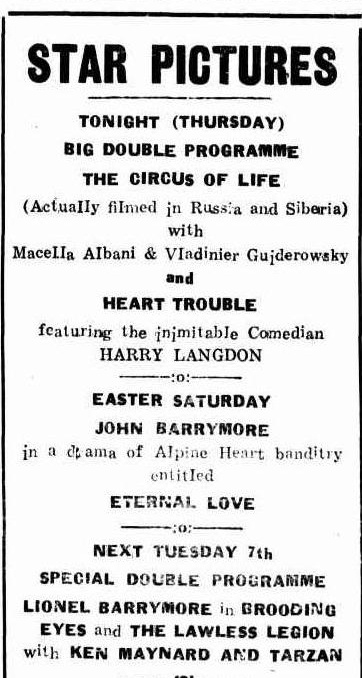
Another Darwin newspaper, the Northern Territory Times, carried an ad for a showing of Heart Trouble as second feature to what appears to be a Russian circus film, or a European circus film shot in Russia.  I couldn't identify it in the IMDB, even looking at a list of Italian diva Marcella Albani's films.

The same issue of the Northern Territory Times also carried an ad about "unusual stunts" in Heart Trouble, but doesn't describe them.

The last reference I could find to Heart Trouble was in the 18-April-1931 Adelaide Advertiser and Register as the second feature to a talkie, Ladies Love Brutes. 

At the same time that Heart Trouble was playing in Australian theaters, I found ads for most of Harry's other silent features, Tramp Tramp Tramp, The Strong Man, Long Pants, Three's a Crowd, and The Chaser.  I didn't find the Sennett feature His First Flame, but I wasn't looking for it.  Perhaps, as some writers have suggested, the Australian market, like the American, was saturated with Harry Langdon. 

Harry visited Australia in 1936 to appear in a stage production of Anything Goes. 
Thursday, August 1, 2013

Harry Langdon, Heart Trouble in Australia #1 -- August 1, 2013


I had a request for anything about Harry Langdon's last silent feature under his lucrative First National contract.  Heart Trouble flopped at the box office and we may never know if it was any good because it is considered lost.  I remembered seeing several items in digitized Australian newspapers.  Here are some of the results.  Click on each image to see a larger version.  I found the newspapers using the Trove Project, which is digitizing more papers all the time.  I split this post into two parts.  

Part One
Part Two
A review from the December, 1928 Motion Picture Magazine 


The earliest reference to Heart Trouble I found was the ad above in the 17-November-1928 Canberra Times.  "What need is an M.D. when you L.T."  L.T.?  Coming soon was a film of the 26-July-1928 heavyweight championship fight between Gene Tunney and challenger Tommy Gun Heeney, a New Zealander.  Heeney put up a good fight, but Tunney won by a TKO in the 11th.  Second feature Almost Human is a dog story.  The IMDB says Heart Trouble was released in the US on 01-October-1928, so it did not take long to reach the capital of Australia.

An article in the 30-November-1928 Perth Daily News gives more detail about the film's plot than I have seen before.  Harry belongs to a family of Germans who emigrated to America.  When America enters the war, he has to enlist, but with which country?  The article reads like a press release.  This shows that the movie had quickly traveled to the remote west coast. 

A brief item in the 01-December-1928 West Australian, from Perth, says that Heart Trouble will open at the Grand Theatre with Master of the World, which I assume is based on the Jules Verne story.  I can't find it in the Internet Movie Database (IMDB).


An ad from the same issue uses a typographical style that seems to have been common in Australian newspapers.  Items like this that repeat the name of the artist and the movie many times turn up really well in searches.  Harry "bombards the blues with bombs of merriment."  

An item from the 03-December-1928 Sydney Morning Herald New Films column is not completely positive about the movie. It says  Harry's whimsicality is "positively irritating."  "At times the picture is genuinely amusing; more often than not, however, it is inordinately dull."  The reviewer gives an Australian point of view: "American audiences may be elated to see a band of American recruits, with bugles playing, drums thumping, and flags flying, on the march in 1917, three years after the Allies had entered the Great War; but the appeal to the other countries involved may not be so pronounced." 

An ad in the 04-December-1928 Perth Daily News show Heart Trouble at the top of the bill.  

 
An ad in the 19-January-1929 Queensland Figaro shows that by the next month, Heart Trouble was on the bottom of a bill with Two Lovers, a Ronald Colman/Vilma Banky silent, and it was only there for the first half of the main feature's six-day run. The other second feature, Almost Human, was on the bottom of the bill with Heart Trouble in Canberra in November. 


This ad in the 26-March-1929 Rockhampton, Queensland Morning Bulletin, has Heart Trouble as second feature to DW Griffith's remake of his own The Battle of the Sexes. I like the ad for the main feature.  Sorry the image got split. 


This ad in the 29-March-1929 Sunshine Advocate has Heart Trouble as second feature to a William Haines silent.

I will stop here for now.  In the next installment we will see talkies arrive in Australia and Heart Trouble be shown as late as 1931. 


Sunday, July 28, 2013

Harry Langdon Heart Trouble -- July 28, 2013

I had a request for anything about Harry Langdon's last silent feature under his lucrative First National contract.  Heart Trouble flopped at the box office and we may never know if it was any good because it is considered lost.

This review, from the December, 1928 Motion Picture Magazine, is somewhat ambivalent about the movie ("What's the use of reviewing a Harry Langdon picture?"), praising it with faint damns or the other way around.

It may be ungentlemanly of me to say it, but that is not a flattering photo of leading lady Doris Dawson.

Be sure to click on the image to see a larger version.  

Wednesday, July 17, 2013

The World's Fair of 1910 Will Look Small to the Crowds I'll Draw -- July 17, 2013

After he left Mack Sennett, Harry Langdon's first feature on a lucrative First National contract was Tramp Tramp Tramp, the story of cross-country walking race.

This ad is from the 08-March-1926 Film Daily. It is one of a series of cross-country ads to parallel the race. I couldn't find one or two editions, so we have missed Indianapolis.  I'm a little confused because the 1910 World's Fair was in Brussels.  The 1904 Louisiana Purchase Exposition, a world's fair, was in Saint Louis. Kansas City, here we come. 

Monday, July 8, 2013

Walter Kerr 100 -- July 8, 2013

Walter Kerr was born 100 years ago today.  He was most famous as a theater critic and a character in his wife Jean Kerr's book Please Don't Eat the Dasies.  I remember him as the author of the book The Silent Clowns, which I first came across at the Anza Branch library.  I later bought a hardcover copy.  Kerr wrote beautifully about movies which I had seen and movies which I had not seen.  This book and Kevin Brownlow's The Parade's Gone By greatly influenced my thinking about silent movies. 

Tuesday, June 18, 2013

Flivvers Are All Right, Too, But It's Tramp-Tramp-Tramp For Mine -- June 18, 2013

After he left Mack Sennett, Harry Langdon's first feature on a lucrative First National contract was Tramp Tramp Tramp, the story of cross-country walking race.  This ad is from the 05-March-1926 Film Daily. It is the third of a series of cross-country ads to parallel the race. Yesterday he was in Pittsburgh and today he is in Detroit.  Naturally, he mentions the mass production of the Model T Ford.  Next stop, Indianapolis. Unfortunately, I couldn't find that edition, so we'll skip to Saint Louis. 

Monday, May 20, 2013

But Watch My Smoke When I Get Going -- May 20, 2013

After he left Mack Sennett, Harry Langdon's first feature on a lucrative First National contract was Tramp Tramp Tramp, the story of cross-country walking race.  This ad is from the 04-March-1926 Film Daily. It is the second of a series of cross-country ads to parallel the race. Yesterday he was in Philadelphia and today he is in Pittsburgh.  Notice that the sign leaves off the "H", which was common in the first part of the Twentieth Century.  Pittsburgh's primary features are smokestacks and pollution.  My dad remembered visiting relatives in Pittsburgh and sitting on the porch watching soot settle on the rails.  Next stop, Detroit. 

Tuesday, April 16, 2013

I'll Be Back in Philly Soon -- April 16, 2013

After he left Mack Sennett, Harry Langdon's first feature on a lucrative First National contract was Tramp Tramp Tramp, the story of cross-country walking race.  This ad is from the 03-March-1926 Film Daily. It is the beginning of a series of cross-country ads to parallel the race.  Jules Mastbaum was a Philadelphia entrepreneur and philanthropist who had founded a chain of movie theaters.  His collection of Rodin sculptures was the basis of the city's Rodin Museum.  A sign points to Harry's next stop, in Pittsburgh. 

Friday, March 15, 2013

He's Gonna Step Out in His New Suit -- March 15, 2013

After he left Mack Sennett, Harry Langdon's first feature on a lucrative First National contract was Tramp Tramp Tramp, the story of cross-country walking race.  First National started as a chain of independent theaters (note the chain in the logo). This ad is from the 01-March-1926 Film Daily. 

Monday, February 18, 2013

See Comical Charlie -- February 18, 2013

The Optic Theater in Los Angeles ran all-comedy bills for some time around 1915. I like the layout of this ad, featuring Charlie Chaplin the "The Champion."  I would be willing to pay a nickel to watch comedies from 9am to 11pm. 

The ad is from the 17-March-1915 Photoplayers' Weekly.

Wednesday, January 16, 2013

Optic Comedy -- January 16, 2013

I would like to learn more about the Optic Comedy Theater, "Charlie Chaplin Always Heading an All Comedy Bill."  I wonder how long that lasted.  The ad is from the 09-January-1915 Photoplayers' Weekly.

Tuesday, December 18, 2012

The Greatest Comedy Ever Seen -- December 18, 2012

This year we mark the 100th anniversary of the Keystone company.  Here is an ad for an early Keystone  release, a full reel of "Stolen Glory," from the 12-October-1912 Moving Picture World.Here is an example of the Keystone people taking advantage of an actual event, the GAR parade, to capture a big crowd scene. 

Sunday, November 18, 2012

The Beating He Needed -- November 18, 2012

This year we mark the 100th anniversary of the Keystone company.  Here is an ad for an early Keystone  release, a split reel of "The Beating He Needed" and "Pedro's Dilemma," from the 05-October-1912 Moving Picture World. "The Beating He Needed" sounds very enlightening: "An amusing story of an effeminate college boy who was sent West to make a man of him.  The plan failed until his father gave him the beating he needed."  Notice the actor in sheepskin chaps.  This became an indicator of a greenhorn in a western film. 

Wednesday, October 17, 2012

A Keystone Every Monday -- October 17, 2012

This year we mark the 100th anniversary of the Keystone company.  Here is an ad for Keystone's first release, a split reel of "The Water Nymph" and "Cohen Collects a Debt," from the 28-September-1912 Moving Picture World.  Most 1912 film ads did not name the performers, but this one talks about "Four Famous Comedians," Mack Sennett, Mabel Normand, Fred Mace and Ford Sterling. That's a nice photo of Mabel. 

The Giants lost the second game to the Cardinals, after a 3.5 hour rain delay.