Showing posts with label movies. Show all posts
Monday, December 31, 2012
2012 -- December 31, 2012
The Giants won the World Series. I did not have high hopes when closer Brian Wilson had to undergo his second Tommy John surgery in April, and outfielder Melky Cabrera, their most consistent hitter, got suspended in August.
The Occupy Movement has not been as active this year, but has carried on in many places. The rebellion in Syria has grown.
I have enjoyed the regular monthly series.
In January I wrote about the latest Treasures set from the National Film Preservation Foundation, Treasures From the American Film Archives, The West. I participated in a 2010 blogathon which raised money to preserve two of the short films in the set. I did my small part for the Internet Strike.
In February I stopped the monthly Benny Bufano series. I will pick it up again on an irregular basis as I photograph more of his sculptures. We celebrated the 200th birthday of Charles Dickens. San Francisco's Old Clam House celebrated its 150th birthday. SMART (Sonoma-Marin Area Rail Transit) broke ground in Petaluma.
In March I started a monthly series of railroad ads.
In April I posted a week of articles on the Titanic to commemorate the 100th anniversary of her sinking.
In May I participated in the third annual For the Love of Film blogathon: For the Love of Hitchcock. I did five articles on Hitchcock in movie industry annuals. We also celebrated the 75th anniversary of the Golden Gate Bridge.
June was an exciting month. Matt Cain pitched a perfect game against the Houston Astros on 13-June-2012. This was the first perfect game in the history of the Giants. Later in the June, the Giants swept the Dodgers in a three-game series. This was the first time they had done that.
Also in June, I revived a monthly series of photos of classic cars from the 2010 San Francisco International Auto Show.
On 24-June-2012 I celebrated the fifth anniversary of this blog.
In July I reached the fifth anniversary of the cat pictures. Three Giants were elected to start on the All Star team, Pablo Sandoval, Buster Posey and Melky Cabrera.
Also in July I revived the monthly series of pulp magazine and comic book covers.
In August, during the London Olympics, I posted a series of newspaper articles about Jim Thorpe. I resumed the Grauman's Chinese series. I also started a new series of ads for the Oz Film Manufacturing Company. Caesar's Italian Restaurant closed.
In September I moved to a new office building. I miss hearing the sirens from Station One. I talked to school kids about the topic of the DAR essay contest: unsung heroes of the Revolutionary War. We celebrated the 150th anniversary of the Preliminary Emancipation Proclamation.
Also in September, I stopped the monthly door series. I'll probably make it an irregular series. I started a short series within the slapstick series to commemorate the 100th anniversary of Keystone.
In October, the Giants won the World Series, sweeping the Detroit Tigers. I went to the parade. BART celebrated its 40th birthday, and we observed the 50th anniversary of the start of Vatican II. I stopped the monthly alley series.
In November, I was happy to see President Barack Obama get reelected. Giants catcher Buster Posey was named National League MVP. I started a new series of ferryboat photos. I attended a festival of historic vehicles that was part of the celebrations leading up to Muni's 100th birthday.
In December, the San Francisco Municipal Railway celebrated its 100th birthday. Pianist and composer Dave Brubeck died.
Among the items in the series on the Van Der Weyde family were a Scientific American obituary of Dr P. H. Van Der Weyde, an obituary of son Nicholas J Van Der Weyde, and photos by his son Henry and his grandson William. I may reduce the frequency of this series one of these months.
Inspired by the America's Cup trials, I included some images of yachts in the WA Coulter series. I'll do more in 2013.
I see I did not mention the killing of unarmed teenager Trayvon Martin in Florida. We don't know the whole story, but there is injustice there. I did mention at least a couple of the terrible mass shootings that have taken place. The NRA has helpfully suggested that the answer is more guns. Teachers should be armed. Firemen should be armed. Everyone in a movie theater should be armed. Violence begets violence. The NRA used to be a good organization that taught responsibility. It has become an agent of evil.
The image shows Texas-born actress Florine McKinney, who appeared in many movies including Horse Feathers with the 4 Marx Brothers. It comes from the wonderful site LucyWho (http://www.lucywho.com/).
Friday, September 14, 2012
The Patchwork Girl of Oz -- September 14, 2012
"The first OZ FILM (now making) will be..."
The Oz Film Manufacturing Company, located in Los Angeles, was formed in 1914 to produce movies based on stories by L Frank Baum, the creator of The Wizard of Oz. The company made some movies, but was not a financial success. The ad is from the 20-June-1914 edition of Moving Picture World. The images are by John R Neill. Be sure to click on the image to see a larger version.
"Produced under the personal supervision of the author, L. FRANK BAUM."
The Oz Film Manufacturing Company, located in Los Angeles, was formed in 1914 to produce movies based on stories by L Frank Baum, the creator of The Wizard of Oz. The company made some movies, but was not a financial success. The ad is from the 20-June-1914 edition of Moving Picture World. The images are by John R Neill. Be sure to click on the image to see a larger version.
"Produced under the personal supervision of the author, L. FRANK BAUM."
Wednesday, August 15, 2012
Nickname #17 -- August 15, 2012
William Beaudine began directing in 1915 and continued directing until 1966. I suspect that no one knows how many shorts, features and television shows he directed. Michael Medved and the other authors of The 50 Worst Films of All Time gave him the nickname "One Shot" because he was rumored to avoid retakes. This is not true. He did retakes when they were needed. I have not noticed flubbed lines in his films that I have seen.
The image is from the 1916 Motion Picture Studio and Trade Annual.
Tuesday, August 14, 2012
The Oz Film Manufacturing Company -- August 14, 2012
"...transferred direct FROM BRAIN TO SCREEN."
The Oz Film Manufacturing Company, located in Los Angeles, was formed in 1914 to produce movies based on stories by L Frank Baum, the creator of The Wizard of Oz. The company made some movies, but was not a financial success. The ad is from the 13-June-1914 edition of Moving Picture World. It's a little small, but I like the images around the edge. Some Oz fan could probably identify the artist. (UPDATE: John R Neill -- thank you, JumpingFrog) Be sure to click on the image to see a larger version.
"OZ Films are produced under the personal supervision of Mr. L. FRANK BAUM."
The Oz Film Manufacturing Company, located in Los Angeles, was formed in 1914 to produce movies based on stories by L Frank Baum, the creator of The Wizard of Oz. The company made some movies, but was not a financial success. The ad is from the 13-June-1914 edition of Moving Picture World. It's a little small, but I like the images around the edge. Some Oz fan could probably identify the artist. (UPDATE: John R Neill -- thank you, JumpingFrog) Be sure to click on the image to see a larger version.
"OZ Films are produced under the personal supervision of Mr. L. FRANK BAUM."
Sunday, July 8, 2012
Ernest Borgnine, RIP -- July 8, 2012
I was to learn that Ernest Borgnine has died. In interviews, he always sounded like a wonderful grandfather or uncle. In movies, he often played murderous villains. I first remember seeing him in reruns of McHale's Navy. Then I saw him in Emperor of the North Pole. Then The Dirty Dozen, then Marty, then Bad Day at Black Rock. I was confused about him, but I always knew he was a good actor, who wasn't afraid to open the throttle.
The poster for Emperor of the North Pole is from the wonderful site LucyWho: http://www.lucywho.com/
Monday, July 2, 2012
Won in the Clouds -- July 2, 2012
Roy Knabenshue was a pioneering American dirigible pilot and builder. He flew Tom Baldwin's California Arrow at the 1904 Saint Louis Exposition. He built an early passenger-carrying dirigible, the White City, in California in 1913. That may be the dirigible featured in this Universal film.
The ad above is from the 28-February-1914 issue of Moving Picture World. The two ads below are from the 07-March-1914 issue. Be sure to click on the images to see larger versions.
The review below is from the 03-April-1914 Washington Times. Kaffir is not a polite term.
Won In The Clouds.
(Universal.)
CECIL JAMES, an Englishman, accompanied by his daughter, Grace, is hunting big game in the wilds of Africa. One day. Bangula, a Kaffir, steals a rifle from the gunrack. When Bangula .s captured by his fellows he is saved from death by the interference of James. Out of gratitude, Bangula leads James and his daughter to the fabled diamond mine of the Kabangans. In the city of Bloemfontein, Roy Knabenshue, an American aeronaut, arrives with his dirigible balloon for the purpose of carrying agents of Bjornsen, a banker,. to the diamond mines of the interior. Knabenshue falls in love with Bjornsen's daughter. Mary. Far in the interior James and his daughter reach a Kaffir village near the diamond mine. From the fact that he smokes a pipe. James is taken to be a fire god by the natives, and meets Portuguese Jack, a renegade, who is worshiped as a fire god and virtually held a prisoner James locates the diamond mines and secures many rough diamonds. Portuguese attempts to force his attentions on Grace, and when they attempt to escape with the diamonds he reports them to the chief of the tribe. They hide the diamonds in the floor of the feast house where the Kaffiirs feed their victims to the lions, and when they finally escape they are obliged to leave the diamonds. How they enlist the American aeronaut in their attempt to recover the diamonds and the thrilling experiences they have make a series of great pictures.
Friday, June 1, 2012
The Sky Monster -- June 1, 2012
| Moving Picture World 02-May-1914 |
LZ 11, the Viktoria Luise, was a passenger-carrying Zeppelin operated by DELAG before World War One. She was requisitioned by the Germany Army during the war. The Imperator was an ocean liner operated by the Hamburg America Line (HAPAG). After the war, Cunard took her over as a war reparation and operated her as the RMS Berengaria.
http://www.silentera.com says that this film was "Originally a German drama on Zeppelins and their possible use in war; reedited and retitled and released as The Sky Monster by The Universal Film Manufacturing Company, Incorporated [Universal Special] in 1914."
The article is from the 30-May-1914 issues of Moving Picture World.
The Sky Monster (Four Parts)
Walter Johnson, a New York millionaire, decides to aid his friend and incidentally reimburse himself and secure a large wager by flying from America to Europe and return in the given period of three days.It seems that Johnson's friend, Mr Parker, is in love with a music hall star named Gerdie Belle, who has left America to appear in Europe. Johnson bets his friend $100,000 that he will have the lady in question in American within three days from the time of his departure, and accordingly arranges his dirigible, Keppelin (Zeppelin- JT) Victoria Luise, for the flight across the Atlantic. Johnson embarks, and after an uneventful flight, arrives in Berlin in 17 hours, where after considerable difficulty he finally locates Gerdie Belle in a moving picture studio in Berlin. She suddenly leaves, however, for Russia, where she is to appear in a musical comedy, and there is nothing to do but for Johnson to follow her in his air craft. He arrives in time for the opening performance, and takes Gerdie Belle into his confidence, but she refuses to be inveigled into the plot. by means of a bottle of chloral, Johnson succeeds in carrying her off bodily and after an exciting chase though the wilds of Russia, he finally outdistances the Cossacks who are pursuing them, and takes her aboard his "Sky Monster."
The heroine recovers consciousness and finds herself a prisoner in Johnson's keeping, as the dirigible is now on its way towards New York. Far in the distance the continent is gradually disappearing from view and Gerdie Belle, realizing the folly of continuing to be cold toward her captor finally softens her heart toward his advances.
Everything points towards a successful arrival in America, but in his hurry, Johnson has forgotten to fill his tank with gasoline, and they find themselves stranded on the Atlantic, midway between America and Europe, without fuel. Luck is again with him, however, for looking in the distance they see the "Imperator," queen of the seas, approaching. They immediately get in wireless communication and tell her of their plight, and she comes to the rescue. We see the gigantic sky monster hovering over the largest vessel afloat, and they take on a goodly supply of gasoline, and depart. Later the "Victoria Luise" runs into the iceberg zone, and as the cold air causes her gas to lose its buoyancy, she settles on the ocean, in danger of being wrecked any minute. Again the airship is on its way, making all haste toward the shores of the land of liberty.
About 10 o'clock on the third day, when the "Victoria Luise" is ploughing through space at 280 miles an hour, a spot appears on the horizon and by means of her searchlight she is enabled to pick up the small crafts on the shore front of the great Atlantic. She is now approaching Barnegate, and turning her head northward, steers for New York at all possible haste, for seconds are now valuable. They pass along the coast by Sandy Hook and arrive at Governor's Island with only a few minutes to spare. We see the millionaire's club, with Mr Parker surrounded by his friends, looking at his watch and rubbing his hands with glee, because already feels sure he has won the wager. But he is mistaken, because promptly at 12 the door opens and Johnson, who has now won the heart of his lady love, enters amid cheers. Parker feels that even though he has lost money he at least has a chance to win the heart of Gerdie Belle, for little does he suspect that Johnson has already won his way into the famous beauty's heart. There is nothing left but praise and a promise to attend the wedding of the first man to cross the Atlantic in three days and the world's famous beauty, Gerdie Belle.
| Moving Picture World 16-May-1914 |
| Moving Picture World 23-May-1914 |
| Ad offered on eBay |
Friday, May 18, 2012
Hitchcock -- He Has Had a Non-Stop Career -- May 18, 2012
This post is part of For the Love of Hitchcock, The Film Preservation Blogathon, hosted again this year by Ferdy on Films (http://www.ferdyonfilms.com/ -- Sunday, Monday) and The Self-Styled Siren (http://selfstyledsiren.blogspot.com/ -- Tuesday, Wednesday), along with Rod of This Island Rod (http://thisislandrod.blogspot.com/ Thursday, Friday).
I hope to contribute these articles this week:
Monday -- Dial HOllywood 9-2411 for Hitchcock
Tuesday -- Hitchcock -- Berdarold, Piccy, London
Wednesday -- Alfred Hitchcock, SRO, RKO, UA, Univ
Thursday -- Hitchcock -- Club: Royal Auto
Friday -- Hitchcock -- He Has Had a Non-Stop Career
Click on images to see larger versions. The image at the top of the page is a full-page ad from The 1963 Film Daily Year Book of Motion Pictures.
Alfred Hitchcock was a rare creative artist in the movie business, but he had to function within the studio system for most of his career. I wanted to document the way he fit in. For this installment of the blogathon, I went through the 1933 World Film Encyclopedia, a British publication edited by Clarence Winchester.
Many industries publish annual books which describe the people who work in them and what they have accomplished. In the film industry, this was a useful way to determine whether someone who said he had worked for DW Griffth or CB DeMille really had. Some of these yearbooks and many other valuable resources are available in the Media History Digital Library (http://mediahistoryproject.org/).
Most sources say Hitchcock was born in 1899.
Graham Cutts directed the movie we are raising funds for, The White Shadow, and Woman to Woman. Hitchcock performed many tasks for both productions. He also directed The Sign of Four, starring Arthur Wontner as Sherlock Holmes.
Betty Compson, an American actress, starred in Woman to Woman and The White Shadow.
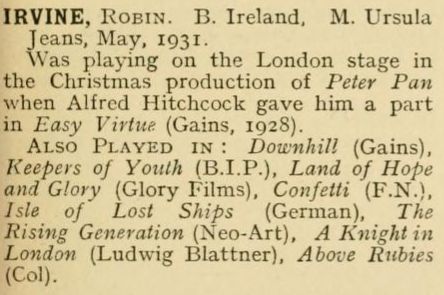
Robert Irvine's biographical sketch says he was discovered by Hitchcock.
Phyllis Konstam's entry says Hitchcock spotted her as an extra in Champagne and gave her a part in Murder.
John Longden was the leading man in Hitchcock's Blackmail. He also appeared in The Skin Game and Juno and the Paycock.
"500 Famous Film Casts" does indeed list 500 movies and their casts. Some Hitchcock films made the list.
Graham Cutts directed Woman to Woman. Alma Reville edited. Hitchcock wrote the script and served as art director and assistant director and met Alma Reville.
Downhill was a silent, one of several films Ivor Novello did with Hitchcock.
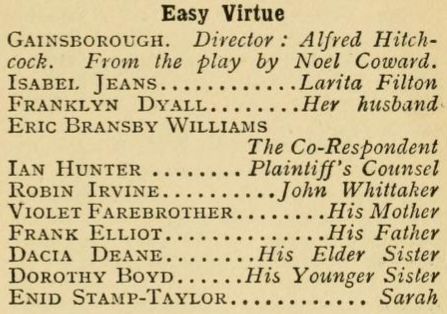
Easy Virtue was another silent.
Blackmail was the first British all-talkie. It was shot as a silent and then mostly reshot. Leading lady Anny Ondra's accent was impossible, although there is a test reel of her talking to Hitchcock, so her lines were spoken off screen by Joan Barry.
Murder, sometimes Murder!, was a rare Hitchcock whodunnit.
The encyclopedia includes many interesting articles, such as "How Films Began" by Claude Friese-Greene, sone of William Friese-Greene, a pioneering experimenter and subject of the inaccurate biopic The Magic Box.
There are images of several famous actors, including this one of Charlie Chaplin in what appears to be a scene from City Lights.
Maurice Chevalier has always been a favorite of mine.
Mickey Mouse and an animator at work.
I did not know that Fay Wray had a dog named Kong.
Ivor Novello, actor, singer and songwriter, appeared in The Lodger and Downhill for Hitchcock. Elizabeth Allan did not appear in The Lodger.
A map shows the location of Hollwood.
Another map shows the locations of studios in Hollywood.
This map shows the locations of studios in Britain.
Thank you to Ferdy on Films (http://www.ferdyonfilms.com/), The Self-Styled Siren (http://selfstyledsiren.blogspot.com/) and This Island Rod (http://thisislandrod.blogspot.com/) for organizing this blogathon. I'm having fun and learning.
Please consider donating to the National Film Preservation Foundation. For the Love of Film III is raising money to place The White Shadow, a 1923 Graham Cutts movie on which Alfred Hitchcock served as assistant director, on the internet for free viewing.
Thursday, May 17, 2012
Hitchcock -- Club: Royal Auto -- May 17, 2012
This post is part of For the Love of Hitchcock, The Film Preservation Blogathon, hosted again this year by Ferdy on Films (http://www.ferdyonfilms.com/ -- Sunday, Monday) and The Self-Styled Siren (http://selfstyledsiren.blogspot.com/ -- Tuesday, Wednesday), along with Rod of This Island Rod (http://thisislandrod.blogspot.com/ Thursday, Friday).
I hope to contribute these articles this week:
Monday -- Dial HOllywood 9-2411 for Hitchcock
Tuesday -- Hitchcock -- Berdarold, Piccy, London
Wednesday -- Alfred Hitchcock, SRO, RKO, UA, Univ
Thursday -- Hitchcock -- Club: Royal Auto
Friday -- Hitchcock -- He Has Had a Non-Stop Career
Click on images to see larger versions. The image at the top of the page is a full-page ad from The 1963 Film Daily Year Book of Motion Pictures.
Alfred Hitchcock was a rare creative artist in the movie business, but he had to function within the studio system for most of his career. I wanted to document the way he fit in. For this installment of the blogathon, I went through several yearbooks from the 1920s and 1930s and dug up some interesting references to Hitchcock.
Many industries publish annual books which describe the people who work in them and what they have accomplished. In the film industry, this was a useful way to determine whether someone who said he had worked for DW Griffth or CB DeMille really had. Some of these yearbooks and many other valuable resources are available in the Media History Digital Library (http://mediahistoryproject.org/).
The Film Daily, "The Daily Newspaper of Motion Pictures," a major source of news for the film industry, also published a yearbook starting around 1918.
The 1927 edition of the Film Daily Yearbook lists Hitchcock's first two directorial credits, The Pleasure Garden and the Mountain Eagle.
The 1927 edition also lists Hitchcock's writing credit on the Graham Cutts movie Woman to Woman.
I felt compelled to include this wonderful full-page ad for Buster Keaton.
The 1929 Motion Picture Almanac was published by The Exhibitors Herald-World.
Hitchcock's Easy Virtue is listed right after C B De Mille's Dynamite.
Hitchcock's The Ring is listed with a couple of movies I have never heard of.
Motion Picture News was a trade paper that merged with The Exhibitors Herald-World to form The Motion Picture Herald in 1930. As described above in the 1929 edition, the Motion Picture News Blue Book was a collection of biographical information about people in the industry. This edition also included some interesting ads.
Hitchcock's entry leaves out his earliest movies.
-
John Ford, the smiling Irishman.
Harold Lloyd looks as if he is singing in this ad for his second talkie, Feet First.
Jean Hersholt's ad has the most interesting portrait. I cannot make out the artist's signature. "Appointed by His Majesty King of Denmark to head Danish constellation of athletes competing in Olympic Games to be held in Los Angeles in 1932."
The ad for Mickey Mouse Sound Cartoons mentions that Disney was still using the Powers Cinephone system. Someone should write a book about Pat Powers.
Lloyd Hamilton was appearing in sound comedies for Educational.
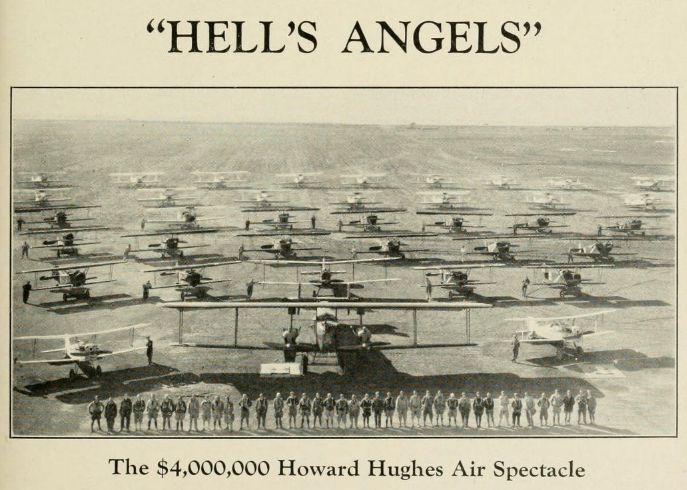
Howard Hughes was promoting Hell's Angels.
Harry Langdon was working for Hal Roach.
The Film Daily Product Guide and Directors' Annual was a mid-year supplement to the Film Daily Yearbook.
Hitchcock's biographical entry has his year of birth wrong. It should be 1899.
The only Hitchcock production listed is The Woman Alone. This was based on Joseph Conrad's The Secret Agent and released in Britain as Sabotage. The Woman Alone was the title for it's initial release in the US. It was reissued in the US as I Married a Murderer. Hitchcock complicated matters further by releasing a movie called The Secret Agent, which was based on a story by W Somerset Maugham.
As a railfan, I had to include this ad for the Fitzpatrick Traveltalks, which turn up frequently on TCM. It features a Southern Pacific GS (Golden State) 4-8-4, in Coast Daylight colors, which is posting next to Central Pacific locomotive 1, the C P Huntington, a unique 1863 4-2-0T which is preserved at the California State Railroad Museum (http://www.csrmf.org/).
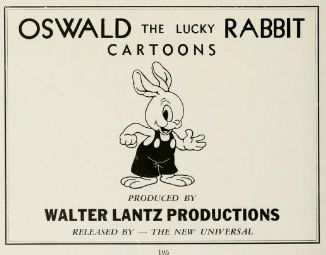
Oswald the Lucky Rabbit was stolen from Walt Disney. The Disney corporation recently got him back.
Sphinx Films Corporation produced Yiddish-language movies, including the famous "Yiddle With His Fiddle," starring Molly Picon.
The 1937-1938 edition of the International Motion Picture Almanac was edited by Terry Ramsaye, who had published A Million And One Nights: A History of the Motion Picture Through 1925, a pioneering book about cinema.
Cameraman John Cox had worked on five Hitchcock movies, including The Ring and Blackmail.
Edgar Clarence was "(i)n charge of architectural decor" for Blackmail.
Graham Cutts is listed as an "independent director." The entry mentions The White Shadow.
Hitchcock's entry has the wrong birth year. Waltzes from Vienna and Strauss' Great Waltz are UK and US release titles for the same movie.
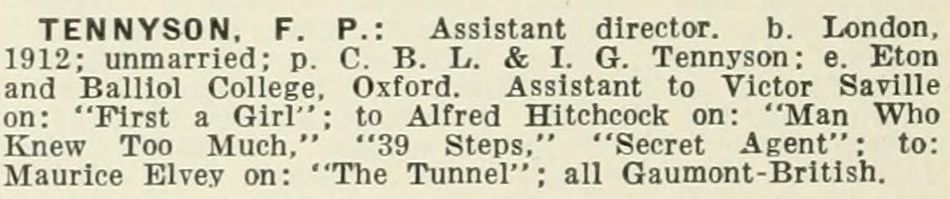
F P Tennyson was assistant director on several Hitchcock movies at Gaumont-British.
A list og Gaumont-British releases includes The Woman Alone and "Alfred Hitchcock Production (Untitled)." The latter could have been The Girl Was Young/Young and Innocent or The Lady Vanishes. King Solomon's Mines with Paul Robeson and Dr Syn with George Arliss are the only other ones I have heard of.
Hitchcock had a small ad in this edition. I like the design.
I guess Hidden Power was yet another potential title for Sabotage/The Woman Alone/I Married a Murderer.
A list of literary properties give the film's release title in the UK, Sabotage.
Another item on the list is that "Untitled Original."
Several big studios had multi-page ads that ran on every odd-numbered page over a large span. I was happy to see entertainer Bill Robinson featured in 20 Century-Fox's ad.
Laurel and Hardy fans will recognize Boris Morros as producer of The Flying Deuces.
Actor Paul Muni shared a page of the Warner Brothers ad with Porky Pig.
The Disney ad features the boss along with Mickey Mouse and Donald Duck.
I like the picture of western star Buck Jones.
Edward Everett Horton's ad is elegant.
An ad for Alliance Films mentions two directed by Graham Cutts, Aren't Men Beasts? and Radio Review of 1937.
Thank you to Ferdy on Films (http://www.ferdyonfilms.com/), The Self-Styled Siren (http://selfstyledsiren.blogspot.com/) and This Island Rod (http://thisislandrod.blogspot.com/) for organizing this blogathon. I'm having fun and learning.
Please consider donating to the National Film Preservation Foundation. For the Love of Film III is raising money to place The White Shadow, a 1923 Graham Cutts movie on which Alfred Hitchcock served as assistant director, on the internet for free viewing.
Subscribe to:
Posts (Atom)