Showing posts with label Presidents' Day. Show all posts

Monday, February 19, 2024

Happy Presidents' Day, 2024 -- February 19, 2024

listal.com

Happy Presidents' Day, everyone.

William Henry Harrison was the ninth President of the United States, the first from the Whig Party and the first to die in office. After a successful career in the military and in politics, the Whig Party chose him to run for president. They had good success with running war heroes, but both of the men who won the presidency died in office. Harrison died one month after his inauguration, so he didn't get much done.

Monday, February 20, 2023

Happy Presidents' Day, 2023 -- February 20, 2023


Happy Presidents' Day, everyone.

President Jimmy Carter has gone into hospice at home. I voted for him in 1980. His basic decency caused him to make some mistakes as president, but he has been our greatest ex-president. He has acted as an actual Christian. He has helped to create peace agreements. The Carter Center promotes human rights. He has worked steadily for Habitat for Humanity.  He taught Sunday School until recently. I'll bet he was good at it. 

I am praying for President Carter and his family. 

I bumped William Henry Harrison to 2024 so I could honor President Carter. I don't think General Harrison would mind. 

Monday, February 21, 2022

Happy Presidents' Day, 2022 -- February 21, 2022

listal.com

Happy Presidents' Day, everyone.

Martin van Buren was an agile politician. He was one of the founders of the Democratic Party. He was Secretary of State under Andrew Jackson, and then served as Jackson's Vice President. When Jackson left office, Van Buren won the 1836 election, but his term was damaged by the Panic of 1837. Van Buren was opposed to Texas joining the Union because of slavery. He lost the 1840 election to William Henry Harrison, a Whig. In 1844, Van Buren ran for president as the nominee of the Free Soil party, an abolitionist organization. He favored abolition for the rest of his life.

listal.com

Martin Van Buren was portrayed by Nigel Hawthorne in Steven Spielberg's Amistad.

Monday, February 15, 2021

Happy Presidents' Day, 2021 -- February 15, 2021


usps.gov

John Quincy Adams was our sixth president. He served our country as diplomat, Senator, Representative, Secretary of State and President. I have seen some comments comparing John Quincy Adams to Donald Trump. I do not think this is fair to Adams. Both men lost the popular vote twice, and both were one-term presidents, but Adams was functionally literate, understood how our government worked, had served our country for most of his adult life, and I doubt that he ever committed treason, sedition or any other crime before or during his presidency. 

After his presidency, Adams served as a Representative for several terms. He suffered a stroke while speaking before the House and died two days later. 


Monday, February 17, 2020

Happy Presidents' Day 2020 -- February 17, 2020


Theodore Roosevelt, the Trust Buster, the Hero of San Juan Hill, TR. One of my favorite Presidents.

Tuesday, February 19, 2019

Our Teddy -- February 19, 2019

Moving Picture World, 01-February-1919
Belated happy Presidents' Day everyone.  Yesterday I was participating in a blogathon.

Former president Theodore Roosevelt died at his family home, Sagamore Hill, near Oyster Bay, New York 100 years ago last month, on 06-January-1919. He was only 60 years old. Vice President Thomas R Marshall said "Death had to take him in his sleep, for if he was awake there'd have been a fight."

Perhaps it is cynical of me, but I'll bet the producers of The Fighting Roosevelts, a movie about TR and life before the presidency, were not prostrated by the news. It probably helped business.

Moving Picture World, 01-February-1919
Across the top, we see photos of the real TR giving a speech.  Below we see scenes from the movie, including:
Roosevelt in the Legislature at twenty-three 
Roosevelt applying the law as New York Police Commissioner
Roosevelt selects future Admiral Sims
Roosevelt becomes a democrat among democrats in the far West
Roosevelt tenders Pres. McKinley his resignation as Asst. Sec'y of the Navy and goes to command the Rough Riders
Roosevelt floors a desperado

Moving Picture World, 01-February-1919
"The biggest box-office attraction since motion pictures began."

Moving Picture World, 01-February-1919
Moving Picture World, 08-February-1919
"The public will think it is a war picture..." so they changed the title.

Moving Picture World, 08-February-1919
I like this suggestion for a series of advertisements.

Moving Picture World, 22-February-1919
CLEAN UP CAMPAIGN FOR OUR TEDDY


Manager Shackman, of New York's Eighty-first Street,
Demonstrated the Value of Showmanship in Putting
Over Big Feature in House with Neighborhood Location

APPROXIMATELY five thousand new patrons of the class who rarely attend a motion picture theatre, four days of capacity business in a house seating twenty-four hundred, and a special Saturday morning matinee for school children which brought crowds so great that a detail of nine policemen was required to preserve order, are the results obtained by S. A. Shackman, owner and manager of the Eighty-first Street Theatre, at Eighty-first, street and Broadway, New York City, from an unusual campaign to put over "Our Teddy," the six-reel screen version of the life and accomplishments of Colonel Theodore Roosevelt, made by McClure Productions, Inc., and distributed by First National Exhibitors' Circuit.

Mr. Shackman changes his program twice a week. This gives him a three days' run for the first half, and four days for the second half of each week. "Our Teddy" was booked to open on Thursday and to close on Sunday night, making a four days' engagement. His theatre is in the heart of a thickly settled district, populated by well-to-do families, in the upper West Side.

Moving Picture World, 22-February-1919

Going Out for New Patrons.

For appeal to this class of patronage he has found that dignity and a certain element of conservatism are essential. His regular advertising mediums include car cards on the Broadway surface lines, five line insertions daily in the New York Times as the morning newspaper, and the Evening World for the afternoon publication, with larger space in the Sunday editions of both ; advance slides, and a variety of lobby display cards, hand lettered and arranged by himself. Supplementing these is the house program of sixteen pages, containing current and advance announcements. Occasionally he uses blotters for distribution to out-going patrons and among the apartment houses in the neighborhood. Window card displays in a dozen choice locations complete the list of regular methods of advertising and publicity.

"Here is a chance," Mr. Shackman said to his assistant, Mr. Gerard, after he had booked the Roosevelt picture, "to bring new patrons to the theatre. I believe that this production will appeal not alone to the 'regulars,' but to the thousands who still believe that motion pictures are beneath average amusement standards. There is the opportunity in 'Our Teddy' to interest them in screen entertainment. The possibility of results easily is worth the effort."

Made Study of Subject.

He then proceeded to analyze the production for novel advertising ideas. He had just been advised that a song had been written under the title of "Good-bye, Teddy Roosevelt, You Were a Real American." After reading the verse and chorus he hit upon the first of a series of new promotional plans that added five thousand potential "regulars" to his clientele.

The concluding scenes of "Our Teddy" show Colonel Roosevelt and his four sons in double exposures over a service star. The action pictures the part taken by each of the four boys in the world war.

With this for his premise Mr. Shackman began a search for a quartet of wounded soldiers. Commanding officers at several Base Hospitals in New York were consulted and four wounded men were finally located at Bast Hospital No. 1. They had sung in the hospitals in France during their convalescence.

Put Novelty in Lobby Display.

Beginning with the matinee on the Sunday preceding the opening of "Our Teddy," Mr. Shackman introduced them as "Pershing's Overseas Quartet.". Specific reference was made to the Roosevelt picture, and then the quartet sang the song while announcement and scene slides from the film were thrown on the screen. This was repeated at every performance.

Variety and novelty were sought for the lobby display. The idea finally approved by Mr. Shackman provided for a display portrait of Theodore Roosevelt, hung from the marquee and facing the street. In an apartment house opposite he placed a spot light which threw a strong light on the portrait after dark each night.

Made Use of Spot Light.

This received a great deal of attention from pedestrians on the opposite side of Broadway, and from a heavy automobile and surface car traffic. A similar portrait, draped with flags, was hung in the center of the marquee above the sidewalk for the attention of passers-by on the theatre side of Broadway.

He used a different style of lobby display, alternating the arrangements of material in the cards so that it appealed both to his regular patrons and to the new clientele he was seeking. Some of the frames contained lobby display photographs, while others were mounted with newspaper and magazine clippings, surrounding large portrait photos of the former President. These latter displays were given preferred position in the frames facing the streets at either side of the lobby.

School Campaign Well Planned.

The public schools were considered for a semi-educational and semi-entertainment appeal to the pupils. Mr. Shackman learned that within a radius of ten blocks of the theatre were schools with a registration of ten thousand children. A personal appeal was made to the principal of each of nine schools, and permission was obtained from them individually for the distribution of ten thousand blotters, announcing a special school children's matinee at 11 :30 o'clock Saturday morning.

To add interest to the occasion he extended an invitation to the New York Council of the Boy Scouts of America for its members to attend the special matinee as his guests. The New York Council has a band. He sought the leader, and arrangements were made for the band of thirty-five pieces to give a short patriotic concert as an overture for the picture. This fact was made a part of the copy on the blotters sent to the schools.

"A surprising feature of the school plan," said Mr. Shackman, "was the marked willingness of the principals to co-operate with me. They looked upon the production as something that every school pupil should see, and the fact that I was arranging a special matinee seemed to them to be the ideal way of presenting the picture to the children." There is an established rule in all New York public schools prohibiting the distribution of advertising matter of any character to the pupils, either outside the school or in the class rooms. Mr. Shackman's blotters were given out in the class rooms, at the direction of the principals, by the various class monitors.

Used Blotters to Advantage.

A cartoon by R. M. Brinkerhoff, picturing in entertaining style his impressions of the production, was the illustration used on the blotters, which were printed in two colors. The blotters were distributed on Tuesday, two days before the picture opened its four days' engagement. There was a practical legitimate purpose in this. Mr. Shackman was confident that every pupil would preserve the blotter for personal use, and that every one of the ten thousand would be certain to tell their parents about the matinee.

He was right. They did both; more effectively than he had dared to hope.

As a further effort to win the "once-in-a-whiles" Mr. Shackman increased the size of his newspaper space in a four days' campaign, starting on Wednesday, and continuing until Saturday. He used ads two columns by two inches in the Times and the Evening World. The copy was written to interest all classes of readers. Small line cuts of the situations drawn in cartoon by Brinkerhoff were used to illustrate the text.

Moving Picture World, 22-February-1919

Making Music Do Its Share.

Walter Davidson, musical director for the Eighty-first Street Theatre, arranged a musical score which included the "American Patrol" for the overture, various other patriotic airs, including "A Hot Time in the Old Town Tonight," and an orchestral accompaniment of "Good-bye, Teddy Roosevelt, You Were a Real American." The enthusiasm of the audiences during the first half of the week satisfied Mr. Shackman that the "Pershing Quartet" would contribute to the atmosphere of the production by singing this song as an introduction, and again with the closing scene.


Got Capacity Opening.

The production started on Thursday to capacity business. On Friday the treasurer notified Mr. Shackman that the advance sale for Saturday and Sunday was far above normal. On Saturday morning, with the special matinee scheduled to begin at 11 :30 o'clock, Mr. Shackman arrived at the theatre at 9:30 o'clock to find the lobby and street jammed with children.

Moving Picture World, 22-February-1919
By 10 o'clock the crowd had grown to such proportions that it was becoming unmanageable, and he telephoned to a police station for assistance. Nine policemen responded, and they were kept busy for nearly two hours.

Sees Hundreds of New Faces.

"The production proved a truly wonderful attraction," said Mr. Shackman. "Mr. Gerard and I watched carefully at every matinee and evening performance, and we saw hundreds of new faces in line at the box office, people whom neither of us could remember ever having seen in the house before. I had arranged the remainder of my program so that these new patrons would be thoroughly pleased with the entire show. I wanted to convince them that the Eighty-first Street Theatre would be well worth their future consideration.

Children Were Home Advertisers.

"Undoubtedly the blotters distributed in the schools sent into the homes of thousands of families the news that the life of Colonel Roosevelt would be told in motion pictures at my house. I am positive that hundreds of fathers and mothers and older brothers and sisters of the school children came to the theatre before Saturday to satisfy themselves.

"It is too early yet to say how many new patrons will result from the campaign and the production, but I am satisfied that the number will be sufficient to more than justify the attempt."


Monday, February 19, 2018

Happy Presidents' Day 2018 -- February 19, 2018


James Monroe was our fifth president.  He served our country as soldier, diplomat, Secretary of State, Secretary of War and President.

"To impose taxes when the public exigencies require them is an obligation of the most sacred character, especially with a free people."  Many people no longer believe this.

Monday, February 20, 2017

Happy Presidents' Day 2017 -- February 20, 2017


Theodore Roosevelt, the Trust Buster, the Hero of San Juan Hill, TR. One of my favorite Presidents.

Monday, February 15, 2016

Happy Presidents' Day 2016 -- February 15, 2016

quotesgram.com

I have always liked James Madison.  It is fascinating to read about his role in giving us the Constitution and the Bill of Rights.  He believed in the separation of church and state.  Many people have mixed them up, to the detriment of both. 

Monday, February 16, 2015

Happy Presidents' Day 2015 -- February 16, 2015

http://www.senate.gov/

Happy Presidents' Day, everyone.  John Adams, our second president, was a leader of the revolution and the early republic.  Thomas Jefferson's followers vilified him as a monarchist, but he was a firm believer in republican government and Enlightenment ideals. 

"Facts are stubborn things; and whatever may be our wishes, our inclinations, or the dictates of our passions, they cannot alter the state of facts and evidence."

Monday, February 18, 2013

Happy Presidents' Day #5 -- February 18, 2013


This article, from the 25-August-1895 Los Angeles Herald, talks about future president Theodore Roosevelt during his time as a New York City police commissioner, when he made a big impression on the force and on voters across the nation. Note that it says he has no political ambitions. "Well heeled" below means armed. 

TEDDY, THE DUDE COMMISSIONER

The Combination That Has Turned Gotham Up-side Down
A DAY WITH MR. ROOSEVELT

What New York's Most Talked About and Most Hated Man Does in Twenty-four Hours -- Hated by Many

Teddy Roosevelt, the man who has ripped the police department of New York wide open and turned it upside down in a very short space of time, has no political ax to grind. He is not working for future recognition when fine offices are to be distributed. In fact, he says that just as soon as a man begins to consider the effects of his actions on his political future he loses all his usefulness.

A day with Mr. Roosevelt is about the busiest day that can be spent in New York these hot times. This young man, who has been called the "dude commissioner," knows no rest. The hottest day does not worry him. He goes right ahead working and showing his teeth.  This latter is no figurative bit of speech.  It is literal. His fine white teeth, which glisten and shine all day long, are known and feared by each one of the 3000 and odd of the police force. "Teddy and his teeth" is an awful combination in Mulberry street. It is a difficult matter to say when Mr. Roosevelt's day begins. Often be works right on from midnight of one day to the next. He has set a terrible example for the rest of the easy-going, luxury-loving, office-holding world of the city.  It was a strange sight in the old days if any police commissioner averaged throughout the week more than two hours work a day. Sixteen to twenty is Roosevelt's average.

An ordinary day is begun by this unusual president of the police board at 7 a.m., when he flashes into the building on Mulberry street. Like a streak of lightning the news darts into every ear, in every room, on every floor, that Teddy is on deck, teeth, eye-glasses, energy and all. 

The clerk who manages the mail of the most talked about man in New York has no sinecure. Roosevelt likes to begin the day by going over these letters.  There is as much excitement in them as in cow punching, a trade in which the head of the New York police excels. It's an off day when less than fifty threatening letters are received. These come mainly from the hangers-on of saloons and the small fry criminal classes (generally Roosevelt has driven the eight thousand and odd owners of saloons well nigh crazy by his Sunday crusade against them, and as each proprietor has at least six hangers on who swear by him, Roosevelt has a fine brigade of 5,000 men pitted against him. This, of course, represents only one division of the grand army of his enemies. In round numbers there are about 250,000 persons in New York who would smile if he were dropped into the river some dark night. But against this quarter of a million there are more than a million and a half of people who are with him up to the hilt.

In eight cases out of ten the letters received by Roosevelt are anonymous. That is the reason the threats do not worry him. It's a question whether they would cause him any disquiet if they were signed. He lived in the western country and with "bad men" on all sides of him for a long time, and always held his end up. He is an adept in the use of all kinds of fire-arms and a fine athlete.

Only the other day a stonemason, a big, brawny fellow, called to see him for the purpose of getting on the force.  Roosevelt used to box regularly every morning in an uptown academy, and soon outgrew the other members of the school. He put too much steam in his blows even for the instructor. So the stone mason was called in to spar with the coming president of the police board.

The craftsman had hard muscles and thought at first it would be great sport to polish off the dude. But it wasn't. The dude could fight. The stonemason soon learned to respect the slugging abilities of the dude. They fought each other early every morning for a long time. If the stonemason passes the regular civil service examination he will get on the force. If he doesn't he won't. Roosevelt likes him and would be glad to do him a favor, but influence, political pulls, etc., are things of the past.

There are hordes of callers every hour in the day upon the commissioner. All kinds of wrongs are poured into his ear.  His sudden prominence has caused many people to believe that be possesses every legal power from that of United States supreme court justice down to street sweeper. He sees all callers and disposes of them with terrific speed. One woman wanted him to come right away and arrest the woman living in the next house to her for throwing things in her back yard. Cranks who want to argue, the excise question with him call in droves and try to present elaborate arguments showing why the citizens of New York should have Sunday beer.

Mr. Roosevelt's position on this question is not generally understood. He says that he is in favor of more liberal excise laws and is not opposed to the sale of drinks on Sunday more than on any other day. But while there is a law in existence prohibiting the sale on Sunday he intends to enforce it. It is not within the scope of his duties to pass judgment upon the justice or injustice of the laws;.  all he must do is to enforce them.

A dozen times in the day Acting Chief Conlin, the present executive head of the department, has conferences with Mr. Roosevelt. Mr. Conlin is striving with might and main to hold the job from which Mr. Byrnes was ousted. Conlin is an old police officer who has been in the service almost as long as Mr, Roosevelt has been on earth, but he, like many others, has found that the newcomer can teach him something.

Roosevelt's main ambition is to show the people of New York that all reformers are not theorists, and consequently impracticable. He says he is a reformer, but he doesn't indulge in the luxury of theorizing unless honesty and sound business methods are to be classed as theoretic. He knew nothing about running a police department when he took the helm. He makes his plans as be goes along and learns. He is manipulating the machinery of the force to suit local conditions. This is the foundation of his plan. Find out the local conditions in each precinct and then adapt the police work to suit them. In many respects Roosevelt has shown the Byrnes regime to be a farce-comedy, particularly as to the suppression of disorderly resorts and the enforcement of the excise law.

Roosevelt usually remains at headquarters until 8 o'clock. Then, if it is to be one of his roaming nights, he starts for one of his many clubs, where he dines and reads until 10 o'clock. About this time the policeman is beginning to feel tired. There are fewer people on the streets and he can indulge in restful violations of the discipline laws with little chance of discovery. At least be could do so before Roosevelt adopted such unholy habits of prowling about all parts of the city at night unearthing the uniformed delinquents.

It may be in Harlem that the commissioner will strike like a bolt of lightning.  Or it may be the far west side or the down town slums of the East Side or perhaps in the turbulent quarter of Hell's Kitchen, where the occupants amuse themselves by dropping bricks and heavy household utensils upon the heads of passing policemen. It is safest to walk in the middle of the street at night time in this quarter, a fact which many policemen have learned. There is less danger of being ambushed by ambitious thugs. No one knows where the commissioner will strike, but he has already worked so much damage to heretofore spotless records that the policemen have created a system of signals by which they inform one another that tbe terror is abroad. What this system is has not been learned, but it is doubtless worked with the aid of saloon hangers-on, who are impressed as messengers and sent flying about the precinct on their mission of alarm.

On his first night's tour Roosevelt found only one policeman doing his  duty. Now it is hard to find one policeman not doing his duty. Whether it is the result of the signal system or an honest improvement in the work of the men is hard to say. It is probably a combination of both.

The police have not taken kindly to this prowling about of their chief, and their friends are even more indignant.  Roosevelt runs the risk of serious injury during his wanderings. Not long ago a man who looked like Roosevelt was mistaken for the commissioner by a crowd of Harlemites. They tried to mob him, but he escaped by fleetness of foot and catching an elevated train. But Roosevelt's nerve is good, and although he is not a big man, he is a fighter, and there is a general impression that when he is sleuthing at night he goes well heeled. 


Monday, February 20, 2012

Happy Presidents' Day #4 -- February 20, 2012

"For twelve years this nation was afflicted with hear-nothing, see-nothing, do-nothing government. The nation looked to government but the government looked away. Nine mocking years with the golden calf and three long years of the scourge! Nine crazy years at the ticker and three long years in the breadlines! Nine mad years of mirage and three long years of despair! Powerful influences strive today to restore that kind of government with its doctrine that that government is best which is most indifferent.

"For nearly four years you have had an administration which instead of twirling its thumbs has rolled up its sleeves. We will keep our sleeves rolled up.

"We had to struggle with the old enemies of peace: business and financial monopoly, speculation, reckless banking, class antagonism, sectionalism, war profiteering.

"They had begun to consider the Government of the United States as a mere appendage to their own affairs. We know now that government by organized money is just as dangerous as government by organized mob.

"Never before in all our history have these forces been so united against one candidate as they stand today. They are unanimous in their hate for me, and I welcome their hatred."


President Franklin Delano Roosevelt, 31-October-1936.  

Today is also the 50th anniversary of John Glenn's Earth orbit aboard Friendship 7.

Monday, February 21, 2011

Happy Presidents' Day #3 -- February 21, 2011

Presidents' Day commemorates all Presidents, some good, some not so good.
James A Garfield didn't have much time to prove whether he was a good president or a bad one. An Ohio native, like many other presidents, he reached the rank of Major General in the Civil War. In the 1880 election, he defeated another general, Winfield Scott Hancock, and became the youngest man elected president up to that time. Four months after his inauguration, Charles Guiteau shot Garfield twice in the Washington Baltimore and Ohio train station. Guiteau was called a disappointed office seeker, which gave impetus to Civil Service reform, but was basically a crazy person.

Garfield lingered for two months and might have recovered if his doctors had not tried so hard to find one of the bullets. After Garfield died, Guiteau admitted in his trial that he shot Garfield, but contended that the doctors had killed him. Unmoved, the jury convicted him and he was hanged.

When my family went to visit relatives in Ohio when I was young, we toured Garfield's home, Lawnfield.

I took the photo of the Garfield Monument in Golden Gate Park on 03-January-2009.

Monday, February 15, 2010

Happy Presidents' Day #2 -- February 15, 2010

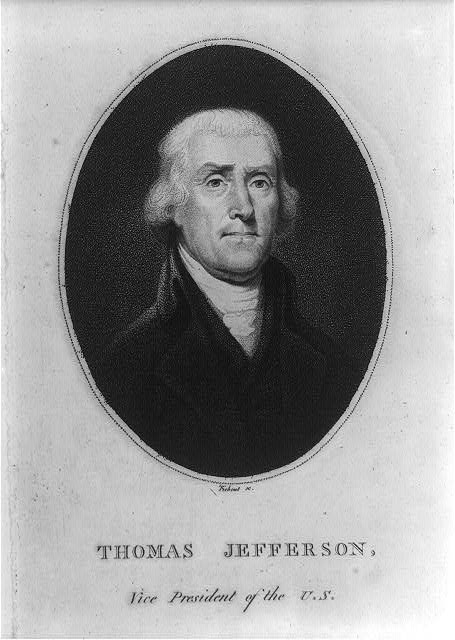
Thomas Jefferson has a mixed reputation. He wrote the Declaration of Indepence. He owned slaves. He made the Louisiana Purchase. He was a propenent of limited government powers. I think his virtues outweigh his faults. I first became interested in him when I found an old issue of National Geographic which had an article about Monticello. I liked his automatic doors and his clock.

"Whenever the people are well-informed, they can be trusted with their own government."

Monday, February 16, 2009

Happy Presidents' Day -- February 16, 2009


Presidents' Day commemorates all Presidents, some good, some not so good.
Theodore Roosevelt has always been a favorite, even though he was a Republican. He was a good writer. He had great confidence, as shown in the accompaning 1904 Puck cartoon, "Terrible Teddy Waits for the Unknown." He waits for the Democrats to nominate their candidate, who turned out to be Alton Parker. It was no contest.


"Too much cannot be said against the men of wealth who sacrifice everything to getting wealth. There is not in the world a more ignoble character than the mere money-getting American, insensible to every duty, regardless of every principle, bent only on amassing a fortune, and putting his fortune only to the basest uses... Such a man is only the more dangerous if he occasionally does some deed like founding a college or endowing a church, which makes those good people who are also foolish forget his real iniquity. These men are equally careless of the working men, whom they oppress, and of the State, whose existence they imperil. There are not very many of them, but there is a very great number of men who approach more or less closely to the type, and, just in so far as they do so approach, they are curses to the country. (Forum, February 1895.) Mem. Ed. XV, 10; Nat. Ed. XIII, 9


Both the caricature and the quote come from the Theodore Roosevelt Association's wonderful website: http://www.theodoreroosevelt.org/


In the morning we looked at a webcast of the Tour de California bike race, which had southbound One closed through town from 8-10:30am.


Still a lot of rain.


Louie Bellson died.