|
| Saint Paul Appeal, 03-March-1923 |
The first article tries to shame the people who committed lynchings and claimed to be Christians. It didn't work.
The Missouri and North Arkansas Railroad mentioned in the second article is not the same railroad as the current company.
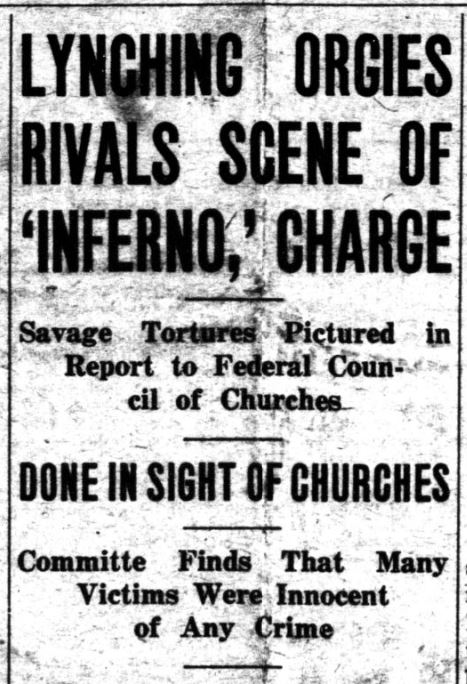
LYNCHING ORGIES
RIVALS SCENE OF
'INFERNO,’ CHARGE
Savage Tortures Pictured in
Report to Federal Coun cil of Churches
DONE IN SIGHT OF CHURCHES
Committe Finds That Many Victims Were Innocent
of Any Crime
(Crusader Service.)
Washington, March 2. -- Like scenes from Dante's "Inferno," and unlike
anything deemed possible in modern life, is the description of the tortures
inflicted in lynching bees in various states throughout this so-called
civilized country, as compiled by the Commission on the Church
and Race Relations of the Federal Council of Churches in its educational
campaign against lynching.
The stories almost pass belief, and yet they are taken from accounts
written by reputable newspaper men in the communities in which they occurred.
The commission states that it seems hardly believable that America,
with its great Christian churches, homes, schools and courts and
holier-than-thou attitude, allowed between 1885 and 1921, the lynching of more
than 4,000 persons, the great majority of whom were colored people. To
add to the enormity of these crimes against humanity, eighty-three of the
victims were women. Scores of victims listed as adult males were mere
youths. Seventeen of the women lynched were white, the others being colored.
Many Victims Innocent.
"Some of those killed by mobs were charged with crimes, many of
them only with misdemeanors, some only with words or acts which are
nowhere punishable by law at any time. All were slain without trial
where they might have faced their accusers, have had witnesses and
have had the evidence considered by a lawful judge or jury. A frenzied
mob was judge, jury and executioner. In many cases persons not sought by
the mobs have been lynched by mistake, so wild and savage has been the
procedure. Some of the victims suffered indescribable torture, such as
saturation of parts of the body with kerosene or gasoline, so that they
could be burned piecemeal, or branding with hot irons.
Within Sight of Churches.
"In some cases these atrocities have been perpetrated within sight of
the churches of the community."
Lynchings are often definitely planned and carried out. Here are a
few illustrations chosen from accounts in leading city newspapers
following lynchings:
1. "Late last night the jailer was enticed away from the prison on the
pretense of a call to make an arrest. As soon as he was out of hearing a
mob of 200 masked men went to the jail and took the keys from his wife,
and securing the three prisoners, took them to the bridges land placed a
strong rope around the neck of each, tied the other end to the timbers of
the bridge and compelled their victims to jump."
Eight Prisoners Shot.
2. (Summarized.) "Masked mob entered the jail at two A. M. and took
out nine prisoners -- one white man and eight Negroes. Eight were shot
to death and one, a Negro, escaped after being wounded. The mob over-
powered the town marshal and the jailer, carried the men out and tied
them to fence posts by their necks and then fired five volleys into their
bodies. Only one of the prisoners had been convicted -- a Negro, under
sentence of death for the murder of another Negro."
CHARGE RAIL HEADS
KILL LYNCHING PROBE
Ku Klux Klan and Sinister Influences
at Work toy Sidetrack Investigation,
Civil Liberties, Writes Governor.
(Crusader Service.)
New York, March 2. -- Charges that investigation by the Arkansas legislature
into the lynching of E. C. Gregor, a railroad striker, at Harrison
on January 15, has been side-tracked by officials of the Missouri
and North Arkansas railroad are contained in a letter sent yesterday to
Governor Thomas C. McRae by Roger N. Baldwin, director, and Harry F.
Ward, chairman of the American Civil Liberties Union. The officers
of the union, who have been in touch with the situation through their
correspondents in Arkansas, offer to "render any assistance possible to the
authorities of the state in restoring civil rights in the affected district
and in bringing to justice the perpetrators of these outrages."
They charge that "sinister influences are at work to prevent anything
being done injhe future, and specific charges which bear out that
contention.