Showing posts with label silent movies. Show all posts

Wednesday, January 2, 2013

Chasing a Million -- January 2, 2013

From the 01-August-1914 Moving Picture World.  The Straits Settlements are now part of Malaysia and a few other entities.  Note that the airplane is not mentioned in the review. 

"Chasing a Million"

A Three-Part Novelty Burlesque by "Leading Players" -- Its Second Title Is "Or Around the World in Eighty Days."  

Reviewed by Hanford C Judson.


This three-reel picture, made for the sake of laughter, has many excellent things in the way of comical situations and thrills that will prove diverting and amusing.  There are bare places in its three reels; but this foolish, rough and tumble stuff seems to be a trump with audiences this hot weather and the offering will probably prove acceptable with the majority, as a whole, while it is sure that all will enjoy the truly funny things with which it is filled.  It doesn't seem to be a cheaply put-together offering, nor is it a studio-made picture.  There is plenty of outdoors in it, with ocean and dry land, rocky coast, jungle and desert.  There are wild animals loose in it and one of its really fine scenes is a heavy thunder storm at sea -- taken in a studio, but the real thing in the fun line for all that.

It opens with a prologue in which we are introduced to the Rajah of Yeabo; his vizier, the Gink; and his priestess, Punkette.  They are on a vacation from the Straight (sic -- JT) Settlements and are doing the delights of gay Paree, where they meet Piggy, the flower girl, and her two steadies, Nutty and Cremo.  When the royal party departs things must have seemed slow and the grand announcement in the "Continental Lyre" of a great race for a million to the Island of Bunco, where the latest copy of the "Lyre" has been hidden, must have been welcome.  The first to get this and return to Paree is to get a million (if it's there).

Piggy, Nutty and Cremo are late at the start; but make up for it by extra exertions which soon carry them way ahead of all other competitors.  After earning prize money by throwing the bull in a real bull fight (it isn't hush money) Cremo gets to the ship first.  Piggy missing it by a hair, follows in a rowboat and catches it at Port Said, at which port, too, Nutty, who has swum the seas, climbs aboard.  From that point the rush across the desert is begun.  Cremo, to pay for his good lunch at the start is now selected for a meal by a crocodile, who chews him up but can't digest him.  Cremo carries a pair of pliers with which he cuts his way out of the reptile's stomach and rejoins his two comrades in misery and with them enjoys many a sad experience with man eating cannibals and with pirates of the Strait Settlements, where, greatly to their surprise, they meet again with their old friend the Rajah -- "How people will meet!"  So the adventure is carried on until they come to Bunco, only to find that an ape has already discovered the copy of "The Lyre" and has torn it.  Yet there is enough left for each to have his portion,  which after more troublous voyaging they bring back to gay Paree, only to find that the "Continental Lyre" has gone into bankruptcy and that there is no million for anyone. 

Friday, December 14, 2012

The Patchwork Girl of Oz #3 -- December 14, 2012

"The new Plant of the Oz Film Company, conceded to be the most completely equipped and best appointed in California if not in America."

The Oz Film Manufacturing Company, located in Los Angeles, was formed in 1914 to produce movies based on stories by L Frank Baum, the creator of The Wizard of Oz.  The company made some movies, but was not a financial success. The ad is from the 11-July-1914 edition of Moving Picture World. It includes an image of their studio, on "Santa Monica Boulevard from Gower to Lodi streets."  Pierre Couderc, "direct from the Folies-Bergere," played the lead role in their first feature, The Patchwork Girl of Oz. He went on to write and direct movies.  Be sure to click on the image to see a larger version.

There was a shooting rampage in a Connecticut grammar school. This followed a rampage in an Oregon shopping mall and a massacre in a Colorado movie theater. Some people say this is not the time to "politicize" an event like this. If not now, when are we supposed to talk about how easy it is for unbalanced people to get guns and ammunition?  When are we going to address the issue of caring for people with mental illnesses? 

Sunday, October 14, 2012

The Patchwork Girl of Oz #2 -- October 14, 2012


The Oz Film Manufacturing Company, located in Los Angeles, was formed in 1914 to produce movies based on stories by L Frank Baum, the creator of The Wizard of Oz. The company made some movies, but was not a financial success. The ad is from the 27-June-1914 edition of Moving Picture World. The images are by John R Neill. Be sure to click on the image to see a larger version.

Pierre Couderc, L'étoile grotesque (the grotesque star) of the Folies-Bergere played the lead role in their first feature, The Patchwork Girl of Oz. He went on to write and direct movies.Director J Farrell MacDonald went on to have a long career as a supporting actor.

The Giants lost the first game of the National League Championship Series to the Cardinals.  

Friday, September 14, 2012

The Patchwork Girl of Oz -- September 14, 2012

"The first OZ FILM (now making) will be..."

The Oz Film Manufacturing Company, located in Los Angeles, was formed in 1914 to produce movies based on stories by L Frank Baum, the creator of The Wizard of Oz.  The company made some movies, but was not a financial success. The ad is from the 20-June-1914 edition of Moving Picture World. The images are by John R Neill.  Be sure to click on the image to see a larger version.

"Produced under the personal supervision of the author, L. FRANK BAUM."  

Tuesday, August 14, 2012

The Oz Film Manufacturing Company -- August 14, 2012

"...transferred direct FROM BRAIN TO SCREEN."  

The Oz Film Manufacturing Company, located in Los Angeles, was formed in 1914 to produce movies based on stories by L Frank Baum, the creator of The Wizard of Oz.  The company made some movies, but was not a financial success. The ad is from the 13-June-1914 edition of Moving Picture World. It's a little small, but I like the images around the edge.  Some Oz fan could probably identify the artist.  (UPDATE:  John R Neill -- thank you, JumpingFrog)  Be sure to click on the image to see a larger version.

"OZ Films are produced under the personal supervision of Mr. L. FRANK BAUM."  

Monday, July 2, 2012

Won in the Clouds -- July 2, 2012


Roy Knabenshue was a pioneering American dirigible pilot and builder.  He flew Tom Baldwin's California Arrow at the 1904 Saint Louis Exposition.  He built an early passenger-carrying dirigible, the White City, in California in 1913.  That may be the dirigible featured in this Universal film.  

The ad above is from the 28-February-1914 issue of Moving Picture World.  The two ads below are from the 07-March-1914 issue.  Be sure to click on the images to see larger versions.  

The review below is from the 03-April-1914 Washington Times. Kaffir is not a polite term. 


Won In The Clouds. 
(Universal.) 

CECIL JAMES, an Englishman, accompanied by his daughter, Grace, is hunting big game in the wilds of Africa. One day. Bangula, a Kaffir, steals a rifle from the gunrack. When Bangula .s captured by his fellows he is saved from death by the interference of James. Out of gratitude, Bangula leads James and his daughter to the fabled diamond mine of the Kabangans. In the city of Bloemfontein, Roy Knabenshue, an American aeronaut, arrives with his dirigible balloon for the purpose of carrying agents of Bjornsen, a banker,. to the diamond mines of the interior. Knabenshue falls in love with Bjornsen's daughter. Mary. Far in the interior James and his daughter reach a Kaffir village near the diamond mine. From the fact that he smokes a pipe. James is taken to be a fire god by the natives, and meets Portuguese Jack, a renegade, who is worshiped as a fire god and virtually held a prisoner James locates the diamond mines and secures many rough diamonds. Portuguese attempts to force his attentions on Grace, and when they attempt to escape with the diamonds he reports them to the chief of the tribe. They hide the diamonds in the floor of the feast house where the Kaffiirs feed their victims to the lions, and when they finally escape they are obliged to leave the diamonds. How they enlist the American aeronaut in their attempt to recover the diamonds and the thrilling experiences they have make a series of great pictures.


Friday, June 1, 2012

The Sky Monster -- June 1, 2012

Moving Picture World 02-May-1914

LZ 11, the Viktoria Luise, was a passenger-carrying Zeppelin operated by DELAG before World War One. She was requisitioned by the Germany Army during the war. The Imperator was an ocean liner operated by the Hamburg America Line (HAPAG). After the war, Cunard took her over as a war reparation and operated her as the RMS Berengaria. 
http://www.silentera.com says that this film was "Originally a German drama on Zeppelins and their possible use in war; reedited and retitled and released as The Sky Monster by The Universal Film Manufacturing Company, Incorporated [Universal Special] in 1914."

The article is  from the 30-May-1914 issues of Moving Picture World. 

The Sky Monster (Four Parts)

Walter Johnson, a New York millionaire, decides to aid his friend and incidentally reimburse himself and secure a large wager by flying from America to Europe and return in the given period of three days.

It seems that Johnson's friend, Mr Parker, is in love with a music hall star named Gerdie Belle, who has left America to appear in Europe.  Johnson bets his friend $100,000 that he will have the lady in question in American within three days from the time of his departure, and accordingly arranges his dirigible, Keppelin (Zeppelin- JT) Victoria Luise, for the flight across the Atlantic.  Johnson embarks, and after an uneventful flight, arrives in Berlin in 17 hours, where after considerable difficulty he finally locates Gerdie Belle in a moving picture studio in Berlin.  She suddenly leaves, however, for Russia, where she is to appear in a musical comedy, and there is nothing to do but for Johnson to follow her in his air craft.  He arrives in time for the opening performance, and takes Gerdie Belle into his confidence, but she refuses to be inveigled into the plot.  by means of a bottle of chloral, Johnson succeeds in carrying her off bodily and after an exciting chase though the wilds of Russia, he finally outdistances the Cossacks who are pursuing them, and takes her aboard his "Sky Monster."

The heroine recovers consciousness and finds herself a prisoner in Johnson's keeping, as the dirigible is now on its way towards New York. Far in the distance the continent is gradually disappearing from view and Gerdie Belle, realizing the folly of continuing to be cold toward her captor finally softens her heart toward his advances.

Everything points towards a successful arrival in America, but in his hurry, Johnson has forgotten to fill his tank with gasoline, and they find themselves stranded on the Atlantic, midway between America and Europe, without fuel.   Luck is again with him, however, for looking in the distance they see the "Imperator," queen of the seas, approaching.  They immediately get in wireless communication and tell her of their plight, and she comes to the rescue.  We see the gigantic sky monster hovering over the largest vessel afloat, and they take on a goodly supply of gasoline, and depart.  Later the "Victoria Luise" runs into the iceberg zone, and as the cold air causes her gas to lose its buoyancy, she settles on the ocean, in danger of being wrecked any minute.  Again the airship is on its way, making all haste toward the shores of the land of liberty.

About 10 o'clock on the third day, when the "Victoria Luise" is ploughing through space at 280 miles an hour, a spot appears on the horizon and by means of her searchlight she is enabled to pick up the small crafts on the shore front of the great Atlantic.  She is now approaching Barnegate, and turning her head northward, steers for New York at all possible haste, for seconds are now valuable.  They pass along the coast by Sandy Hook and arrive at Governor's Island with only a few minutes to spare.  We see the millionaire's club, with Mr Parker surrounded by his friends, looking at his watch and rubbing his hands with glee, because already feels sure he has won the wager.  But he is mistaken, because promptly at 12 the door opens and Johnson, who has now won the heart of his lady love, enters amid cheers.  Parker feels that even though he has lost money he at least has a chance to win the heart of Gerdie Belle, for little does he suspect that Johnson has already won his way into the famous beauty's heart.  There is nothing left but praise and a promise to attend the wedding of the first man to cross the Atlantic in three days and the world's famous beauty, Gerdie Belle. 

Moving Picture World 16-May-1914
Moving Picture World 23-May-1914
Ad offered on eBay


Saturday, May 19, 2012

DW Griffith's America -- May 19, 2012

I went to the Hyatt Garden Hotel in Foster City to speak to the Daughters of the American Revolution.  After lunch, I talked about DW Griffith, his movie America and the poor performance of movies about the Revolution.  I had fun.  Some of them had opinions about why they don't make many movies about the Revolution and why many of them do poorly at the box office. 

Monday, April 23, 2012

Like Sterling on Silver -- April 23, 2012

An ad from the 1927 Film Daily Yearbook touts two reel comedies produced by the Christie Film Company.  It features various stars, most of whom are not well known today.  "The Name Christie on Comedy is like Sterling on Silver."

Sunday, April 8, 2012

Happy Easter #5 -- April 8, 2012


Happy Easter, everyone. Here is a Bunny for Easter. John Bunny was a popular performer in early Vitagraph comedies like "A Cure for Pokeritis" (1912), "Hearts and Diamonds" (1914) and "The Pickwick Papers" (1913). He was born to play Mr Pickwick. Bunny died in 1915 and the world mourned.A detail from a Vitagraph ad in the 23-May-1914 Moving Picture World.  Be sure to click on the image to see the larger version.  Note his tooth. 

Last night we went to Easter Vigil at Good Shepherd.  It was a nice service and my daughter was happy because they did not use incense. 

Tuesday, March 20, 2012

Buster Keaton -- March 20, 2012


An ad from the 1927 Film Daily Yearbook. I wonder who took the photo.

Posing with a bird on his hat while wearing a dark-colored coat just proves his courage. 

Tuesday, March 13, 2012

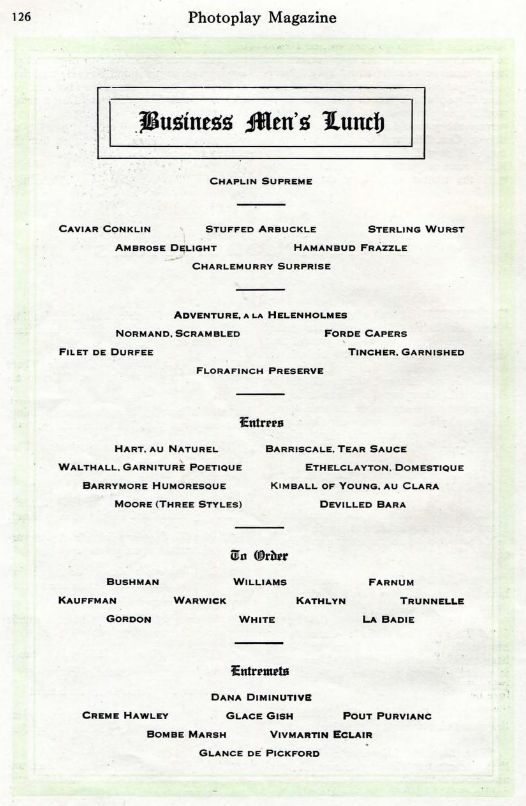
Hamanbud Frazzle - March 13, 2012

I came across a page titled "Business Men's Lunch" in the November, 1915 Photoplay.  I started looking at the items and noticed all sorts of interesting things like "Chaplin Supreme," "Stuffed Arbuckle," and "Kimball of Young, au Clara."  The only one I don't understand is "Moore (Three Styles)."  Is that Owen Moore, Mary Pickford's first husband?  "Glace Gish" is very funny.  Be sure to click on the image to see a larger version.

Friday, February 17, 2012

The Highest Priced Picture Ever Shown in Corpus Christi! -- February 17, 2012

This week at the AMUSU (think about it) Theater in Corpus Christi, TX, Charlie Chaplin in The Kid, supported by Jack Coogan, also a Snub Pollard comedy and Literary Digest Topics of the Day.  Wow, what a show.  Chaplin's young costar was usually called Jackie Coogan; his dad was billed as Jack Coogan.   I wonder if The Kid was really "The Highest Priced Picture Ever Shown in Corpus Christi!"

From the 04-July-1921 Corpus Christi Caller.Be sure to click on the image to see a larger version.

Thursday, January 19, 2012

Treasures 5: The West #3 -- January 19, 2012


One of my Christmas presents was the fifth Treasures From the American Film Archives, The West.

Disc three starts with The Lady of the Dugout, which stars and was produced by former bank and train robber Al Jennings, allegedly based on true events in his life.  Jennings, who once shared a prison cell with O. Henry, was known for telling stretchers, so I wouldn't accept the movie as a documentary, but it does have a very realistic feel to it.  The only parts that didn't feel real were the Mojave Desert standing in for Oklahoma and Tehachapi with its huge mountains representing a Texas town.  Jennings and his brother Frank were good, understated performers.

The Passing of the Oklahoma Outlaw was made in 1915 by a group of lawmen as a response to and earlier, now lost, Al Jennings movie.  Marshal Bill Tilghman and two others produced the movie and appeared in it, along with other peace officers and at least one real bandit, Arkansas Tom Jones.  Tilghman and his partners felt that other movies glamorized bad men.  This one, which unfortunately exists only in parts, takes a different approach.  It includes bits about the original Wild Bunch and Cattle Annie and Little Breeches.  I liked the subtitle "Outlaws do what they do because they are what they are."  That would be a good line for a film noir.  The image above is an ad from the 09-June-1920 Tulsa Daily World, announcing a showing of The Passing of the Oklahoma Outlaws (an alternate title) with a personal appearance by Marshal Bill Tilghman. Be sure to click on the image to see a larger version.

"The Girl Ranchers" is a 1914 Nestor one-reeler, which was distributed by Universal.  It was silly, but fun.

"Legal Advice" was a 1916 Selig Polyscope one-reeler written by, produced by, directed by and starring Tom Mix.  It may have been the first entire Mix Selig movie that I have seen.  It was a funny story about a pretty female lawyer who came to a western town.  My wife enjoyed the powerful wind blowing through the interiors.  The lawyer had to hold down her dress during one scene.  The end was disturbing.

Womanhandled was a 1925 Paramount feature, directed by Woody van Dyke and starring Richard Dix and Esther Ralston.  It was a comedy, making fun of western movie cliches.  The movie includes scenes shot on location in Central Park and Houston, Texas.  The scenes by the Houston train depot include lots of streetcars.  Richard Dix was actually funny in this movie.

"Beauty Spots in America: Castle Hot Springs, Arizona" is a 1916 Essanay split reel which shows life around the elegant resort.

"The Romance of Water" is a 1931 one-reeler produced by the Los Angeles Department of Water and Power to justify their stealing water from the Owens Valley.  It doesn't mention the water war and the dynamiting of the acqueduct.

"A New Miracle in the Desert" is an item from a Hearst Metrotone newsreel which tells about the Colorado River acqueduct, which allowed Los Angeles to steal water that it didn't even need.

"The West in Promotional Travelogues" is a group of excerpts from various travel movies, including Edison's 1898 "Sunset Limited," a view of the Georgetown Loop, and tours in Yosemite and Yellowstone.

I enjoyed the whole set.  I'm grateful to my family for the gift.  I recommend it highly.

Disc one: http://cablecarguy.blogspot.com/2012/01/treasures-5-west-1-january-11-2012.html

Disc two: http://cablecarguy.blogspot.com/2012/01/treasures-5-west-2-january-12-2012.html


Sunday, January 15, 2012

His Lordship's Dilemma -- January 15, 2012

WC Fields' second movie, "His Lordship's Dilemma," is lost.  It was produced in 1915 by Gaumont.  "John T. Rocks and the Flivver" was a Thanhouser production.  "The Great Question," not to be confused with DW Griffith's The Greatest Question, was an American Film Manufacturing Company production.

The ad is from the Omaha Daily Bee, 24-October-1915.

Wednesday, January 11, 2012

Treasures 5: The West #1 -- January 11, 2012

One of my Christmas presents was the fifth Treasures From the American Film Archives, The West.

Disc one starts with a Biograph split reel comedy, "The Tourists," directed by Mack Sennett in 1912.  Mabel Normand and her companions get off a Santa Fe train in Albuquerque and Mabel is very enthusiastic about the crafts sold by Native American women in front of the Fred Harvey Company's Indian Building.  Failing to get back on the train before it leaves, Mabel wanders away from her party and into the area where the Native Americans live.  She flirts with a man called "Big Chief" until his wife and other ladies chase Mabel and her friends onto the next train, which pulls out with a Santa Fe California Limited drum sign clearly visible on the observation platform.

"The Sergeant" is a 1910 Selig Polyscope one reeler that was mostly shot in the Yosemite Valley.  This movie is one of the cache discovered in the New Zealand archive.  It was preserved with funds that we helped raise in the the 2010 For the Love of Film Blogathon (http://cablecarguy.blogspot.com/2010/02/why-do-we-need-to-preserve-films-brief.html).  It stars Hobart Bosworth as a cavalry sergeant who loses his stripes when he goes for a ride with the Colonel's daughter.  Their horses get stolen by a "renegade" and they spend the night out.  Later the cavalrymen and the daughter are trapped by attacking Native Americans.  The former sergeant dives into the river to get help.  The film was by Francis Boggs, an important early director who was shot to death in Los Angeles the next year.

Salomy Jane is the only surviving feature produced by the California Motion Picture Company in San Rafael and at the Russian River.   In his commentary Gary Scharnhorst does a good job of explaining how the movie is related the the Bret Harte story and Paul Armstrong's stage play.  It stars the beautiful Beatriz Michelena, wife of producer George Middleton.  She was good.  The advertisement above is from the 20-January-1915 Bisbee, Arizona Daily Review.  Alco Film Company, the distributor, did a poor job.

"Sunshine Gatherers" is a 1921 Prizmacolor one reeler which promotes the Del Monte company's canned fruits.  It opens with a cheerful history of the missions of California.  The two-color Prizmacolor process gave good results.

"Deschutes Driftwood" is a 1916 documentary shot along the Oregon Trunk Lines, showing the adventures of Weak Kneed Walter, a hobo who keeps getting tossed off of trains.  There are excellent views of the bridges and other features along the line.

"The 'Promised Land' Barred to 'Hoboes'" is a brief segment from a 1936 Hearst Metrotone newsreel, which documents the Los Angeles Police Department's humanitarian project to intercept migrants at the California border and kick them out if they didn't have money or a waiting job.

"Last of the Line" is a 1914 New York Motion Picture Company two-reeler which stars Japanese actor Sessue Hayakawa and his wife Tsuru Aoki as Native Americans.  The rest of the tribe was played by actual Native Americans.  Thomas H Ince produced this story of a chief's son, Hayakawa, who returns to the reservation ruined by his education in another world.

"The Indian-detour" is a 1926 one-reeler promoting the Santa Fe and Fred Harvey Company's special excursion which allowed riders on transcontinental trains to get off in Las Vegas, New Mexico or Albuquerque and take a three-day trip by Harveycoach (bus) or Harveycar (auto) to visit various Native American sites.

"Native Americans in Newsreels" includes clips from several newsreels showing Native Americans lobbying in Washington DC and visiting other locations.

"We Can Take It" is a 1935 silent short by the USDA, documenting the work of the Civilian Conservation Corps.  The commentary points out that many of the scenes are staged, and that the camps were actually segregated, but the movie gives a good idea of the good work done by the Corps.  Some of the flood control and fire prevention projects would be considered wrong today, but they were considered the right thing to do at the time.

I'll do Disc Two another day.

Disc Two: http://cablecarguy.blogspot.com/2012/01/treasures-5-west-2-january-12-2012.html

Disc Three: http://cablecarguy.blogspot.com/2012/01/treasures-5-west-3-january-19-2012.html

Friday, October 21, 2011

Slapstick #14 -- October 21, 2011

An ad for Harold Lloyd's second talkie, Feet First, from the Perth, Western Australia Sunday Times, 08-March-1931.  Feet First concluded with Harold climbing a tall building, as he had in Safety Last.  I think the climb worked better in Safety Last because Harold's cries and the other noises made the scene in the talkie too realistic.

We had another earthquake last night.

The Libyan people finally caught Colonel Gaddafi.  I hope they find peace.

Thursday, October 20, 2011

Barbara Kent, RIP -- October 20, 2011

I was sad to learn that actress Barbara Kent, a native of Canada, has died at the age of 104.  She was virtually the last surviving person who acted in an American silent movie as an adult.  She was Harold Lloyd's leading lady in Welcome Danger and Feet First.

Today we were supposed to have an earthquake drill at 10:30am, but it didn't happen.  In the afternoon, we had a real earthquake, about a 4.0.  I felt one short, sharp jolt.

Thursday, September 29, 2011

Her Husband's Trademark -- September 29, 2011

Gloria Swanson appeared in Her Husband's Trademark in this advertisement from the 26-March-1922 Ogden Standard-Examiner.  Look at her eyes.  The Birth of a Race, intended as a response to The Birth of a Nation, had sat on the shelf for four years.  Be sure to click on the image to see a larger version.

Thursday, September 22, 2011

Slapstick #13 -- September 22, 2011


Ben Turpin and Phyllis Haver starred in Mack Sennett's feature comedy Married Life.  Turpin, who had a long career in silent and sound movies, was famous for his crossed eyes.  Be sure to click on the image to see a larger version.  Note the prominent "NOT A WAR PICTURE."  War movies fell out of favor for a while in the early 1920s, but came back to popularity with movies like What Price Glory? and Lilac Time.

From the 25-February North Platte Semi-Weekly Tribune.