This post is part of For the Love of Hitchcock, The Film Preservation Blogathon, hosted again this year by Ferdy on Films (http://www.ferdyonfilms.com/ -- Sunday, Monday) and The Self-Styled Siren (http://selfstyledsiren.blogspot.com/ -- Tuesday, Wednesday), along with Rod of This Island Rod (http://thisislandrod.blogspot.com/ Thursday, Friday).
I hope to contribute these articles this week:
Monday -- Dial HOllywood 9-2411 for Hitchcock
Tuesday -- Hitchcock -- Berdarold, Piccy, London
Wednesday -- Alfred Hitchcock, SRO, RKO, UA, Univ
Thursday -- Hitchcock -- Club: Royal Auto
Friday -- Hitchcock -- He Has Had a Non-Stop Career
Click on images to see larger versions. The image at the top of the page is a full-page ad from The 1963 Film Daily Year Book of Motion Pictures.
Alfred Hitchcock was a rare creative artist in the movie business, but he had to function within the studio system for most of his career. I wanted to document the way he fit in. For this installment of the blogathon, I went through several yearbooks from the 1920s and 1930s and dug up some interesting references to Hitchcock.
Many industries publish annual books which describe the people who work in them and what they have accomplished. In the film industry, this was a useful way to determine whether someone who said he had worked for DW Griffth or CB DeMille really had.
Some of these yearbooks and many other valuable resources are available in the Media History Digital Library (
http://mediahistoryproject.org/).
The Film Daily, "The Daily Newspaper of Motion Pictures," a major source of news for the film industry, also published a yearbook starting around 1918.
The 1927 edition of the
Film Daily Yearbook lists Hitchcock's first two directorial credits,
The Pleasure Garden and the
Mountain Eagle.
The 1927 edition also lists Hitchcock's writing credit on the Graham Cutts movie
Woman to Woman.
I felt compelled to include this wonderful full-page ad for Buster Keaton.
The 1929 Motion Picture Almanac was published by
The Exhibitors Herald-World.
Hitchcock's
Easy Virtue is listed right after C B De Mille's
Dynamite.
Hitchcock's
The Ring is listed with a couple of movies I have never heard of.
Motion Picture News was a trade paper that merged with
The Exhibitors Herald-World to form
The Motion Picture Herald in 1930. As described above in the 1929 edition, the
Motion Picture News Blue Book was a collection of biographical information about people in the industry. This edition also included some interesting ads.
Hitchcock's entry leaves out his earliest movies.
-
John Ford, the smiling Irishman.
Harold Lloyd looks as if he is singing in this ad for his second talkie,
Feet First.
Jean Hersholt's ad has the most interesting portrait. I cannot make out the artist's signature. "Appointed by His Majesty King of Denmark to head Danish constellation of athletes competing in Olympic Games to be held in Los Angeles in 1932."
The ad for Mickey Mouse Sound Cartoons mentions that Disney was still using the Powers Cinephone system. Someone should write a book about Pat Powers.
Lloyd Hamilton was appearing in sound comedies for Educational.
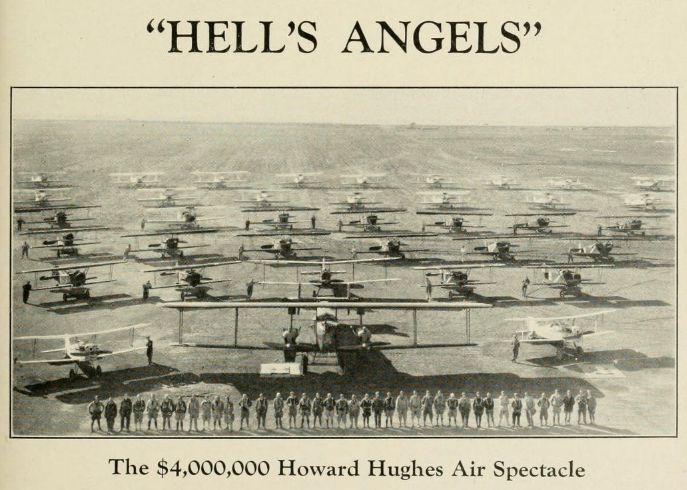
Howard Hughes was promoting
Hell's Angels.
Harry Langdon was working for Hal Roach.
The Film Daily Product Guide and Directors' Annual was a mid-year supplement to the
Film Daily Yearbook.
Hitchcock's biographical entry has his year of birth wrong. It should be 1899.
The only Hitchcock production listed is
The Woman Alone. This was based on Joseph Conrad's
The Secret Agent and released in Britain as
Sabotage. The Woman Alone was the title for it's initial release in the US. It was reissued in the US as
I Married a Murderer. Hitchcock complicated matters further by releasing a movie called The Secret Agent, which was based on a story by W Somerset Maugham.
As a railfan, I had to include this ad for the Fitzpatrick Traveltalks, which turn up frequently on TCM. It features a Southern Pacific GS (Golden State) 4-8-4, in Coast Daylight colors, which is posting next to Central Pacific locomotive 1, the C P Huntington, a unique 1863 4-2-0T which is preserved at the California State Railroad Museum (
http://www.csrmf.org/).
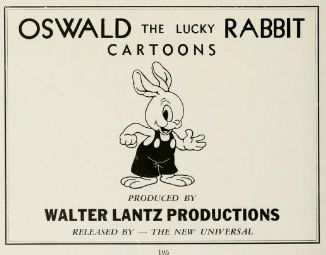
Oswald the Lucky Rabbit was stolen from Walt Disney. The Disney corporation recently got him back.
Sphinx Films Corporation produced Yiddish-language movies, including the famous "Yiddle With His Fiddle," starring Molly Picon.
The 1937-1938 edition of the
International Motion Picture Almanac was edited by Terry Ramsaye, who had published
A Million And One Nights: A History of the Motion Picture Through 1925, a pioneering book about cinema.
Cameraman John Cox had worked on five Hitchcock movies, including
The Ring and
Blackmail.
Edgar Clarence was "(i)n charge of architectural decor" for
Blackmail.
Graham Cutts is listed as an "independent director." The entry mentions
The White Shadow.
Hitchcock's entry has the wrong birth year.
Waltzes from Vienna and
Strauss' Great Waltz are UK and US release titles for the same movie.
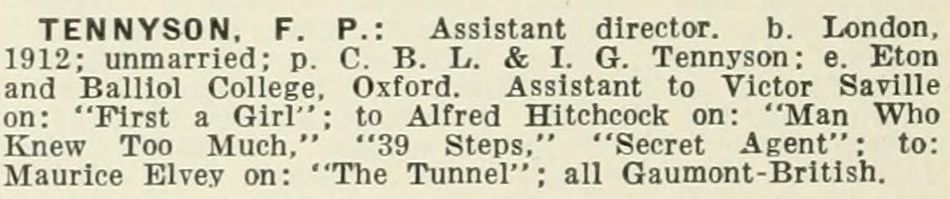
F P Tennyson was assistant director on several Hitchcock movies at Gaumont-British.
A list og Gaumont-British releases includes
The Woman Alone and "Alfred Hitchcock Production (Untitled)." The latter could have been
The Girl Was Young/
Young and Innocent or
The Lady Vanishes.
King Solomon's Mines with Paul Robeson and
Dr Syn with George Arliss are the only other ones I have heard of.
Hitchcock had a small ad in this edition. I like the design.
I guess
Hidden Power was yet another potential title for
Sabotage/
The Woman Alone/
I Married a Murderer.
A list of literary properties give the film's release title in the UK,
Sabotage.
Another item on the list is that "Untitled Original."
Several big studios had multi-page ads that ran on every odd-numbered page over a large span. I was happy to see entertainer Bill Robinson featured in 20 Century-Fox's ad.
Laurel and Hardy fans will recognize Boris Morros as producer of
The Flying Deuces.
Actor Paul Muni shared a page of the Warner Brothers ad with Porky Pig.
The Disney ad features the boss along with Mickey Mouse and Donald Duck.
I like the picture of western star Buck Jones.
Edward Everett Horton's ad is elegant.
An ad for Alliance Films mentions two directed by Graham Cutts,
Aren't Men Beasts? and
Radio Review of 1937.
Thank you to Ferdy on Films (http://www.ferdyonfilms.com/), The Self-Styled Siren (http://selfstyledsiren.blogspot.com/) and This Island Rod (http://thisislandrod.blogspot.com/) for organizing this blogathon. I'm having fun and learning.
Please consider donating to the National Film Preservation Foundation. For the Love of Film III is raising money to place The White Shadow, a 1923 Graham Cutts movie on which Alfred Hitchcock served as assistant director, on the internet for free viewing.