Showing posts with label otr. Show all posts

Saturday, August 9, 2025

Radio Music for Film -- August 9, 2025

Film Daily, 27-August-1925

Radio was a hot topic in 1925. Ufa, the big German film production company, did an experiment with RCA. An audience of 500 at the Briarcliff Lodge, a ritzy hotel in Briarcliff Manor, New York watched Fritz Lang's Siegfried, which was part one of his adaption of Die Nibelungen. During the first half of the film, the article says "there was no orchestra at that showing." During the second half, guests heard a broadcast on RCA,'s station WJY, which carried a score from the Century Theater in New York City. Composer and conductor Hugo Riesenfeld did the arrangement and led the orchestra. It must have been difficult to keep the music in sync with the movie. 

Automobile Blue Book, Volume One, 1919

New York Daily News, 28-August-1925

Springfield Morning Union, 23-August-1925

This article about the broadcast says how the synchronization problem was taken care of: "A trained musician will be stationed with the projection operator who will instruct the operator as to the speed od showing the film in order to coordinate with the music coming in via the air route."

This seems like an expensive way to bring orchestral music to theaters in small towns.


Film Daily, 27-August-1925

Radio Film on Coast

15 Theaters Screen Special Reel and
Hear Voices of Players in Perfect Synchronization

Los Angeles -- Fifteen theaters on Monday night projected a reel specially prepared, and at the same time broadcast through their radio receiving sets a talk by the principals in the picture in perfect synchronization.

A new angle touching on the possibilities of the radio and the motion picture is believed to have been hit upon. While this particular attempt savors strongly of Metro-Goldwyn-Mayer publicilty its import cannot be overlooked. The studio prepared a picture with Norma Shearer and Lew Cody as central figures. It was designed to exploit "A Slave of Fashion" in which both appear. By arrangement with the Examiner, Station KFI and the Freed-Eisemann Radio Corp., the picture was projected simultaneously at nine o'clock in fifteen theaters of the West Coast chain, including the Cameo, Alhamra, Criterion, Strand, Circle, Highland, Rivoli, Rosebud, Alvarado, De Luxe, Apollo at Hollywood and Liberty at Long Beach.

While Miss Shearer and Cody talked at the station, the operator in each of these theaters donned headphones and cranked his machine in unison with the ticking of the metronome, all metronomes being calibrated in harmony with the master mechanism at KFI. The master film was also shown at the broadcasting station in order to give the players their cues when to talk, pause, laugh and inflect the voice. The picture in itself was out and out exploitation. It showed Miss Shearer and Cody leaving their homes for KFI and their arrival. In the last portion, extreme close-ups of them speaking into the microphone were shown, revealing their lip movements for an extreme synchronization test.

The results were proclaimed in no uncertain fashion. The exploitation value is held to be so tremendous by M.-G.-M. that another performance will be staged tonight at Loew's State when the broadcasting will be done in full view of the audience, revealing exactly how it is done.

One important figure here expressed the opinion that the test was sufficient proof to him that radio films were a definite possibility and that one reel dramas with all action spoken might soon become a reality through the air.

Douglas Shearer, brother of Norma worked out the details and conducted the first experiment. The Los Angeles critics praised the effort highly.


Partial Success Here
Static Interferes with "Siegfried" Experiment, But Sponsors Claim
It's Feasible

The broadcasting from the Century, of the Wagnerian musical score for "Siegfried" to Briarcliff Lodge for a special showing of this production on Tuesday night may mark a new development.

This initial experiment is the first step in an attempt to develop a practical method for supplying theaters in small towns with special musical scores played by a high grade orchestra in a big city first-run. Joe Fliesler of Ufa sponsored the idea and he arranged with Major General J. G. Harbord, president of the Radio Corp. of America to broadcast the score through station WJY.

By way of contrast, the first half of the picture was shown without any musical accompaniment to the hundreds of guests at the Lodge. Alongside the screen stood the radio sets ready to tune in for the second half. Exhibitors will be interested to know the steps necessary to bring special orchestra music into their theater to synchronize with their screening of a feature.

The Century screening was showing at a speed of 85, and the music was synchronized to that speed. The Briarcliff operator ran his machine at the same speed. The radio operator tuned in a few minutes before the given time of the screening of the second half. As both pictures were being screened in perfect time together, the synchronizing over the radio became purely automatic. It is held to be easy to take up any variations in the music by increasing the speed of the projector.

In this experiment, results were not conclusive as the wrong broadcasting station was selected, Briarclifif Lodge being badly situated to pick up WJY. Static was present, and made necessary tuning out at frequent intervals. But there were stretches when the orchestration 35 miles a way came through perfectly, and in accurate synchronization.

The Ufa was satisfied with results obtained under these unfavorable conditions. It was said that it represented only the first step in a series of experiments. The opinion was expressed that ultimately it will be possible for example for Famous through the new Paramount theater to broadcast the musical score on all its features to every house in neighboring towns which happens to be playing the current feature.

The whole plan is held to be one of mechanical principles involving nothing but proper team work between a radio station, and the theaters which are to receive the synchronized orchestration. Any problems that may arise are said to be only those that confront any owner of a radio set.

Ordinarily the director of the orchestra synchronizes his music to the film. Here the process is just reversed -- the Film is synchronized to the music. The benefit to the exhibitor apparently is that it gives him the radio to appeal to the radio fans, as well as exceptional music of big city orchestras not ordinarily secured even over the radio.

The reaction of the audience at Briarcliff was very favorable, judging from comments heard after the performance.


Busy on Radio Movies

Writing in the Evening World yesterday, George R. Witte stated that Col. Edward H. R. Green, son of Hetty Green, is experimenting with the sending of motion pictures by wireless. He has conducted a number of expensive experiments but to date has kept the extent of his progress secret.

C. Francis Jenkins, Washington inventor, has likewise been working on the transmission of motion pictures through the air and only recently claimed to have perfected his invention. Even more recent than this is the word from Madison, Wis., of the success along same lines met by Douglas F. W. Coffey, a college student who has wirelessed motion pictures a distance of eight miles.

Meanwhile, in the Los Angeles area, fifteen theaters showed a special one-reeler. Stars Lew Cody and Norma Shearer promoted their film A Slave of Passion. They broadcast their dialogue from radio station KFI and synchronization with the film in the fifteen theaters appeared to work. The projectionist in each theater wore headphones and timed their cranking using a metronome. Norma's brother Douglas was involved in the experiment. He later got a credit as recording supervisor on nearly every M-G-M talkie for twenty years.

The showing of Siegfried at the Briarcliff Lodge did not go smoothly because the radios could not pick up the station without static. 

The item also mentions three experimenters who were working on mechanical television. 

Pasadena Post, 24-August-1925

"Radio-Cinema." That is a new one on me.

Long Beach Press-Telegram, 24-August-1925


Saturday, August 2, 2025

Krazy Kat -- No "Officer Pupp" Today -- August 2, 2025

San Antonio Light, 07-August-1924

I love George Herriman's Krazy Kat. Ignatz breaks through the fourth wall. Click on the image to see a larger version.

Brooklyn Times-Union, 11-August-1924

I see that Boston radio station WNAC had a show called the "Krazy Kat Kiddies Klub." I'll have to look into that.

Washington Times, 30-June-1918


Wednesday, April 9, 2025

Educational Players Do Their Stuff on the Air -- April 9, 2025

Moving Picture World, 04-April-1925

Radio station KFWB went on the air in March, 1925. It was founded by Warner Brothers and served as a publicity arm for the studio. KFWB no longer belongs to Warner Brothers, but it is still on the air.


Educational Players Do
Their Stuff on the Air

JACK WHITE'S Mermaid Comedy Company, together with performers appearing in other units producing comedies for distribution through Educational Film Exchanges, Inc., last week staged a very successful exploitation tieup when stars of the various companies broadcast a program from the recently opened radio station KFWB at Los Angeles, operated by Warner Brothers.

The program was opened by Eddie Nelson, now starring in Mermaid Comedies, who delivered a monologue and some of the vaudeville chatter which he used on the Orpheum Circuit in the West, where he is known as "The Sunkist Kid." This was followed by the Mermaid Quartette which sang two numbers.

Following this came Clem Beauchamp, an assistant director and a promising lyric tenor, who delivered two songs. The O'Neal sisters, Zelma and Bernice, then sang two of their latest songs, "When You and I Were Young, Maggie," a la 1925, and "Log Cabin." Zelma O'Neil sang a special comedy number, "I'm a Pickford That Nobody Picked," one of her successes from Harry Carroll's "Pickings," the show in which she was appearing when Jack White discovered her. Miss O'Neal is a Cameo star.

Lige Conley, Mermaid star, followed with a display of his versatility in rendering a piano, banjo and saxophone solo. At this point the entire radio program was tied up with the showing of two Mermaid Comedies in Los Angeles, when it was announced that Conley could be seen at Loew's State in "Fast and Furious" and in "What a Night" at the California.

Joseph Diskay, the tenor, a favorite with radio fans, contributed his services to the program and sang two numbers, and Miss Hilda Goldman, operatic soprano, also popular with radio fans on the West Coast, obliged with selections.

Thursday, March 13, 2025

St Patrick Radio Program on KPO -- March 13, 2025

San Francisco Bulletin, 16-March-1925

Saint Patrick's Day is coming.

100 years ago this month, on the eve of Saint Patrick's Day, San Francisco's KPO broadcast a special program. KPO became today's KNBR (680 Kilohertz).
+

San Francisco Bulletin, 16-March-1925


Thursday, February 20, 2025

The Angry Dane -- February 20, 2025

London Daily Telegraph, 19-February-1925

In 1922, John Barrymore played Hamlet 101 times on Broadway and then toured the US until early 1924. In 1925, he took the play to London. 

At the San Francisco Film Festival, I saw a test he did in 1934 or 1935 for a movie adaption of Hamlet, but he was having memory problems. In 1937, as part of a series called Streamlined Shakespeare, he played the part on the radio.

London Daily Mirror, 20-February-1925

THE ANGRY DANE
Mr. Barrymore's Novel Hamlet -- Miss Fay
Compton as Ophelia
By Our Dramatic Critic

Great interest was taken in the Barrymore "Hamlet," produced last night at the Haymarket Theater before a distinguished audience, which included the Earl of Oxford and Asquith.

Mr. John Barrymore's Hamlet is regarded in the States as a great histrionic achievement. This verdict would seem to have been endorsed by last night's audience, for enthusiasm was terrific.

It may be said at once that Mr. Barrymore is not the greatest Hamlet one has seen, he is a most interesting, accomplished and novel one, not reaching perhaps the ultimate profundities of the character, yet illuminating it always, and throwing into relief the natural and human qualities of the man.

Mr. Barrymore is not so much, the melancholy as the angry Dane; the supreme instance of the man with a just grievance which preys on his mind until he has purged his conscience in revenge.

The novelty of the impersonation lies in the modern or colloquial note that Mr. Barrymore strikes.

The whole company is excellent. Fay Compton as Ophelia plays the part with a power of suggestion in her acting that has surely never been surpassed. She not only distils the essential pathos of the character but makes Ophelia a more real woman than one has seen her made before.


Tuesday, February 11, 2025

KGO -- Seven Keys to Baldpate -- February 11, 2025

Oakland Post-Enquirer, 26-February-1925

Radio station KGO, which is still on the air, was General Electric's station in Oakland. One night in February, 1925, KGO broadcast George M Cohan's play Seven Keys to Baldpate, a comic mystery which was based on the first novel by Earl Derr Biggers, who later created Charlie Chan. Director Wilda Wilson Church was a pioneer in developing drama on radio.

Oakland Post-Enquirer, 26-February-1925


Friday, January 31, 2025

Kirk Douglas Heads Great Gatsby Play on the Family Hour -- January 31, 2025

Sioux City Journal, 01-January-1950

Family Hour of Stars was a CBS Radio program that ran from 1948 to 1950. It featured a repertory group of stars who played in "radio adaptions of great works of literature."

On 01-January-1950, Kirk Douglas starred in F Scott Fitzgerald's The Great Gatsby. Douglas played Gatsby, so I imagine the character was more in the foreground than Gatsby is usually.

Friday, January 24, 2025

Get Ready for Hard Realism -- January 24, 2025

Fresno Bee, 05-January-1925

Jack Webb began his radio career in San Francisco, where he wrote and performed in several shows. Dragnet, produced in Los Angeles, came on the air in 1949. Webb tried to make the show as realistic as he could. Dragnet moved to television in 1952.

Wednesday, January 8, 2025

Blackface to Radiate Laughs -- January 8, 2025


San Francisco Bulletin, 13-January-1925

Blackface was a popular form of entertainment 100 years ago, even on the radio where the burnt cork was not needed. I am not familiar with the vaudeville team of Chic Mcguire and Tom Brisendine. They performed during a break in a musical broadcast on San Francisco radio station KFRC. Please excuse the racism.

San Francisco Bulletin, 13-January-1925


Wednesday, December 25, 2024

Christmas, 2024 -- December 25, 2024


Santa Claus, using a radio loudspeaker, wishes San Franciscans a Merry Christmas.

Merry Christmas, everyone. Peace on Earth and goodwill to men (women, and children). We all need peace.

Sunday, October 27, 2024

Would YOU Put the Lights Out for Lights Out? -- October 27, 2024

Winona Daily Times, 17-February-1947

Halloween is coming.

Yesterday I wrote a bit about Arch Oboler's radio horror show Lights Out:

I later came across this item, which I like. It advertised an episode starring Boris Karloff.

"Would YOU Put the Lights Out for Lights Out?" 

Saturday, October 26, 2024

Turn Your Lights Out -- October 26, 2024

Oakland Tribune, 02-February-1972

Halloween is coming.

When I was a kid, Gene Nelson on KSFO played old radio shows at 10 pm on weeknights. I would be in bed by ten so I could listen every night unless the Giants' game ran late. I had to keep the radio's volume turned down very low because my dad was a light sleeper. 

Nelson often played episodes of great horror shows. Arch Oboler's Lights Out was hard to come by, but it had many wonderful stories including "The Chicken Heart" and "The Dark." 

When I took public speaking in high school, I reenacted Bill Cosby's routine about "The Chicken Heart." 

On this night, Nelson also played an episode of The Inner Sanctum, which was not as much fun as Lights Out, but which had one of the best openings of any radio show.

My wife and I both miss Dinner Jazz on KJAZ.

Friday, January 5, 2024

Comic Book -- Hop Harrigan -- January 5, 2024

listal.com

Among the characters featured in All-American Comics was Hop Harrigan, an adventurous aviator. He later appeared in a radio program and a movie serial.

Tuesday, May 9, 2023

Hale's Radio to Relay Music -- May 9, 2023

San Francisco Examiner, 25-April-1923


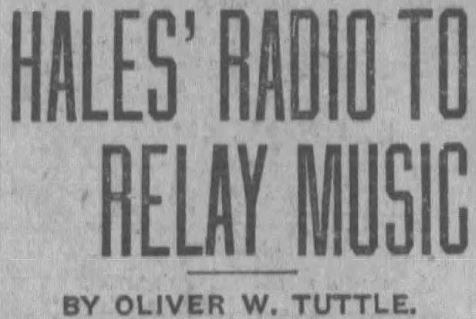
In the golden age of radio, remote music broadcasts from hotels and clubs were very common. Here is an early example from the Fairmont Hotel to station KPO. John W Weeks was Secretary of War in President Harding's cabinet. Known as an honest man, Weeks was not involved in the Teapot Dome scandal.

Hale's Radio to
Relay Music

by Oliver W. Tuttle.

Commencing Sunday night at 8:30 o'clock "KPO," Hale Brothers' big broadcasting station, will inaugurate its new remote control system from the Fairmont Hotel.

Controlled by a switch install on the huge panel in the "KPO" operating room, the magic waves of Rudy Seiger's famous Fairmont Orchestra.

This notable feat of radio engineering skill was made possible through the co-operation with Hale Brothers of the Fairmont Hotel and the Leo J Meyberg Company.

Since the closing down of the old "KDN" station at the Fairmont radio fans have constantly inquired why Rudy Seiger and his musicians were no longer to be heard via the radio. They will now be heard daily between the hours of 1 and 2 and 4:30 and 5:30 o'clock in the afternoon. The regular Sunday concert will also be a feature of the weekly program.

The concert Sunday night will be featured by violin solos by Rudy Seiger. The members of the orchestra are J. Chandler Smith, piano; Jasha Schwarzman, cello; Jerome Simon, violin; H. Seiger, base, and Rudy Seiger, conductor.

Secretary of War John Weeks will speak from Hale Brothers' studio tonight at 8 o'clock.

His words will be eagerly listened to by thousands of radio fans up and down the Pacific coast, who, through the medium of their receiving sets, will have this great opportunity of hearing a figure of national importance. An attractive musical program will also be broadcasted.

San Francisco Examiner, 25-April-1923

Rudy Seiger's Shell Symphonists Orchestra: "Destiny" (1928)

Wednesday, March 29, 2023

Broadcasting the Moxie Song -- March 29, 2023

Boston Globe, 12-March-1923

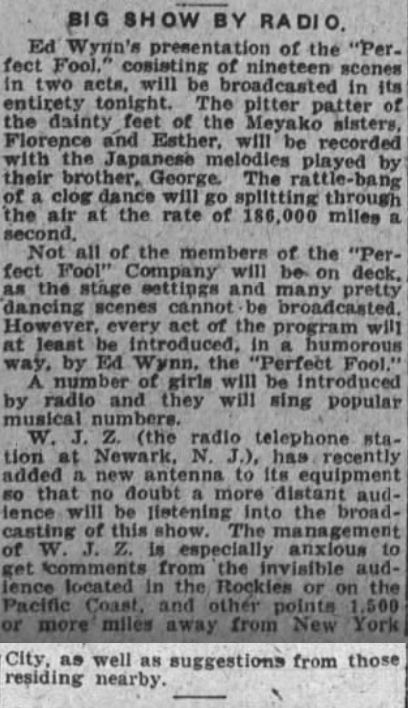
I have tried Moxie. It tasted funny, but I liked it. Ed Wynn was a popular comedian who toured in his revue, The Perfect Fool.

Brooklyn Times-Union, 19-February-1922

On 19-February-1922, Ed Wynn and most of the cast performed the show on WJZ in Newark. This was the first complete broadcast of a theatrical performance. 

Brooklyn Times-Union, 19-February-1922

Wednesday, October 5, 2022

Pulp -- The Shadow -- October 5, 2022

coverbrowser.com

Halloween is coming. The cover of the May, 1946 The Shadow looks pretty scary. 

When I was a kid, Gene Nelson on KSFO played old radio shows at night. He often played episodes of The Shadow. At some point, I found a copy of Jim Harmon's The Great Radio Heroes in the library and read that the Shadow was a very different character in the pulp magazines. That character sounded more interesting. The whole "clouds men's minds" didn't make a lot of sense, but wearing dark clothes and hiding in the shadows sounded cool. Later still, I got to read reprints and found that they were pretty cool.

Saturday, August 13, 2022

Program for Radio Fans -- August 13, 2022

San Francisco Examiner, 30-August-1922

All private/commercial stations shared the 360 Metre Wavelength (832.75683 Kilohertz) for their regular broadcasts. They also shared the 485 Metre Wavelength (618.12878 Kilohertz) for weather reports. 

KPO became today's KNBR (680 Kilohertz) and KQW San Jose became today's KCBS (740 Kilohertz). 

Sunday, April 17, 2022

KPO/KNBR 100 -- April 17, 2022


San Francisco radio station KPO began broadcasting 100 years ago today, on 17-April-1922. I remember reading about the 50th anniversary of successor KNBR in the Chronicle. The photos of the early studios caught my attention. 

The original KPO studios were in the Hale Brothers department store at Fifth and Market. Hale Brothers owned the station. In 1929, the station moved to the Hale Brothers annex, seen behind the corner store. In 1927, the station became an early affiliate of the NBC Red Network. NBC acquired KPO in the 1930s and changed the call letters to KNBC. Later, they wanted to use the call sign for a Los Angeles station and changed the San Francisco station to KNBR.

San Francisco Examiner, 15-April-1922

Notice that the article does not mention call letters. KPO's planned content sounds exciting. 

San Francisco Examiner, 18-April-1922

The radio schedule for the day after KPO went on the air. Notice that no call signs are used, just the names of the owners ("The Emporium") or the location of the station ("Rock Ridge, Oakland"). All stations shared a single frequency. KPO started out with a one-hour slice from 9am to 10am.

KNBR has carried radio broadcasts of San Francisco Giants games since 1979. 

Radio history from John Schneider's wonderful site Voices Out of the Fog:
http://www.sfradiomuseum.com/schneider/articles.shtml


Monday, March 21, 2022

First Test of Examiner Radio Wins Huge Success -- March 21, 2022

San Francisco Examiner, 24-March-1922

KUO, the radio station of the San Francisco Examiner, officially went on the air on 01-April-1922, but this article describes a test broadcast. Like many early stations, KUO did not last long. By 1924, it had stopped entertainment broadcasts and by 1927, it was off the air. I found it interesting that the article explained that listeners did not have to pay for the service. Note the use of "broadcasted" instead of "broadcast."


FIRST TEST OF EXAMINER RADIO WINS HUGE SUCCESS

ENTIRE STATE
RESPONDS TO
'K.U.O.' CALL

Army of Fans Hears Results of
Efforts for Their Benefit
Achieve Goal; Program Soon

By OLIVER W. TUTTLE.

Success.

This one word spelled the first test of "The San Francisco Examiner's" radio broadcasting station last night.

Promptly at 9 o'clock, when the ether wave was stiled from hum drum of radio traffic, Charles Gaal, licensed radio operator at "The Examiner's" high powered station, threw in a switch and spoke out into space.

His voice carried to distant points and announced:

"Hello, hello, hello. This is 'The San Francisco Examiner's' broadcasting station. K. U. O. -- K. U. O. Receivers will kindly give us a check. Thank you. Thank you.

Then followed a short musical concert to test the radiation.

A corps of radio engineers of the California Electric Supply Company stood breathlessly by as Gaal made his test. Only the dull hum of the motor interrupted the stillness.

The moment was the crucial test of weeks of work and in the construction of the apparatus, and like all radio broadcasting apparatus, and like all radio broadcasting stations, nothing definite is known until the first test is made.

Within a few moments after Gaal's voice went crashing out over space telephone messages and wires came in a steady stream into the radio editor, offering congratulations and explaining the merits of the test.

First honors for reporting the test went to C. W. Caplinger, 560 Geary Street. Then came J. A. Shea at 22nd and Mission Street. Oakland added its report with ten phone calls and closely following came wires from distant points.

California and the whole coast is on the wave of a new epidemic.

It is scientifically termed Radio-itis and everybody seems determinedly bent on joining the rapidly growing army of radio fans as o participate fully in the extensive musical and news programs which will shortly be broadcasted daily by "The San Francisco Examiner" from its high powered radio station on top of the Hearst Building.

Constantly the radiophone brings into the home or office music, voices and information broadcasted out over the ether wave of space.

Weird, to be sure, is this new-born infant of science, but it is so simple in delivery and charm that no home or gathering will be complete without it.

A small wooden box, possibly two feet square, with the proper equipment inside makes it possible to capture out of space the mystifying electric currents bringing into the room or hall concert music and other broadcasted data.

NO SERVICE COST.

Unlike other means of communication there is no cost for service. Like opening the window and inhaling the air this new means of entertainment fits any pocketbook and popularizes the family fireside.

You need not be a city dweller to participate fully in enjoying "The Examiner's" broadcasting program. receiving sets far flung in the mountain hamlets, on ranches down the valley or on ships at sea will all\ be in reach of the musical concerts and news programs which will be distributed broadcast from "The Examiner's" high powered station on the Hearst building.

Under government regulation the air is proportioned off into wave meters. Over one of these meters already assigned, "The Examiner" will broadcast its program. But all receiving sets can listen in. No government license if necessary for a receiving set and no fees are payable by the radio fan for the entertainment.


Station KUO broadcast from the roof of the Hearst Building at Third and Market Streets in San Francisco. I took the photo in 2010.

San Francisco Examiner, 24-March-1922

I keep telling people we need more women in technology. I wonder if I know any of Alice Daly's grandchildren. 
+

Tuesday, January 18, 2022

News of Wireless Talking Activities and Developments -- January 18, 2022

New York Evening World, 23-January-1922

Radio was becoming a hot topic in 1922.

New York Evening World, 23-January-1922

The station that started as WJZ is now known as WABC. It was owned by Westinghouse. WDY was owned by RCA. Note that Frankie Frisch (The Fordham Flash) of the New York Giants was giving a talk. Pittsburgh station KDKA was a pioneering station which celebrated its 100th anniversary in 2020. I wonder why the Governor of Kansas was speaking. Radio station IXZ was operated by the Clark University Radio Club of Worcester, Massachusetts.

New York Evening World, 23-January-1922