Showing posts with label Spanish-American War. Show all posts

Wednesday, March 20, 2024

El Generalissimo Wheeler -- March 20, 1899

San Francisco Call, 01-March-1899

During the Spanish-American War, the armored cruiser Cristóbal Colón was part of the Spanish squadron that was penned in by the US Navy at Santiago de Cuba. The squadron tried to run the blockade and escape on 03-July-1898. Cristóbal Colón was the last surviving Spanish ship before her crew beached her to avoid sinking. 

El Generalissimo Wheeler must have been named after General Fighting Joe Wheeler, who served the Confederacy as a general and volunteered to serve in the US Army during the Spanish-American War. 


EL GENERALISSIMO WHEELER
His Stirring Transition From the Cristobal 
Colon to Golden Gate Park.

WHEN the young: student of natural history goes out to Golden Gate Park to study the buffalo, the deer, the llama and other wild animals from American forests he will see Generalissimo Wheeler rooting contentedly for worms in the paddock. The Generalissimo came under, the American flag with Porto Rico, the Philippines, Guam and other spoils of war, and while he was not mentioned in the peace protocol or the subsequent treaty, he was none the less won by Yankee valor.

He was first seen industriously swimming away from the luckless Cristobal Colon when that Spanish warship was dying under the Oregon's battering shells off the Cuban coast. He was picked up by a boat's crew from the American vessel and carried, expressing his gratitude in hearty grunts, aboard the Oregon. He probably had been intended for a juicy roast on the table of the Spanish skipper, but the Oregon's guns saved his bacon, and Generalissimo Wheeler, as he was then christened, renounced allegiance to the baby King of Spain forever.

Piggy Wheeler accompanied the Oregon on her return trip around the Horn, and aboard of her reached Honolulu. The crew decided that the Generalissimo had seen enough of Spanish misrule, and fearing to take him to Manila, where some American soldier would steal him for the centerpiece of a camp  bean bake, they decided to present him to Golden Gate Park. He was therefore carried, squealing. vociferously, aboard the Australia and given in charge of Captain Houdlette. To-day his pigship will be presented to Mayor Phelan, with a letter and the compliments of the Oregon's gallant crew, and then Generalissimo Wheeler will be one of the 200 freaks of the park "zoo."

San Francisco Call, 31-August-1899

STATE FAIR WILL HAVE
A HERO OF THE WAR
EL GENERALISSIMO WHEELER, FAMOUS PIG.

EL GENERALISSIMO WHEELER, the great black pig, wallowing in happy contentment in the corral at Golden Gate Park, will be one of the features at the Sacramento State Fair. This pig has a history for bravery and daring, but his greatest accomplishment is a knack of avoiding danger and
coming out of all difficulties with an unharmed skin. When the Oregon was knocking sections out of the Christobal Colon, the pig jumped off the Spanish warship and swam toward the Oregon. He was picked up by a boat's crew and placed safely on board the pride of the navy. When the Oregon made her trip
around the Horn this prize bacon remained on board. At Honolulu the pig threatened to destroy the discipline of the ship, he was placed on shore. Captain Houdlette of the Australia guaranteed to freight the live animal to San Francisco, bestowing his individual care and attention upon it during the trip to this city. This was done, and in the last days of February Mr. Bacon Generalissimo Wheeler arrived. He was presented to Mayor Phelan and given special quarters in the park Zoo.

When Sacramento learns of the treat in store for it no doubt a reception welcome will be arranged in "Wheeler's" honor.

Monday, May 1, 2023

The Battle of Manila Bay -- May 1, 2023

Los Angeles Herald, 03-May-1898

These items from the 02-May-2023 Alexandria Gazette contain some of the earliest reports of the Battle of Manilla Bay, which took place 125 years ago, on May 1, 1898. The spelling of Manila varied in the original article. 

A NAVAL BATTLE.

A naval battle has been fought near Manilla. All advices from the scene of the engagement come by Spanish cable, but there seems to be no doubt that the American fleet won a victory in the two engagements which took place. From the best sources obtainable it is learned that the American fleet engaged the fortifications at Cavite and the Spanish gunboats at daylight Sunday, and after a severe action, during which at least two of the largest Spanish warships, including the Spanish Admiral's flagship, were destroyed, retired to land their wounded and refit. After a short interval the American fleet returned to the attack, which must have been disastrous to the Spanish fleet. The loss of life was undoubtedly very large. The American vessels suffered considerable damage. The captain of the Spanish flagship was killed.

The battle took place on the morning of May 1st. which, reckoning the difference in time, would be about 5 o'clock Saturday evening in Washington. From the fact that the Spanish still coutrol the cable at Manila it is apparent that the U. S. fleet has not yet taken that city.

Following are the official dispatches received at Madrid from the Governor General of the Philippines to the minister of war, Lieut. Gen. Correa as tc the engagement off Manila:

"Our fleet engaged the enemy in a brilliant combat, protected by the Cavite and Manila forts. They obliged the enemy, with heavy loss, to maneuver repeatedly. At nine o'clock the American squadron took refuge behind the foreign merchant shipping, on the east side of the bay.

"Our fleet, considering the enemy's superiority, naturally sullered a severe loss. The Maria Christina is on fire and another ship, believed to be the Don Juan de Austria, was blown up.

"There was considerable loss of life. Captain Cadarso, commanding the Maria Christina, is among the killed The spirit of the army, navy and volunteers is excellent."

A dispatch from Havana says : Admiral Bermejo, Minister of Marine joined the Cabinet council Saturday night and informed his colleagues that the Spanish forces had gained a victory in the Philippines. He asserted that he found difficulty in restraining his joyful emotion. A later official dispatch does not mention the destruction of any American vessel, although it says that the United States squadron finally cast anchor in the bay behind the foreign merchantmen.

A dispatch from Madrid, dated at midnight last night, says: El Heraldo de Madrid says that Admiral Montejo changed his flagship during the engagement or between the two encounters in order to better direct the maneuvers. In this way he escaped the fate of the commander of the Reina Maria Christina. The second engagement, according to El Heraldo, was apparently begun by the Americans, after landing their wounded on the west side of the bay. In the latter engagement the Spanish ships Mindanao and Ulloa suffered heavily. Ministers speak of "serious but honorable losses."

A dispatch from London says dispatches received there seem to make it clear that the Asiatic squadron of the United States, Admiral Dewey commanding, yesterday engaged and completely defeated the Asiatic squadron of Spain in the harbor of Manilla, in the Philippine Islands. During the two engagements that took place Commodore Montejo, commanding the Spanish fleet, lost three of his largest ships. His flagship, the armored cruiser Reina Christina and the armored cruiser Castilla, were burned and the cruiser Don Juau de Austria was blown up. Several other Spanish vessels were badly damaged.

Under the protection of the guns in the fortifications the Spanish warships opened fire on the American fleet. For several hours the harbor resounded with the roar of guns.
A shot reached the iron cruiser Don Juan de Austria. A terrific explosion followed and the ship was blown up causing great loss of life.

There was a heavy loss of life among the Spanish. The captain commanding the Reina Christina was killed. Commodore Montejor, commanding the fleet, shifted his flag from the Christina to the Isle de Cuba, a much smaller steel-protected cruiser, just before the Christina sank. Commodore Dewey's squadron left Subic bay, a few miles from Manilla, about four o'clock Saturday afternoon and proceeded toward Manilla. Under the cover of darkness he entered the harbor of Manilla, passing the forts. The batteries at the forts announced his arrival.

Both fleets lined up for battle about daybreak. The guns of the American warships began firing on the fortress of Cavite and the arsenal of Manila. Then the battle raged.

The American squadron about 9 o'clock in the morning drew off to one side of the bay and took refuge behind some foreign vessels. The ships had evidently suffered considerable damage. After some hasty repairs they returned to the conflict.

During this engagement the guns of Cavite maintained a steadier and stronger fire upon Admiral Dewey's ships than in the first encounter, but the American guns were used with teliing effect. As the smoke lifted it was seen that the flagship Reina Christina was on fire. This vessel was completely burned.

The cruiser Castilla, next to the flagship the largest and most powerful of the Spanish squadron, was burned. The cruiser Don Antonio de Ulloa and the Mindanoa were badly damaged in this encounter.

That the American squadron received serious damage in the engagement cannot be doubted. Early reports had it that five of Dewey's ships had been sunk. Later advices from Madrid put the number at two. The latest reports received from Madrid make no mention of any American ship being destroyed.

There were undoubtedly heavy losses in men on both sides. One apparent trust-worthy report states that the Spanish had two hundred killed and four hundred wounded.

Trustworthy details of the American loss of life will hardly be obtainable until Admiral Dewey has taken Manila or sent a vessel with dispatches to Hong Kong.

TO-DAY'S TELEGRAPHIC NEWS
The Victory at Manilla.

London. May 2 -- The afternoon papers to-day comment upon the victory of the U. S. fleet at Manilla. The Pall Mall Gazette says: "The earlier Spanish stories left no shadow of doubt that the Spanish fleet had been smashed and the later information this morning places it even beyond the possibility of a Spanish denial." The newspapers all discuss the ultimate fate of the Philippine Islands as a question in which the European powers are vitally interested and they agree in saying that another element of discord has been introduced into the far Eastern scramble.

A Madrid dispatch to the Evening News says the Queen Regent, who, it appears, had already heard of the reverse, declared that while the loss of so many ships was a misfortune, there was "satisfaction in the reflection that the Spaniards had covered themselves with honor." A dispatch to the Mail received from Madrid this morning says: "The Americans are now moving on Manilla, but there has beeu no capitulation yet."

The British governor of the Straits Settlement has sent a cable dispatch to the colonial office here saying the United States fleet "annihilated" the Spanish fleet in a two hours' engagement. ? The dispatch adds that Commodore Dewey last night demanded the surrender of all the torpedoes and guns at Manilla and the control of the cables, under pain of bombardment. General Augusti, the Spanish Governor General, refused to surrender them, and, it is supposed, the bombardment of Manilla is now procending.

London, May 2. -- The details of the battle at Manilla have been received at the British Colonial office. The dispatch announces that the United States fleet entered Manilla harbor at daybreak yesterday, stationing itself opposite the city. A fort opened fire on the American ships, whereupon they shifted their position to one near Cavite, in Manilla bay, engaging in a fierce fight against both the forts and the Spanish fleet. The engagement last (sic - JT) two hours, and resulted in the annihilation of the Spanish fleet. This dispatch adds that the American ships withdrew to their t magazine vessel, in the centre of the roadstead, for the purpose of coaling. One American vessel, the name of which is not mentioned, is said to have been disabled.

Berlin, May 2. -- The news of the victory of the United States fleet at Manilla was received here, except in government circles, with general incredulity. The newspapers expressed doubts as to its reliability. They said it was "derived mostly from American sources and, doubtless, had been grossly exaggerated or was baseless."

From Madrid.

MADRID, May 2. -- A dispatch to the Liberal from Manila says Admiral Montijo, the Spanish commander, acknowledges that the Spanish fleet has been completely demolished. He adds that the crew of the Spanish warship Mindanao has been saved. A member of the Cabinet this morning stated that the account of yesterday's naval battle sent by the Governor General of the Philippine Islands had been compietely born out by later dispatches. The last shot was fired at 11:30, when the American warships steamed off. The newspapers express a determination to avenge the defeat of the Spanish fleet. The conduct of the Spanish admiral in sinking the remnant of his fleet in order to prevent its capture is highly extolled by the press.

The Imperial advises the government to arm all the available shipping for the purpose of capturing and destroying American merchant vessels.

Further advices from Manila say the United States fleet has taken up a position in front of Manila and has established a blockade of the port. The population of Manila is fleeing from the city. A bombardment of the town is expected to take place to day.

The authorities here have adopted the most extreme military precautions to check the increasing public indignation at the disaster to the Spanish fleet. Martial law will be proclaimed if the government is "provoked over hostile demonstrations" in the streets. The feeling of discontent is everywhere. The military feel equally with the civil elements the effects of the disaster, in which, according to one announcement, "our inferior war craft, although they fought pluckily, perished through lack of foresight in responsible quarters.

It is now raining which may prevent he Second of May procession, as well as the bull fight. Both gatherings are liable to result in demonstrations. Senor Robledo, the conservative leader and former minister of justice, is expected to inaugurate a sensational debate in the chamber to-morrow, in which he will be backed up by the carlists and republicans. General Weyler, whose popularity is increasing, will also provoke a debate in the Senate.

Preparing for Action.

Key West, Fla., May 2. -- A demonstration by the fleet off the coast of Cuba is hardly expected to-day but it is understood a movement has been planned. A howling gale is now blowing and the sea is running high. There was a long conference on board the flagship New York yesterday, between Rear Admiral Sampson, Captain Evans, Captain Taylor and Captain Chadwick, the purpose of which could not be ascertained. Early yesterday morning tugs were then sent out, calling in all the other vessels of the fleet in that vicinity and at noon the ships were lying off the batteries, west of Havana and within eight miles of the shore. After the ships had remained in this position for several hours it became evident that no immediate movement was contemplated, as the fleet opened out and returned to their various stations along the coast.

News of the engagement between the United States and Spanish fleets at Manilla has not yet reached the Cuban blockading squadron, but they probably will be advised of it this morning.

The Blockade of Havana.

Key West, Fla., May 2. -- The blockade of Havana continues. The United States fleet is lying about ten miles off Morro Castle. The weather is fine and a stiff breeze is blowing. The British steamer Strathdee, from Progresso to Sagua la Grande, in ballast, was made to heave to at 1.30 this morning, after two shots had been fired from the flagship. The Strathdee proved her identity and was allowed to proceed, as Sagua la Grande is not a blockaded point. Captain Currie said he was stopped twice before during the night.

War Bulletins.

Madrid, May 2. -- The British consul at Manilla has had a conference with Commodore Dewey.

Hong Kong, May 2. -- It is announced at the cable office here that the transmission of messages to Manilla or from that place is interrupted.

London, May 2 -- It is believed that the Spaniards have cut the cable at Manila.

London, May 2. -- A cable message has been received at the foreign office here from the British consul at Manilla announcing that the bombardment lasted an hour and a-half and that the Spanish lleet was practically annihilated by the fleet of the United States.

London, May 2. -- The Parnellite members of parliament have sent the following dispatch to President McKinley: "In the names of millions of Irishmen, the Parnellite members of the House of Commons send you their congratulations on the brilliant victory of the American fleet.
(Signed) "John Redmond."

Portland, Maine, May 2. -- The United States cruiser Columbia arrived here this morning.

DENVER, Col , Mav 2. -- According to Col. W. J. Volkmar," Adjt.-Gen'L of the department of the Colorado, volunteers raised in the States west of the Missouri river will probably be sent across the Pacific ocean to hold the Philippine Islands.

New York, May 2. -- A Hong Kong dispatch says: The bombardment of Manilla has begun. The inhabitants are fleeing to (he country. The operators in the cable station in the midst of the forts have fled to save their lives.

Block Island, R. I., May 2. -- The cruiser New Orleans passed here at 10 o'clock bound east.

PROVINCETOWN, Mass., May 2. -- The cruiser San Francisco steamed into this harbor at 9:27 this morning and dropped anchor near the Katahdin.

As Heard at Paris.

Paris, May 2. -- A dispatch from Madrid says that, according to the latest dispatches, the British consul at Manilla, in his visit to Commodore Dewey, made representations, in behalf of the consular corps, against the bombardment of the town. The dispatch also says: "French, British and German war vessels are off Manilla. No Spanish warship surrendered and the majority perished. Two Spanish commanders were killed while resisting to the last, moment. The Spanish losses are estimated at four hundred men killed, including many natives. The American squadron attacked furiously both the Spanish squadron and Cavite, where it caused great damage."

Commenting on the battle, the Temps says: "The United States put into the balance a too crushing superiority of resources and forces to leave a doubt as to the result." Later the Temps says: "Directly Castilian honor has received the satisfaction it demands, will not the moment have come for Europe to say its word, and take as a basis for its mediatory action the wise advice of the Duke of Devonshire in his speech of Saturday evening?"

Foreign News.

London, May 2. -- The Evening Standard commenting on the American victory says: "Everyone will hope this prompt and decisive blow to the Spanish forces will lead to an early termination of hostilities, a hope which has been encouraged by the remarkable language of Senor Silvela in the Cortes, when he declared the Cuban problem is reduced to a question of honor for Spanish arms."

San Francisco Call, 27-January-1895

Commodore George Dewey's flagship, the Olympia, is preserved at the Independence Seaport Museum in Philadelphia.

Wednesday, February 15, 2023

Maine Destroyed in Havana Harbor 125 -- February 15, 2023

San Francisco Call, 16-February-1898

On 15-February-1898, US second-class battleship (or armored cruiser) Maine blew up in the harbor of Havana, Cuba. The incident, which was probably an accident, was one factor which led to the Spanish-American War.

On 15-March-1889, seven ships from the US, Germany and the UK were sunk by a typhoon while they were moored in the harbor of Apia, Samoa.

Enrique Dupuy de Lôme was the Spanish ambassador in Washington. He wrote a letter disparaging the United States and President McKinley. Cuban rebels shared the intercepted letter with the newspapers. This became another factor which led to the Spanish-American War.


MAINE DESTROYED IN HAVANA HARBOR

THE SHIP IS
BLOWN UP
AT ANCHOR

Four Hundred and Twenty
of Uncle Sam's Brave
Boys Are Killed.
One of the Most Awful Disasters
That Have Ever Overtaken the
American Navy, and Spain
is Open to Suspicion.

HAVANA, Feb. 15. -- The Maine has blown up. Captain Sigsbee and various officers saved, and he says he believes about 100 men were killed and injured. The vessel is now burning and is sinking to the bottom of the bay. The detonation was tremendous. All Havana alarmed.

San Francisco Call, 16-February-1898

HAVANA. Feb. 15. -- The American battleship Maine, lying at anchor here, was destroyed by an explosion at 10 o'clock to-night. Of her crew of 450 officers and men, only 33 are known to have been saved.

The explosion shook the whole city and threw Havana into a panic.

It is understood at this writing that Captain Sigsbee and a few of his officers were visiting a merchantman in the harbor at the time of the disaster and are safe.

None of the few survivors who have been seen can tell me how the explosion occurred. The injured are being taken on stretchers to the Casa de Socorro, where surgeons are in attendance.

James Rowe, the ship's cook, was the least injured of any that were brought in when I was there.

"I don't know, sir," he replied, speaking with difficulty. "I turned in my hammock at 8 o'clock and heard three bells strike. I don't remember anything until I felt myself turning over and over and falling heavily upon the deck, in a mass of smoke. I got on foot and worked my way on deck. When I got there the superstructure of the deck was dipping under water, and I jumped overboard to keep from being drawn down by the suction. "I was picked up by a boat from the Spanish man-of-war. Three more were picked up by the same boat. They were Daniel Cronin, a landsman; Charles Berryman, boatswain; Albert John, a seaman, and __ Bloomer, a landsman."

One poor fellow whose face is injured past all recognition is lying moaning in a cot in the hospital. I asked him his name and he mumbled back through horribly swollen lips: "My folks would feel uneasy if I told you."

So far as I can learn now the explosion took place in the magazine used for the storage of gun cotton for the torpedoes. The vessel lies with her bow wholly submerged and only a part of her stern showing.

The explosion shook the city from end to end, and created the wildest excitement. All the electric lights were blown out by the shock. Fire engines rushed madly from one district to another, and no one knew for certain from which point the explosion came.

Some shouted the report that it was the arsenal, others said it was a bomb, and it was not until 11 o'clock that the real cause was known.

Consul-General Lee, who was at the Hotel Ingleterra, received a telephone message from General Blanco telling him that the Maine had been blown up. Lee hastened to the palace, where the Cabinet is now assembled.

Admiral Manterola ordered that boats of all kinds go to the assistance of the Maine and her wounded. The Havana firemen also gave aid, tending carefully to the wounded as they were brought on shore. It was a terrible sight. General Zolano and the other generals were ordered by Captain-General Blanco to take steps to help the Maine's crew in every way possible. The correspondent went close to the Maine in one of the boats of the cruiser Alfonso XII, and saw others of the wounded who corroborate the statement of those first interviewed that they were asleep when the explosion occurred.

Captain Sigsbee said the explosion occurred in the bow of the vessel. He received a wound in the head. Orders were given to the other officers to save themselves as best they could. The latter, who were literally thrown from their bunks in their night clothing, gave the necessary orders with great self-control.

The first theory was that there had been a preliminary explosion of powder or dynamite below the water, but this was ascertained to be not true.

Admiral Manterola believes that the first explosion was of a grenade, but whether one of the ship's magazines blew up or whether a bomb was placed beside her and set off by the Spaniards is not known.

Because of the excitement in the city the military authorities ordered the troops to quarters, and the streets are filled with jostling crowds of excited citizens and soldiers.

San Francisco Call, 16-February-1898

SIGSBEE ASKS FOR
SUSPENSION OF JUDGMENT.

Wants to Know All the Facts Before
the American People Lay the
Blame Finally Upon Spain.

WASHINGTON, Feb. 15. -- I called upon Secretary of the Navy John T. Long at an early hour this morning, and he confirmed the Herald's dispatch that the Maine had been blown up and destroyed in Havana harbor. In answer to my questions, he said:

"Yes, I have received a report from Captain Sigsbee of the Maine, announcing that the battleship had been destroyed by an explosion in the harbor of Havana.

The captain cables that some were killed and many wounded, and that the Spanish soldiers did everything In their power to rescue those who were thrown into the water.

"Moreover the captain's dispatch speaks of the great kindness of the officers and citizens of Havana, who showered attentions upon the sufferers. They cared tenderly for the wounded. The captain, in his dispatch to me, also tells of the heroic work of the officers and men of the cruiser Alfonso."

"Mr. Secretary," I asked, "does Captain Sigsbee assign any cause of the explosion?"

"No," replied the Secretary; "I presume that as yet the cause is a mystery."

The following was the dispatch received by the Secretary of the Navy from Captain Sigsbee:

"Maine blown up in Havana harbor at 9:40 last night and destroyed. Many wounded and doubtless many killed and drowned. "Wounded and others on board the Spanish man-of-war and Ward line steamer. Send lighthouse tender from Key West for crew and a few pieces of equipment. Vessel still above water. No one had other clothes than those upon him.

"Public opinion should be suspended until further report. All the officers are believed to be saved. Jenkins and Merritt are not yet accounted for. Many Spanish officers, including representatives of General Blanco, now with me and express sympathy. SIGSBEE."

The officers referred to in the above dispatch, are Lieutenant Friend W. Jenkins and Assistant Engineer Darwin R. Merritt.

From the wording of the dispatch the Navy Department think it is possible that they were on shore at the time of the accident.

The Secretary of the Navy received another dispatch from Key West at the same time with the above, but its contents were not made public.

The orders for the light-house tenders were at once sent to Key West in plain language, thus avoiding the delay that would have arisen from the use of a cipher.

Secretary Long received Captain Sigsbee's dispatch but a few minutes before the Associated Press dispatches were handed him. He received the news with apparent calm, and his first act was to comply with Captain Sigsbee's request that assistance be sent from Key West. He wired Captain Forsythe at Key West to proceed with the naval tender Fern to Havana harbor.

Secretary Long then sent for Captain Dickens, and the two discussed Captain Sigsbee's brief telegram. No other naval officers were present, and besides the Secretary and Captain Dickens the naval colony here is ignorant of this disaster, the greatest which has befallen the American navy since the storm in Apia many years ago.

The Secretary is inclined to believe that most of the officers of the Maine were on shore at the time of the accident, as it was still in the night.

While neither the Secretary nor Captain Dickens is inclined to discuss the probable cause of the accident, several suggestions were ventured. They believe that it may have been caused by a fire in the bunkers, heating the bulkhead near a magazine, or that an accident may have occurred while inspecting high explosives for torpedoes. Of course, this is mere speculation, and the Secretary is anxiously waiting a more detailed report from Captain Sigsbee.

Later the Secretary sent another telegram to Key West, directing that the tender Mangrove also be sent to Havana.

Secretary Day received the following dispatch from General Lee:

"The Maine blew up at 9:40. The explosion occurred well forward, under the men's quarters, consequently many were lost. It is believed all the officers were saved, but Jenkins and Merrit are not accounted for. The cause of explosion is yet to be investigated. The Captain-General and the army and navy officers rendered every assistance. Sigsbee and most of his officers are on board the steamer City of Washington. Others are on the Spanish gunboat and in the city. I am with Sigsbee, who has telegraphed the Navy Department. LEE."

OFFICERS OF THE NAVY
HOLD HURRIED CONFERENCE

Great Excitement Created at Key
West by the Receipt of the
Startling News.

KEY WEST, Feb. 16. -- This has certainly been the most eventful night ever witnessed in Key West. The excitement commenced shortly before 10 o'clock last night, when the first report was received that the famous tug Dauntless had arrived at a port on the east coast and was taking on arms and ammunition for Cuba.

The celebrated little filibuster was reported to have arrived at Palm Beach this morning with a load of men and would sail before any attempt could be made to detain her. The information was immediately conveyed to the commanders of naval vessels in the harbor, who commenced to make preparations to intercept the filibusters.

It was ascertained there were only a few vessels here available. There were the torpedo boats Cushing and Ericsson and the supply boat Fern, which arrived yesterday from the fleet at Dry Tortugas. All the other naval vessels had been scattered at different points in the gulf.

Then came the report that the battleship had been blown up. This news was first received by the commandant of the station, who in turn communicated the information to the several officers in command. A telephone message was sent the commanding army officer at the barracks.

Meanwhile the news rapidly spread over the entire city, and the cable office became the center of attraction. The fact that the two torpedo boats were getting up steam and would be ready to sail added to the excitement.

A hurried conference was meanwhile being had between several naval officers present, and a line of action promptly decided upon.

The torpedo boat Ericsson was first to get under way. She steamed out with open throttles and headed for the westward. While it is not positively known where she has gone the impression is she has been dispatched to the Dry Tortugas to notify Admiral Sicard of the disaster to the Maine.

The Cushing is puffing at the wharf ready to steam out and apparently only waiting orders to proceed to Havana.

As I write this dispatch, at 3 a. m., the quartermaster of the supply boat Fern is sitting in the cable office waiting to receive any message that may come for the general.

Every Government vessel in the harbor is getting ready to sail for Havana as soon as orders are received.

THE MAINE PRACTICALLY
A NEW BATTLESHIP.

Was Built in 1890 at New York, and
Had a Complement of
874 Men.

The second-class battleship Maine was built at the United States navy yard at New York in 1890. Her dimensions are as follows: Length, 310 feet; breadth, 57 feet; draught, 21 1/2 feet. The Maine was of 6648 tons displacement. She was provided with engines of 9000 horse-power, and could maintain a speed of seventeen knots an hour. She carried twin screw engines, vertical and with triple expansion. Her armor was eleven inches in thickness. The fighting machinery of the battleship consisted of four 10-inch and six 6-inch breech-loading rifles. As a secondary battery she carried fourteen rapid-fire, four revolving cannon and four Gatlings. The cost of the battleship was $2,588,000. She had a steel hull and a complement of 874 men.

SPANIARDS ARE
NOW IN A MOST
WARLIKE MOOD

Clamoring for Conflict While the
Two Nations Are Closing
the De Lome Incident.

NEW YORK, Feb. 15. -- The Herald's Washington correspondent telegraphs: The administration offices were deeply gratified to-day by the Herald's announcement from Madrid that Spain would make a complete and satisfactory disavowal of the De Lome letter. This is the only authentic information which has reached here, the only official dispatch on the subject being the one received yesterday from Minister Woodford stating that Senor Sagasta had promised that a satisfactory disavowal would he made. In the light of this and the Herald's dispatch this morning the authorities now no longer hesitate to say that the incident is closed, and that all that remains is the publication of Spain's reply, which will follow as soon as Minister Woodford is heard from. With the arrival of the new Minister active negotiations in connection with the proposed new commercial treaty will begin.

By this action Spain will attempt to show the world that the statements made by Senor de Lome that she was insincere in her desire to negotiate a reciprocity convention are untrue. When Senor Louis Polo de Bernabe is formally presented to the President it is expected there will be an exchange of addresses which will contain expressions of friendship and good will and demonstrate that harmony exists in the relations between the two Governments. Calderon Carlisle, attorney for Senor Canalejas, in the matter of securing a return of the letter addressed to him by Senor De Lome and which caused the resignation of the latter here as Minister, is considering: what steps shall be taken to detect and punish the person or persons who abstracted the communication from the mails.

"We know, of course," said an official in the State Department to me today, "that Mr. Carlisle's object in obtaining the letter is to use it as evidence in any prosecution that might be inaugurated against the person or persons who stole the letter or who have had it in their possession. If the letter was stolen, then the person or persons in whose possession it was might be Indicted for being receivers of stolen goods. It seems to me that the Cuban Junta made a mistake in turning that letter over to the State Department without at least securing a promise for its return."

Mr. Carlisle declines to state what action he proposes against any of the persons who may have been responsible for the publication of the letter.

PEOPLE CLAMOR FOR WAR,
GOVERNMENT WANTS PEACE.

Copyrighted 1898 by James Gordon Bennett.

MADRID. Feb. 15. -- Public feeling here against the United States is very highly strung. In the public mind the firm conviction is that the United States means to force war upon Spain and that the latter must absolutely stand her ground; that in Cuba the autonomists would side with Spain, fighting against United States troops, and that if the Spaniards would encourage the landing of American troops in the greatest number possible, now that the unhealthy season is coming on, it would kill them off like flies.

At the same time ships of war could bombard the coast towns, which, with the exception of New York, are considered unprotected, the United States not having sufficient warships to guard them.

Great calculations are also made on the widespread ruin which would fall upon businessmen in the United States, whereas the bourse here would scarcely change, as would be the case with the United States. A war would merely be the first step toward the solution of a question which is slowly bleeding the resources of the country to death.

Such is the representative idea of public Spanish feeling to-day; but, mark you, do not quote it as the Government's. The action of the Government, telegraphed to you last evening, has not popularized it at home. There are indications that the Ministers are not displeased to get rid of a representative who could not sincerely reflect their feelings, for Senor de Lome was a fervent member of the National party, headed by Senor Romero Robledo and General Weyler. The Government feels relief now at having one of Its own men, who truly represents the most liberal ideas of the Cabinet, and who starts full of the idea of the importance of pushing the commercial treaty, the details of which he is far more fitted to deal with than was Senor de Lome.

Wednesday, October 3, 2018

"Off to Sea" Signal on the Battle-Ship Oregon -- October 3, 2018

San Francisco Call, 27-March-1898
From the 27-March-1898 San Francisco Call. Click on the image for a larger view. 

Oregon was a pre-Dreadnought battleship, built at San Francisco's Union Iron Works. When the Spanish-American War was on the brink of erupting, Oregon sailed around the Horn to the east coast in three weeks. This provided ammunition for proponents of a Panama Canal. Oregon served in the fleet that destroyed the Spanish fleet at Santiago de Cuba on 03-July-1898. In 1915 she visited the Panama-Pacific International Exposition in San Francisco. Starting in 1925, she was preserved at Portland, Oregon as a museum ship. When World War II broke out, she was converted to a barge.

It is the last day of the Oregon's stay in San Francisco, and the decks in the great battle-ship are crowded with hurrying, perspiring throngs of bluejackets. In a few hours she will be off to make a showing with the other Atlantic battle-ships in the Spanish question. Every one who can is at work, apparently everything is in confusion, but in reality orderly discipline prevails and all the arrangements for the long voyage which the ship is to make around the Horn for the Atlantic seaboard are being carried out with matter of fact precision. Few people have any idea of the amount of labor involved in preparing a huge battle-ship like this for sea. Theoretically a man-of-war, once commissioned is supposed to be always ready for action. But in practice there is always a great deal to be done at the last moment, especially when a voyage of such exceptional length is contemplated. And in the Oregon's case the work was complicated by the fact that the ship had just come out of drydock, where her sea-going qualities have been greatly improved by the addition of a couple of bilge keels to check the tendency to excessive rolling which the vessel formerly manifested.

Thus all the ammunition which had been discharged previously to going into drydock had to be taken on board again; no light task considering that over 408 tons of shell and powder, gun-cotton and other explosives, are stowed away far below the water line in the magazines.

Each of the monster thirteen-inch guns in the turrets fires a shell weighing over 1200 pounds. There are four of these guns, two forward and two aft; their long muzzles can be seen projecting far beyond the turrets. For every gun 100 rounds of shell has to be carried, and this means a weight of over 200 tons.

Then there are the eight-inch guns in the smaller turrets, the six-inch guns, the rapid-firing six-pounders and all the numerous machine guns which go to complete the secondary battery and which are intended to play havoc with any torpedo-boat or unarmored vessel which may come within range. These weapons all require supplies. In action they would eat up cartridges with the greatest voracity, and the result is that there are over 400 tons of ammunition of all kinds in the magazines.

On the upper deck of the central citadel, or armored battery, wherein all the fighting power of the ship is concentrated, the sailors may be seen giving the finishing touches to the six-pounder rapid-firing guns which frown over the breastwork. They are dainty, dangerous little weapons, for, though they are light enough to be handled with the utmost ease, their shell is heavy enough to pierce the skin of any vessel not protected by armor. One of these projectiles, striking the boiler or engines, is quite sufficient to disable, if not sink, a torpedo-boat.

To make sure that everything is all right a crew of four sailors is going through drill with the gun, and our photograph shows clearly the manner in which it is worked. The captain of the gun directs it by means of a projecting arm, against which he presses his shoulder, and so accurately is the weapon balanced that the slightest force will swing it from side to side, elevate or depress it, as desired. It can be aimed quite as readily as a small rifle and fired as quickly. Another man operates the breech mechanism, inserting the cartridges as they are handed up to him by a third member of the crew. All the captain of the gun has to do is to aim and pull the trigger, and, with a practiced crew, as many as twenty rounds a minute can be fired from this death-dealing little weapon.

Another reason for all the bustle on board is an important change which is being made in the armament of the crew. Sailors have rifles as well as big guns wherewith to deal damage to an enemy, but hitherto the only small arm on board the ship has been the old fashioned Lee rifle.

In view of present emergencies, the naval authorities have substituted a far more modern and effective weapon. The tug Unadilla is alongside, and a string of sailors are busy passing out the old rifles and their ammunition and taking on board the new guns. The rifle is a marvel of compact mechanism. It is light and easy to handle, and has an extremely small bore, firing a bullet about the size of a pea. But this little bullet will reach a range of 2000 yards, and will penetrate at half that distance three feet of timber. Attached to the breech of the rifle is a small magazine, in which five cartridges, held in a metal clip, can be placed at once. Just as in a Winchester, one pull on the breech lever ejects the usual cartridge and inserts a new one, so that five shots can be fired consecutively in the briefest space of time.

Sixteen hundred tons of coal are already safely stowed below in the capacious bunkers of the warship; but the task of coaling has left its traces all over the upper decks. Sailors are busy everywhere touching up the paint work and polishing the brass rails of the superstructure; the decks are still moist from the hard scrubbing which they have recently undergone, and the ship will soon be as clean and white as on the first day when she left the dockyard.

Everybody is not preparing for fighting, though. The arts of peace as well as of war are being cultivated, and the sailor with the sewing-machine is carrying on a distinctly pacific trade. A sewing-machine seems strangely out of place on board an ironclad, yet many sailors possess the little hand-machines and are very dexterous in their use. The man is making up thick blue serge frocks, which will doubtless prove useful when the vessel gets through the tropics and encounters the biting blasts of the Antarctic off Cape Horn.

Forward, under the shelter of the breastwork which rises above the deck, there is quite a little gathering of men, who, for some reason or other, have nothing to do. Many of them are on the sick list; one poor young fellow had his hand smashed through a shell dropping on it. Some have been on guard during the night, and are, therefore, relieved during the day.

But all are happy and jolly, and exulting over the prospect of a brush with Spain. They exchange rude sailor jokes one with the other, and even the man who is shaving is not allowed to perform this delicate operation in peace. "When the photographer proceeds deliberately to focus his camera upon him he is bidden to put more lather on, and he responds by sticking a great dab of the creamy white soap on the tip of his nose. Altogether, he is a most ridiculous-looking individual, and not a bit sailor-like, though I suppose shaving is just as much part of a sailor's discipline as gun drill or general quarters.

As the day wears on and it becomes known that the battle-ship is to leave for the south at daylight on the morrow the officers on the quarter-deck have a busy time stalling off intruders. Boat after boat, laden with friends, or it may be sweethearts of gallant tars, comes alongside, the occupants, in defiance of all rules and regulations, striving to obtain one last word with the men who so soon are to sail away. Sometimes a pretty face and a tearful eye melt the heart of the officer of the day, and an interview is permitted, but more often the visitors have to row back disappointed. Who knows when they may see their dear ones again?

Apart from the chances of battle, the Oregon, having once rounded the Horn, may never return to the Pacific station. The exigencies of naval service may keep her in the Atlantic, but wherever she is, we may rest satisfied that she will be serving the Union faithfully and well.
J. F. ROSE-SOLEY.

San Francisco Call, 27-March-1898

San Francisco Call, 27-March-1898

Saturday, September 27, 2014

San Francisco is Well Protected -- September 27, 2014


From the 26-May-1897 San Francisco Call. William A Coulter did many maritime drawings for the newspaper. The Camanche (that's how the Navy spelled it) was a Civil War monitor with an unusual history. After being built, she was disassembled and loaded into the hold of a sailing ship, the Aquila, which carried her around the horn. Aquila sank in her berth in San Francisco. After being salvaged, Camanche was assembled and launched in late 1864. Monterey and Monadnock were examples of New Navy monitors. Both were able to cross the Pacific during the Spanish-American war. Alert had been commissioned in 1875. Bennington was a New Navy gunboat. Wheeling and Marietta were gunboats which had just been built at the Union Iron Works in San Francisco.

Click on the image for a larger view. 

Monday, February 24, 2014

Joshua Lawrence Chamberlin 100 Years -- February 24, 2014


Joshua Lawrence Chamberlin of Maine died only 100 years ago.  He took a leave of absence from his position as a professor at Bowdoin College to volunteer for the Union Army.  He served well, rising to the rank of Brigadier General, with a brevet to Major General.  He received the Congressional Medal of Honor for his leadership of the 20th Maine on Little Round Top during the second day of the Battle of Gettysburg.  Chamberlin was wounded six times during the war. 

When the Confederate Army of Northern Virginia surrendered at Appomatox Courthouse, Chamberlin led the Union Troops as the defeated Confederates passed in review.  Chamberlin ordered his men to stand at attention and carry arms (a form of salute) as a sign of respect. 

After the war, Chamberlin served as Republican Governor of Maine.  After he left office, Chamberlin returned to Bowdoin College and taught until the effects of his wounds forced him to resign.  He volunteered to serve in the Spanish-American War but was turned down because of his health.  When he died in 1914, he was considered to be the last veteran of the US Civil War to die of his wounds. 

A lot of people became aware of Chamberlin when he was prominently featured in Ken Burns' 1990 series The Civil War. 

Chamberlin's Medal of Honor citation:
"The President of the United States of America, in the name of Congress, takes pleasure in presenting the Medal of Honor to Colonel Joshua Lawrence Chamberlain, United States Army, for extraordinary heroism on 2 July 1863, while serving with 20th Maine Infantry, in action at Gettysburg, Pennsylvania, for daring heroism and great tenacity in holding his position on the Little Round Top against repeated assaults, and carrying the advance position on the Great Round Top."

Saturday, April 28, 2012

Bark Carrolton Was in Trouble -- April 28, 2012

The Battleship Oregon was built by the Union Iron Works in San Francisco.  Oregon served in the fleet that destroyed the Spanish fleet at Santiago de Cuba. In 1914 she visited the Panama-Pacific International Exposition in San Francisco. Starting in 1925, she was preserved at Portland, Oregon as a museum ship. When World War II broke out, she was scrapped. 

From the 15-March-1897 San Francisco Call. William A Coulter did many maritime drawings for the newspaper. Click on the image to see a larger version. 

BARK CARROLTON WAS IN TROUBLE

After Making a Picturesque Entry She Went Adrift.

Collided With the Battle-Ship Oregon, but Did Very Little Damage.

The American bark Carrolton made a most picturesque entry into port last Friday, but she did not look so well yesterday morning when she was afoul of the battle-ship Oregon. The red-stack tug Sea King separated the two vessels and the Carrolton is again at her anchorage.  As the Carrolton was making the Golden Gate the moon broke through the clouds and showed her the way in. She was brought to an anchor off Folsom-street wharf, but during the night fouled her anchor. The turn of the tide set her adrift, and the first thing the crew knew about the accident was when she bumped up against the Oregon. Neither vessel was damaged to any extent and the Carrolton will dock to-day to discharge her cargo of coal.

Saturday, February 26, 2011

Clothing the Big Battle-Ship -- February 26, 2011

From the 21-February-1895 San Francisco Call. William A Coulter did many maritime drawings for the newspaper. Click on the image for a larger view. Oregon was a pre-Dreadnought battleship, built at San Francisco's Union Iron Works. When the Spanish-American War was on the brink of erupting, Oregon sailed around the Horn to the east coast in three weeks. This provided ammunition for proponents of a Panama Canal. Oregon served in the fleet that destroyed the Spanish fleet at Santiago de Cuba. In 1914 she visited the Panama-Pacific International Exposition in San Francisco. Starting in 1925, she was preserved at Portland, Oregon as a museum ship. When World War II broke out, she was scrapped. The Harvey Process was a method of treating armor plate which produced a hardened face and a more elastic back which could prevent splinters from flying through the ship. The Holzer shot was a type of armor piercing ammunition.

CLOTHING THE BIG BATTLE-SHIP.

THE OREGON'S HARVEYIZED NICKEL EIGHTEEN-INCH STEEL PLATES

ARE ALMOST INVULNERABLE.


Small Slabs of Blue-Gray Metal That Will Shield the Gunners.


The battle-ship Oregon, the next floating fighter from the Union Iron Works, is fast progressing toward the day of her completion. Even from the unfinished condition there is shadowed forth a promise of what the great steel destroyer will be when she springs full armed and equipped from the hands that molded her from shapeless masses of unsightly metal.
She is now taking on her first tier of forward turret plates, steel, and case hardened by the Harvey process. These small slabs of blue-gray metal are each 12 feet long, 8 feet wide, 18 inches thick and weigh 30 tons. The great density of this impenetrable armor can be readily understood when in recent tests a forged steel projectile which perforated uninjured with considerable velocity seventeen inches of wrought iron was broken like glass by the hard face of a Harveyized nickel plate.
An eight-inch Holtzer shot, weighing 250 pounds, with a 7700 striking velocity and an energy of 5008 foot-tons and a calculated perforation through 11.71 inches of steel, was shivered against a 10-ton plate.
A sample Harveyized plate, 10 feet long by 6 feet broad by 14 inches thick, representing 250 tons of nickel plate, was tested with three 500-pound steel shots from a 10-inch gun, with a striking velocity of 1400 feet per second. The penetration was slight and the projectiles were considerably damaged.
The 18-inch steel coating, weighing 420 tons, which is being riveted to the Oregon's forward turret, is valued at $140,000; costly but ample protection for the two 13-inch guns stationed there.

Thursday, May 27, 2010

Cruiser Olympia Is Formally Delivered -- May 27, 2010


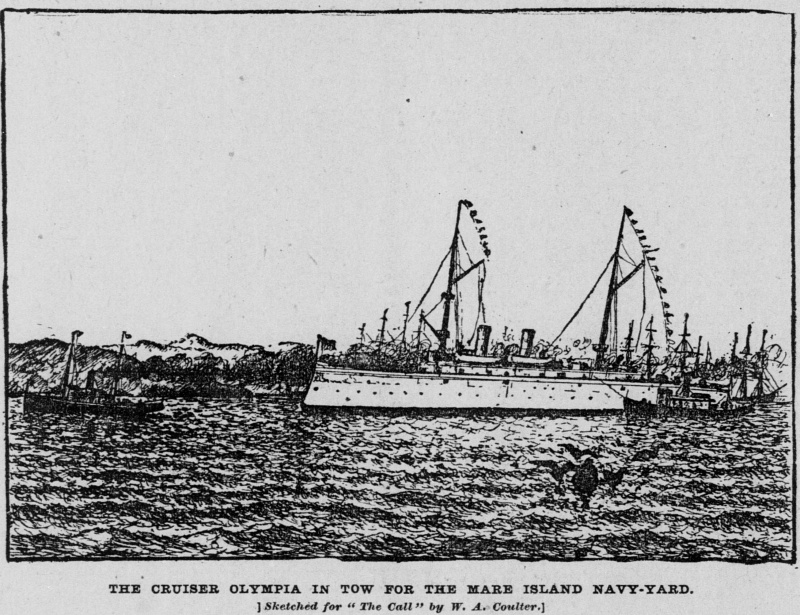
From the 27-January-1895 San Francisco Call. WA Coulter did many maritime drawings for the newspaper. This one shows the new protected cruiser Olympia, built by San Francisco's Union Iron Works, which went on to a distinguished career in the New Navy. Olympia served as Commodore Dewey's flagship at the Battle of Manila Bay. Olympia still survives, serving as a museum ship in Philadelphia. Charleston was the Navy's first protected cruiser. Protected cruiser San Francisco served the Navy until 1937. Monterey was a monitor. On the outbreak of the Spanish-American War, battleship Oregon sailed 14,000 miles from San Francisco to Florida and arrived in time to participate in the battle of Santiago de Cuba.

I like the ram bows on warships of this period.


NOW AT MARE ISLAND.

Cruiser Olympia Is Formally Delivered.

TOWED TO THE NAVY-YARD.

Will Be Ready for Business in a Very Short Time.

LATEST TRIUMPH OF THE COAST.


In Another Month the Handsome Flagship Will Be in Condition to Meet All Comers.


Uncle Sam has taken unto himself a new cruiser, which is the greatest in strength, speed and armament yet turned out by the Scotts.

The Olympia is now at Mare Island, where she went yesterday to be formally turned over to the Government. The Pacific Coast has been wonderfully successful in turning out fighters for the white navy, and the Scotts look with special pride on their last product, yet they have a strong and lingering affection for the Charleston, which was their first experiment, and which has seen more real service up to date than any other member of the new navy.

She has been in the atmosphere of wars, if not an active participant, all the way from Rio de Janeiro to China, and has been of incalculable benefit to our commerce in foreign ports from a moral point of view.

The San Francisco was a somewhat larger enterprise, which was also a success, and then came another experiment in the shape of the coast-defense vessel Monterey, and that has fulfilled all expectations.

The Olympia is the fourth jewel in the diadem of the Union Iron Works, or rather the "fourth one of our babies," as Irving M. Scott puts it.

Soon the great battle-ship Oregon will be ready to go into commission, and then the Pacific Coast alone will have turned out a navy that could have destroyed all the war vessels of the North and South employed in the recent rebellion in very short order.

When the Olympia was about to be taken from her moorings at the iron works there was quite a little crowd present, as well as a delegation of naval men from Mare Island.

The cruiser looked as clean as if she had just come out of a bath. Her brasswork glowed under the bright rays of the sun, her decks were clean enough to eat from, and the six and eight inch guns had been burnished and housed with their neat canvas covers.

It required three big tugs to take the monster on her journey to the navy-yard. The first to lay hold of her was the Vigilant, which swung her head out and towed her clear of the wharf, when the tugs Active and Alert fastened on to either side. It was rather a queer sight to see the three little fellows grappling with the glittering white fighter, which was so helpless without men or steam-power.

She took her departure amid the blowing of whistles, huzzas of spectators and the waving of handkerchiefs. The three strong tugs fairly scooted along with her through the water, passing in quite close along the wharves, where she was greeted with other salutes.

A run was made in the direction of Alcatraz, and the course taken thence to the yard, where it is expected she will be able to go in commission within about a month. This is provided the requisite crew of 280 men can be secured, and that will be a hard matter, as the 6000 men allowed the navy by act of Congress are all employed. She may have to wait until 2000 more are allowed by an act which is now proposed.
Update 04-June-2010: The organization that takes care of Olympia, the Independence Seaport Museum, is threatening to sink her as a reef or scrap her because they cannot afford to give her the maintenance she needs. Olympia has not been drydocked for over 60 years. The Friends of the Cruiser Olympia (http://www.fotco.org/) are trying to raise money to save her.